
In September 2023, Laura Jawad watched her website lose 95% of its organic traffic.
Not slowly. Not with warning. In a matter of days, a site she'd built over years became invisible. She documented the whole thing-the confusion, the panic, the fruitless attempts to understand what went wrong. By her own accounting, she did nothing differently. Google's Helpful Content Update simply decided her site was no longer helpful.
She wasn't alone. An analysis by Search Engine Land documented over 500 domains "hammered" by the update. Sistrix found that 32% of travel publishers-213 sites-lost more than 90% of their organic traffic. As of late 2024, virtually none of them had recovered.
This is what it looks like when a business has no defensive moat.
The Graveyard
The history of SEO is littered with corpses. Not failed startups or bad ideas-successful sites that got destroyed because they weren't prepared for what came.
HubPages. In 2011, they had 130,000 authors and over a million articles. Then Google's Panda update hit. CEO Paul Edmondson described it as "a very blunt instrument that hit the entire site." SearchMetrics measured a 62% drop in visibility. They tried everything-moving content to subdomains, building quality detection systems, laying off staff to cut costs. It didn't matter. Fourteen years later, they're a ghost of what they were. Never recovered.
JCPenney. In February 2011, the New York Times ran an investigation into how JCPenney ranked #1 for practically everything they sold. Turns out their SEO agency, SearchDex, had built thousands of spammy links from doorway pages and link farms. Google's Matt Cutts confirmed the violation. JCPenney's organic visibility dropped 90% overnight. The penalty lasted 90 days-an eternity in retail. They claimed they had no idea what their agency was doing. Maybe true. Didn't matter. They paid the price anyway.
Expedia. January 2014. SearchMetrics reported a 25% visibility drop overnight for one of the world's largest travel sites. The suspected cause: a WordPress theme they'd distributed for free that included hidden keyword-rich links in the footer. The scheme had run undetected for three years. When it broke, Expedia's stock dropped 4.5%-hundreds of millions in market cap vaporized in a day. They scrambled to remove 40,000 links per day to recover.
Rap Genius. Christmas Day, 2013. TechCrunch reported that Google had destroyed the lyrics site's rankings. The crime: asking bloggers to embed links to Justin Bieber lyrics pages in exchange for tweets. A blogger exposed the scheme on Hacker News. Google's webspam team saw it and acted within hours. SearchMetrics measured a 92% drop in visibility. The site went from first page to sixth page for their core queries-a -60 penalty in SEO parlance.
BMW Germany. February 2006. CNN reported that Google had blacklisted BMW.de-one of the world's most valuable brands-for using doorway pages. Forbes found the German word for "used car" appeared 42 times in a single doorway page. Google's Matt Cutts made an example of them. PageRank dropped to zero. The brand that had spent decades building reputation became invisible for its own name.
These aren't ancient history. The September 2023 HCU alone likely destroyed more organic traffic value than all previous penalties combined. And here's the thing that should terrify you: most of those sites were doing nothing obviously wrong. They weren't running link schemes. They weren't cloaking. They were just... vulnerable. Built on sand without knowing it.
The Blind Spot
The SEO industry has a defense problem. Go to any conference. Read any blog. Count the ratio of "how to grow traffic" content versus "how to protect traffic" content.
It's probably 50 to 1. Maybe 100 to 1.
This is insane. Consider what we're building on. Google made 4,725 changes to search in 2022 alone-roughly 13 changes per day. They run over 600,000 experiments annually. The ground beneath you shifts constantly. You're building a castle on a platform that reconfigures itself while you sleep.
Finance has entire disciplines around hedging and risk management. Cybersecurity is literally just defense. Military strategy dedicates equal attention to holding ground as taking it. But SEO? We're all offense, all the time.
I think I know why. Defense doesn't make case studies. "We prevented a disaster that would have happened" doesn't get you speaking slots. You can't put "maintained rankings during algorithm update" in a portfolio. The wins are invisible.
But here's what I've learned after twenty years: I've seen more traffic destroyed by lack of defense than I've seen gained by brilliant offense. The sites that survive algorithm updates aren't the ones with the cleverest tactics. They're the ones that built moats before they needed them.
Nassim Taleb has a term for this: antifragile. Not just resilient-able to bounce back-but actually strengthened by stress. "The resilient resists shocks and stays the same," Taleb writes. "The antifragile gets better." The question isn't whether shocks will come. They will. Google confirms major updates 2-4 times per year. The question is whether you'll be destroyed by them or strengthened.
The Attack Surface
Cybersecurity has this concept called "attack surface." It's the sum of all the points where an attacker could try to breach your system. Smaller attack surface, harder to attack. Simple idea.
Every SEO strategy has an attack surface. Most people never map it. They don't even know it exists until something breaks.
Diagram 1: Attack Surface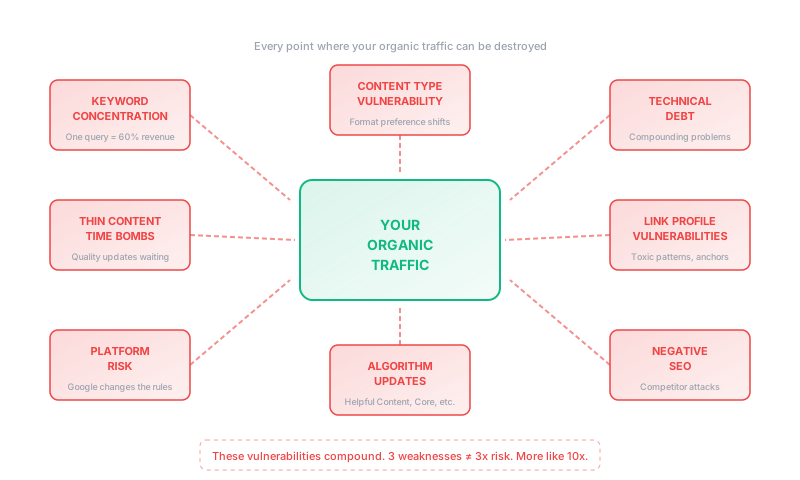
Look at that diagram. These are the walls of your fortress, and every one of them can be breached:
Keyword concentration. If one keyword drives more than 20% of your traffic, you're exposed. When OurCrowd first came to me, their organic strategy was dangerously concentrated. We didn't just grow traffic-we diversified the portfolio so no single query could sink them. This is portfolio theory applied to SEO: you don't put all your capital in one stock, you don't put all your traffic in one keyword.
Content type vulnerability. All your content is 2,000-word guides? Google decides it wants videos or short answers. You're invisible overnight. The HCU didn't just hit bad content-it hit certain formats harder than others. Sites that had diversified content types weathered it better than those dependent on one format.
Thin content time bombs. Every low-quality page you've published is a liability on your books. It's not hurting you today. But quality updates are cumulative-Google's HCU evaluates your entire site, not just individual pages. One day the ratio tips, and it doesn't tell you which pages triggered the assessment. It just tanks everything.
Technical debt. Redirect chains you'll fix later. Core Web Vitals you'll address next quarter. Mobile issues that "aren't that bad." Every deferred fix is a crack in your foundation. Expedia's WordPress theme scheme ran for three years before it exploded. Technical debt compounds. It interacts in ways you don't expect. And one day it cascades.
Link profile vulnerabilities. JCPenney didn't know what their agency was doing. Interflora didn't think their advertorials would trigger a penalty. Link Detox analysis found over 70% toxic links in Interflora's profile. I once inherited a site that spent seven years in penalty purgatory because of links a previous agency bought. You're responsible for every link pointing at your site, even the ones you didn't ask for.
Platform risk. You're not building on your own land. You're building on Google's land, and they change the rules whenever they want. Featured snippets steal your clicks. AI Overviews eat your traffic. Zero-click searches mean your ranking matters less every year. This isn't a vulnerability you can fix-it's a reality you have to plan around.
Negative SEO. Yes, it exists. Kinsta documented a real attack on their domain-over 100 malicious links from .tk domains. Ahrefs found someone linking to their tool from over a million spammy pages. Google's Gary Illyes claims he's "looked at hundreds of supposed cases" and none were real, but practitioners in the field disagree. The smaller your backlink profile, the more vulnerable you are. Sites with fewer than 300 referring domains are most at risk.
The compounding problem
These vulnerabilities don't exist in isolation. HubPages had thin content AND concentrated traffic AND user-generated quality issues. JCPenney had link schemes AND agency negligence. A site with multiple vulnerabilities isn't 3x at risk-it's 10x. The weaknesses interact.
Defense in Depth
Military strategists figured this out centuries ago. You don't defend with a single wall. You defend with layers. Breach one, there's another behind it. Each layer buys time. Each layer reduces damage. The attacker has to break through everything. The defender only needs one layer to hold.
Cybersecurity calls this "defense in depth." The principle translates directly to SEO.
Diagram 2: Defense in Depth
Here are the five walls:
Wall 1: Monitoring and Early Warning
You can't defend what you can't see. HubPages found out about Panda when traffic cratered. JCPenney found out when the New York Times called for comment. By then it was too late.
Set up monitoring that actually matters:
Daily rank tracking for your top 50 keywords. Not because daily fluctuations matter-they don't-but because you need to see trends forming. Rap Genius's penalty hit on Christmas Day. If they'd been monitoring, they'd have seen the drop within hours instead of days.
Search Console alerts. Google sends you messages there. Manual actions, security issues, indexing problems-Google tells you about these. Set up email forwarding. Check weekly at minimum.
Traffic anomaly detection. Set a threshold: if organic traffic drops more than 15% week-over-week, something triggers an alert. Could be seasonality. Could be catastrophe. Either way, you want to know immediately, not in next month's report.
Backlink monitoring. Ahrefs and similar tools send weekly reports. Read them. The finance site that lost 50% of traffic had 65% of their backlinks coming from penalized or non-indexed pages-something they'd have caught with basic monitoring.
The 15-minute weekly check
Every Monday: Search Console messages, top 20 keyword positions, week-over-week traffic, new backlinks report. 15 minutes catches 90% of emerging problems before they become disasters.
Wall 2: Traffic Diversification
Finance calls it portfolio theory. Don't put all your eggs in one basket. Harry Markowitz won a Nobel Prize for formalizing this in 1990. The concept translates directly: diversify across keywords, intents, and content types.
Keyword diversification. If your top keyword drives more than 20% of traffic, you're overexposed. When Expedia got hit, their losses were concentrated in generic terms like "flights" and "cheap hotels." Their brand traffic helped them survive. That's diversification working.
Intent diversification. Informational, commercial, transactional, navigational. If all your traffic comes from one intent type, you're vulnerable to SERP feature changes. The September HCU hit informational content hardest. Sites with balanced portfolios survived better.
Format diversification. Don't build only long-form guides. Don't build only product pages. The sites that survived the HCU often had varied content: tools, databases, genuine first-person expertise mixed with guides. Monocultures die first.
Wall 3: Technical Resilience
This is the boring stuff nobody wants to do. And it's the stuff that saves you.
Clean technical foundation. No redirect chains. No orphan pages. No crawl errors accumulating in Search Console. When Psik came to me, Google couldn't see any of their pages because of a rendering issue. The content was great. Google couldn't read it. That's a technical time bomb waiting to explode.
Indexation hygiene. Know exactly what's in Google's index. Run quarterly audits comparing indexed pages to intended pages. Index bloat was a major factor in HCU casualties. Sites with too many thin or duplicate pages in the index got hit harder.
Speed margins. Don't aim for "passing" on Core Web Vitals. Aim for excellent. Build a buffer. When things go wrong-and they will-you want headroom, not a crisis.
Wall 4: Content Quality Insurance
Every piece of content you publish is either an asset or a liability. There's no neutral.
The September 2023 HCU specifically evaluated sites on a site-wide basis. Even sites with good content could see overall declines if they had "substantial amounts of unhelpful material." One marketer who lost 95% of her traffic had plenty of good content-it was the mediocre content that poisoned the well.
The quality audit. Quarterly: run through every indexed page. Does it deserve to exist? Does it provide unique value? Would you be proud to show it to Google's quality raters? If the answer is no, either fix it or kill it. "It's not hurting us" is a statement about today, not tomorrow.
The refresh protocol. Content decays. Set a refresh schedule. High-value pages get reviewed annually at minimum. Nothing lives forever without maintenance.
The publish standard. Before anything goes live, it passes a bar. Not "is this good enough?" but "will this still be valuable in two years?" Every quick-hit thin piece you publish in the name of volume is a liability you'll carry forward.
The content ratio rule
Run this calculation: pages with real traffic / total indexed pages. If that ratio is below 50%, you have a quality problem waiting to trigger. The more dead weight you carry, the higher your risk profile. HubPages had over a million articles. How many were actually good?
Wall 5: Reputation Defense
This one's outside traditional SEO, but it's part of your attack surface. Interflora's penalty came from paid advertorials in UK newspapers. The Independent saw their PageRank drop from 8 to 4 in days-collateral damage from association.
Monitor brand mentions. What are people saying about you? Set up Google Alerts for your brand name. Check what shows up when someone searches "[brand] reviews" or "[brand] complaints."
Proactive reputation building. Don't wait until you have a reputation problem. Build a buffer of positive signals. Get covered in legitimate press. Cultivate real reviews from real customers.
Know your partners. JCPenney blamed their agency. Interflora blamed the newspapers. Doesn't matter who's at fault-you pay the price. Vet your vendors. Audit their work. Trust but verify.
The Early Warning Dashboard
Talk is cheap. Here's what to actually monitor, and what the warning signs look like:
Diagram 3: Warning Dashboard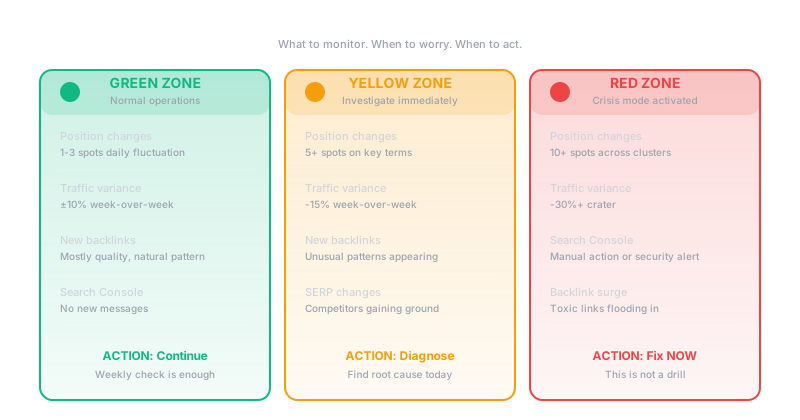
Green zone: Normal fluctuations. Daily position changes of 1-3 spots. Week-over-week traffic within 10%. New backlinks are mostly quality. No Search Console messages. Sleep well.
Yellow zone: Pay attention. Position drops of 5+ spots on important keywords. Traffic down 15% week-over-week. Unusual backlink patterns. Start investigating today. The September HCU rolled out over two weeks-sites that caught it early had time to react.
Red zone: Act now. Position drops of 10+ spots. Traffic craters 30%+. Manual action warning. Surge of toxic backlinks. Rap Genius saw a 92% visibility drop on Christmas Day. By the time most employees saw it, it was already a crisis.
When Defense Fails
Sometimes you do everything right and it still breaks. The September 2023 HCU hit sites that genuinely provided first-hand expertise in travel, health, and finance. Some of the casualties were well-documented sites with clear E-E-A-T signals. Google isn't fair. Algorithm updates aren't precision instruments.
This is when having a recovery playbook matters.
Step 1: Diagnose precisely. What actually happened? Follow a systematic process. Was it a manual action? An algorithm update? A technical issue? A competitor move? BMW knew exactly what they'd done wrong-doorway pages-and fixed it immediately. Most sites aren't that lucky.
Step 2: Contain the damage. What can you fix immediately? Rap Genius removed links as fast as possible. Expedia removed 40,000 links per day. Speed matters. Every day the problem persists, the damage compounds.
Step 3: Assess the timeline. Rap Genius recovered in 10 days. Interflora in 11. JCPenney took 90. HCU victims are still waiting after more than a year. The timeline depends on the type of penalty and the scale of the problem. Set realistic expectations.
Step 4: Learn and fortify. Every hit teaches you something about your vulnerabilities. After Panda, HubPages built quality detection systems they wish they'd had before. After the 2013 penalty, Rap Genius wrote a public apology for being "such morons." The companies that come back stronger are the ones that use the crisis to identify weaknesses they didn't know they had.
The Cost of Not Defending
Let me be direct about this. Defense costs time and attention. It's not free.
But here's the math nobody does: recovery costs 10x prevention.
Expedia saw their stock drop 4.5% in a day-hundreds of millions in market cap. JCPenney lost 90 days of organic visibility during retail's most competitive season. HubPages laid off staff and never regained their position. The September HCU victims are still bleeding a year later, many having seen only about one-third of their original traffic return-and that's considered a win.
And those are the survivors. Some sites never come back. Some businesses can't survive months of 90% traffic loss. The companies that go under because of an algorithm update don't become case studies. They just disappear.
So who pays when defense gets neglected? Sometimes it's the marketing team that gets blamed. Sometimes it's the CMO who loses their job. Sometimes it's the employees who get laid off when revenue craters. Sometimes it's the founder who watches their company die.
The cost is real. It's just deferred until it isn't.
Build the Moat
The best time to build a moat was before you needed it. The second best time is now.
Start with a vulnerability assessment. Map your attack surface. Where are you concentrated? Where have you accumulated debt? What would hurt worst if it broke tomorrow?
Then build your early warning system. Set up the monitoring. Create the alerts. Make sure you'll know when something shifts before it becomes a crisis.
Then start fortifying. Diversify your keyword portfolio. Fix the technical debt. Audit the content quality. Build layers of defense so no single breach destroys you.
This isn't glamorous work. You won't get conference speaking slots for it. Nobody writes case studies about the disaster that didn't happen because you were prepared. But the sites that survive the next algorithm update-and there will always be a next one, Google confirms them regularly-will be the ones that built walls before the siege.
Taleb would call this asymmetric. The cost of defense is small and ongoing. The cost of no defense is catastrophic but rare. The math is obvious once you see it: pay a little consistently to avoid paying everything occasionally.
HubPages didn't build a moat. JCPenney trusted an agency without verification. Expedia let a WordPress theme run unchecked for three years. Interflora didn't nofollow their paid links. The September 2023 casualties accumulated thin content without auditing.
Everyone else will be calling their SEO consultant at 6 AM wondering what went wrong.
Which one will you be?