The Fence
The burglar was already on my balcony when I walked out of the bathroom.
There is a particular quality to the silence between seeing an intruder and deciding what to do about it. A thickness in the air. The French doors were open. He was maybe fifteen feet away, close enough that I could see his hands working the lock, far enough that running seemed optional. The smart move was to shout, call the police, let the professionals handle it. The smart move was to stay inside.
I chose heroism.
Heroism, in this case, meant sprinting across my living room, out the door, and into the Jerusalem night like a man who had never once considered the consequences of his actions. The burglar ran. I chased. We were both operating on pure adrenaline, which is another way of saying we were both operating on pure stupidity.
He went over a fence. I went over the same fence. Except somewhere between the top of that wooden rail fence and the ground on the other side, my trajectory shifted. My foot slipped. My body rotated. And in one clarifying moment of physics, the full weight of my heroic momentum came down directly on the crossbar, turning my future-babies factory into what felt like mashed potatoes.
The first ten minutes were hell upon earth. The kind of pain that exists outside language, that erases everything except itself. I lay there in the dark, watching the burglar disappear into the night, wondering if this was how it ended. Not with a bang, but with a very specific kind of whimper.
Recovery took two weeks. Two weeks of awkward sitting. Two weeks of walking like a man who had recently been the victim of a very targeted attack. Two weeks of my wife looking at me with that particular expression wives develop when their husbands make catastrophically stupid decisions in the name of masculinity.
The shortcut over the fence instead of around. The decision that seemed right in the moment. The instant, absolute regret.
I've watched companies make exactly the same calculation with their link building. It seems faster. It seems smarter. And then they're lying on the ground wondering what they've done.
Diagram: The Shortcut Illusion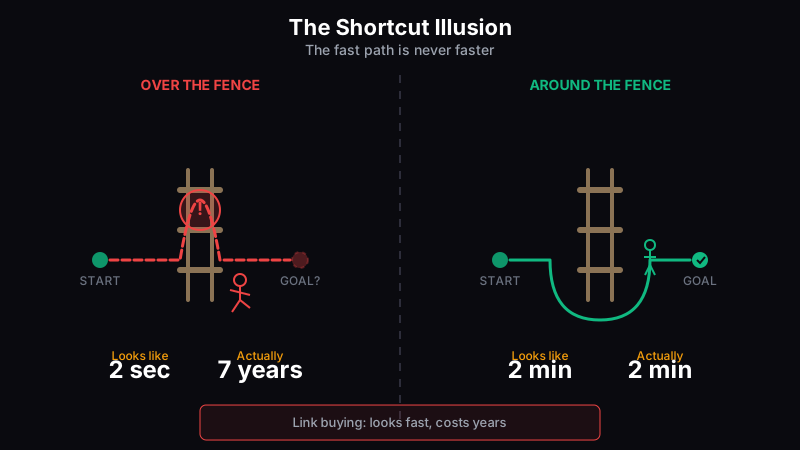
The Glory Days
Before there was disaster, there was dominance.
A major consumer products brand, a tobacco company's e-cigarette line (though I won't name names), held the kingdom. Pre-2007, they were number one for nearly every tier-one non-branded e-cigarette search that mattered. The organic channel wasn't just performing; it was printing money. Google loved them. Users found them. Revenue followed. In the quiet empire of search visibility, they had everything.
Then came the negligent SEO provider.
Somewhere in 2007 or 2008, someone made a decision. Perhaps they were impatient. Perhaps they were ignorant. Perhaps they looked at the competition and thought: we could be doing more. The provider they hired, or the provider's provider (the chain of accountability as murky as these things always are), started buying links. Blog networks. Forum spam. Paid directories with the editorial standards of a drunk raccoon. Fifteen hundred points of future pain, planted like landmines across the web, each one a small explosion waiting to detonate.
For a while, nothing happened. That's the insidious part. The links worked. Rankings held. Traffic flowed. The fence looked perfectly climbable.
The lag between action and consequence
Bad links don't always hurt immediately. Sometimes they work for years before Google catches on. By the time the penalty hits, the people who made the decision are long gone, and you're left holding the wreckage.
The Fall
The manual action arrived sometime after 2008. Google's judgment, handed down like a sentence from a court that doesn't explain its reasoning, doesn't negotiate, and doesn't care about your revenue projections.
Ninety to ninety-five percent traffic loss. Overnight.
That number deserves a moment. Ninety to ninety-five percent. Not a dip. Not a fluctuation. Not the kind of movement that makes you squint at your analytics and wonder if something's wrong with the tracking. This was annihilation. The brand that had been number one for everything was suddenly number one for nothing. Invisible. Gone.
But here's the real horror: the duration.
Not seven weeks. Not seven months. Seven years.
Seven years in the wilderness. Seven years watching competitors who had played clean lap them again and again. Seven years of market share bleeding out slowly, like a wound that won't close. Seven years of hiring SEO firms to fix the problem, watching them fail, writing checks that bought nothing but disappointment. Hundreds of thousands of dollars, scattered into the void.
Seven years is not a stumble. It's a coma. It's waking up and discovering that the world moved on without you, that the customers who once typed your name into search bars now type your competitors' names instead, that the muscle memory of market leadership has been replaced by the muscle memory of someone else.
The brand that was number one became invisible. And every month of invisibility was another month of competitors building the moat that would have been theirs.
I wasn't there for the fall. I arrived in 2015, when the wreckage had already calcified into something that looked permanent. The SEO manager who inherited this disaster (me, as it happened) opened the Search Console and found the digital equivalent of a crime scene photograph: a manual action notice, dusty with age, sitting there like a headstone marking where the traffic was buried.
Diagram: The Penalty Timeline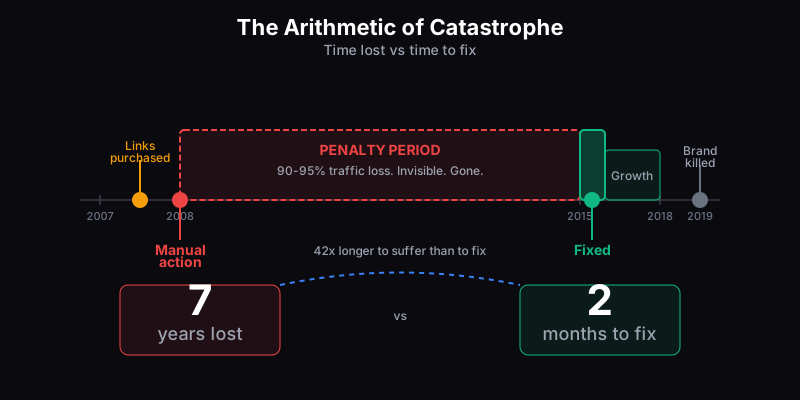
The Archaeology
Recovery begins with excavation.
I spent the first two weeks building a map of the devastation. Every backlink. Every referring domain. Every poisoned handshake the brand had ever accepted from the dark corners of the internet. The tools existed (Ahrefs, Majestic, the old Google Disavow interface), but tools only show you what's there. Understanding what you're looking at requires something else: the specific expertise of having seen this before, of knowing which patterns spell death and which are merely ugly.
The final count: 1,500+ toxic links.
Fifteen hundred individual connections to be severed, each one requiring action. Blog networks with names like "BestArticleDirectory2007.info." Forum signatures on sites that hadn't seen a human visitor since the Bush administration. Paid placements on directories that charged $50 for the privilege of poisoning your link profile. Every single one planted by someone who thought they were helping, or who didn't care either way.
The reconsideration process doesn't accept apologies. It doesn't accept intentions. It demands proof of cleanup. You don't get to say "we're sorry." You have to demonstrate, in granular detail, that you've done everything possible to undo the damage. That you've contacted every site owner. That you've documented every outreach attempt. That you've compiled the evidence of your penance into a dossier thick enough to prove you've suffered.
Diagram: The Link Archaeology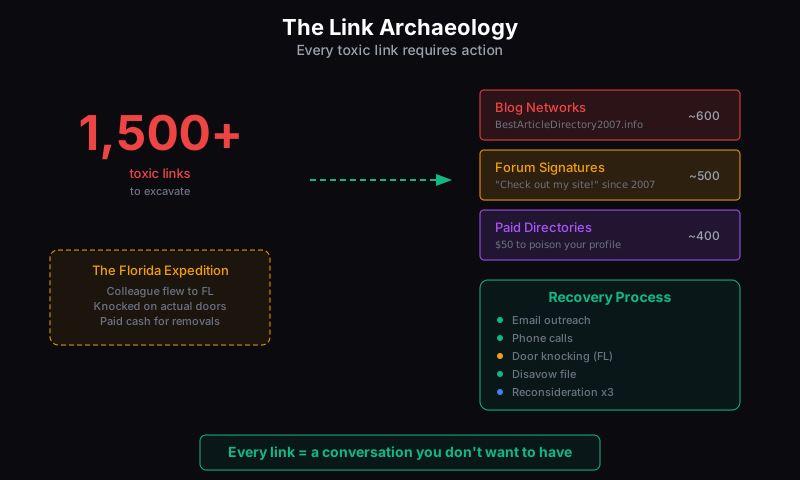
What a link cleanup actually requires
Identify every toxic link. Find contact information for every site owner. Send personalized outreach explaining why you need the link removed. Document every attempt. Follow up repeatedly. Compile everything into a reconsideration request. Wait. Get rejected. Fix what they complained about. Submit again. Repeat until absolved.
The Campaign
We called it a campaign because "desperate siege warfare conducted against the entropy of the internet" didn't fit on the project brief.
Every site owner contacted. Every single one. Emails first: hundreds of them, composed with the careful politeness of someone asking a favor they have no right to ask. Most went ignored. The domains had long since been abandoned, their owners having moved on to other ventures or other lives or simply having forgotten they ever registered "SEOLinkBuildingNetwork.biz" in the first place.
Phone calls next. There is a specific awkwardness to calling a stranger and explaining that their website, which they haven't thought about in seven years, contains a link that is actively destroying a business they've never heard of. Some were helpful. Some were confused. Some demanded money.
And then there was Florida.
A colleague (I won't name him, because this story belongs to him and I only tell it with his permission) flew to Florida. Rented a car. Drove to physical addresses associated with the most stubborn domains. Knocked on actual doors. Paid actual cash to actual webmasters to remove links that should never have been placed.
This is what link penalty recovery looks like in practice: a man standing on a stranger's doorstep in suburban Florida, explaining Google's manual action policy, offering payment for the removal of a forum signature that dates to the second Bush administration. The absurdity of it. The desperation. The willingness to do whatever it takes because seven years has been long enough.
Two months of this. Two months of outreach, documentation, compilation. Two months of building the case for redemption while simultaneously wondering if redemption was even possible, if maybe the brand had simply been marked for death and all our efforts were elaborate theater for an audience that had already made up its mind.
The Submission
A reconsideration request is part legal brief, part confession, part prayer.
You explain what happened. You document what you found. You demonstrate what you did about it. You acknowledge the sin, usually committed by someone else, years ago, for reasons no one remembers, and you pledge, in writing, that it will never happen again. You attach the spreadsheets, the outreach logs, the screenshots of removed links, the disavow file containing every URL you couldn't get manually removed. You make your case.
Then you wait.
The first request was rejected. They often are. Google's response was characteristically opaque: insufficient effort, try again. So we tried again. More outreach. More documentation. More evidence of penance. The second request. The third.
I don't remember which submission finally worked. What I remember is the email: "Manual action revoked." Three words that undid seven years of penalty. Three words that opened the gates.
The Resurrection
Traffic didn't creep back. It exploded.
The data tells the story with a clarity that words can't match. From late 2015 through 2018, everything changed. Keywords ranking in the top positions grew from near-zero to 11,500+. Branded traffic peaked at over 13,400. The brand that had been invisible for seven years was suddenly visible everywhere. The system, having lifted its judgment, allowed the natural strengths of the site (the authority, the content, the relevance) to finally express themselves.
Three years of triumph. Rankings climbing. Revenue recovering. Market position rebuilding. All the things that had been impossible during the penalty years became possible again. The resurrection was real.
The arithmetic of expertise
Seven years of penalty. Two months to fix. That's not a commentary on difficulty (the work was genuinely hard). It's a commentary on knowing what to do. The brand had hired multiple firms over those seven years, spent hundreds of thousands of dollars, and gotten nowhere. The difference wasn't effort. It was expertise.
But I want to be honest about what was lost, even in victory. Seven years of revenue. Seven years of market position. Seven years of momentum that competitors had used to entrench themselves. The resurrection was real, but it was a resurrection into a landscape that had transformed while the brand slept. The customers who might have been loyal had developed loyalty to someone else. The market share that might have been defended had been claimed by others.
You can recover from a link penalty. The recovery just doesn't give you back the time.
The Coda
2019. The parent company killed the brand.
I don't know why. I wasn't in the boardroom. Maybe the category was dying. Maybe regulatory pressure made the business untenable. Maybe some executive looked at a spreadsheet and decided the numbers didn't justify the headache. Corporate decisions operate on their own logic, opaque to those of us who merely build the things that get decided about.
All that recovery. All that work. The months of outreach, the Florida doorsteps, the painstaking documentation, the reconsideration requests, the slow climb back from nothing. The 11,500 keywords. The 13,400 branded traffic. The resurrection itself.
And then: zero. The brand discontinued. The domain retired. The traffic dropping to nothing, not because of any penalty or failure, but because someone in a conference room decided there were better places to allocate resources.
Semrush graph: The full arc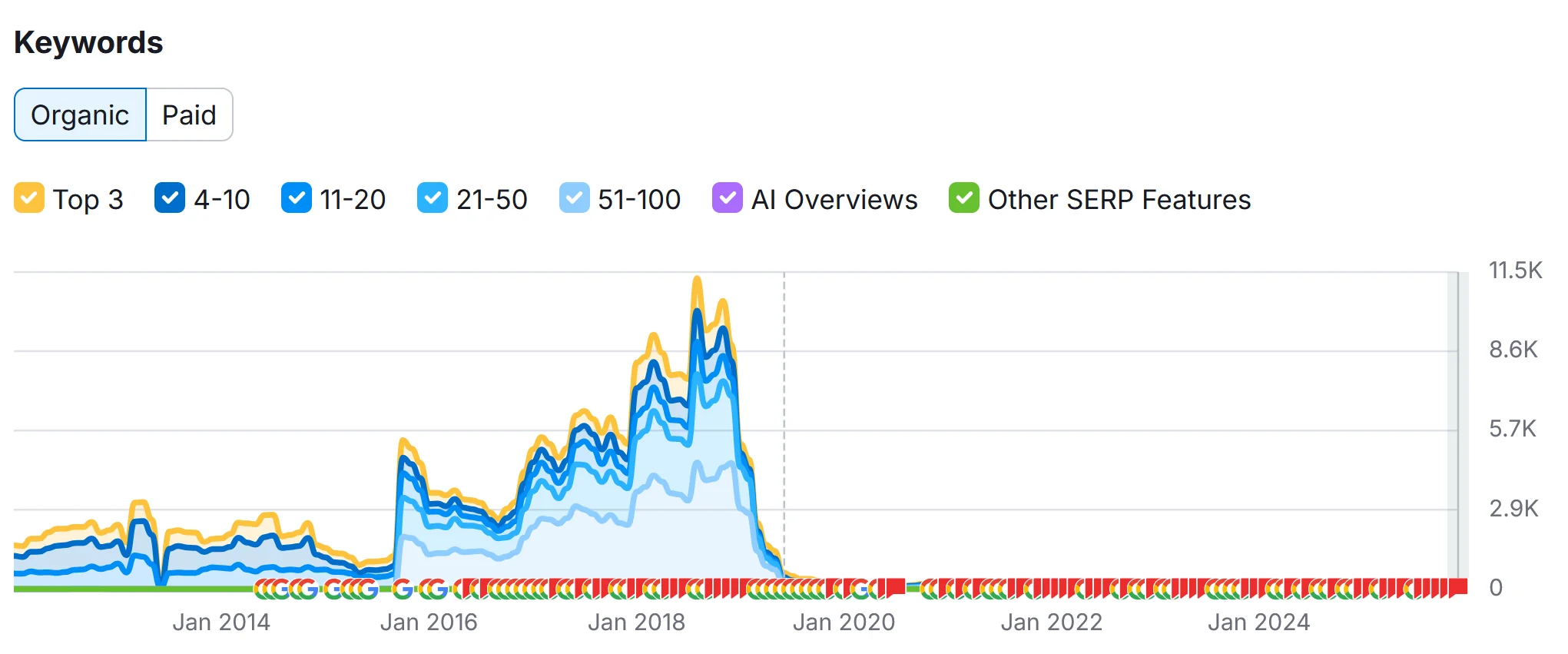
The tragedy isn't the penalty. It's the time.
You can recover from almost anything. But you can't recover the years. And sometimes, by the time you're healthy again, the game has moved on. The business has moved on. The decision-makers have moved on.
The Lesson
Here is what I tell people now, when they ask about link building:
The shortcut is never shorter. Buying links feels like acceleration. It feels like getting ahead while your competitors plod along doing things the hard way. And sometimes it works, for a while. But the while eventually ends, and when it does, you're not back where you started. You're years behind where you would have been if you'd never climbed the fence in the first place.
Due diligence matters. If you're acquiring a company, audit the link profile before the deal closes. If you're inheriting a website, check the Search Console for manual actions before you make promises about what you can deliver. The sins of previous owners don't care whether you knew about them. Google certainly doesn't.
Expertise compresses recovery time. Seven years of penalty, two months to fix, with the right person. That's not magic. That's pattern recognition. That's having done this before, knowing what works and what doesn't, understanding the specific documentation that Google needs to see before they'll lift a judgment. The firms that failed before me weren't stupid. They just didn't have the specific expertise this specific problem required.
Sometimes recovery isn't enough. You can do everything right. You can fix the penalty, restore the traffic, rebuild the rankings. And the business can still kill the brand. Recovery doesn't guarantee survival. It just makes survival possible.
And here is what I think about, when I pass a wooden fence:
Ten minutes of unfathomable pain. Two weeks of recovery. The memory of wood against flesh, the instant calculation that turned out to be wrong, the moment of weightlessness before impact. You can walk normally again, eventually. You can forget, mostly. But there's always that flinch when you see a rail fence. That flash of remembered catastrophe.
The brand is dead now. The penalty is ancient history. The links have been disavowed, the domains have expired, the colleagues who knocked on doors in Florida have moved on to other roles and other challenges. All that remains is the story, and the lesson, and the particular ache of watching something you saved get killed by forces entirely outside your control.
I don't chase burglars anymore. I don't recommend link schemes, either.
The fence is still there. It always is.
For techniques to audit your own link profile before disaster strikes, see The Technical SEO Checklist (The Real One). For understanding what different ranking signals actually mean, check out Diagnose Any Traffic Drop in 30 Minutes. If you're curious about what I actually recommend instead of link buying, read The Only Link Worth Building.
If you're sitting on a link penalty, or worried you might be, get in touch. I offer a technical SEO audit that includes full link profile analysis. It's cheaper than Florida.