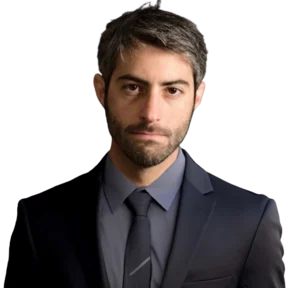
I built my first website in 2000. I was sixteen, the internet was still making that dial-up screech, and I had no idea what I was doing. But I remember the moment I uploaded that first page and realized that anyone in the world could theoretically find it. That feeling stuck with me, not the building part but the finding part. How does anyone find anything in this infinite mess of pages?
That question has basically driven everything I've done since.
The winding path
I studied Geography at the Hebrew University of Jerusalem and Computer Science at the University of York. That combination sounds random, and at the time it was. But geography is the study of why things end up where they do and how you find them in a space too large to walk across, and computer science is how you build the machine that answers the question. I did not choose either one as preparation for a career in search. It turned out to be exactly that.
Since 2005 I have been doing this professionally. That is two decades now, which frankly makes me feel old. In that time I have worked with retail brands, advertising agencies, Fortune 500 companies, sold-out music festivals, and more startups than I can count. Some of those projects were massive successes and some were spectacular failures, and I learned more from the failures, as you do.
For twelve years I was the seasonal CMO of the Jerusalem Beer Festival, Israel's largest annual beer festival, where I sold approximately 200,000 tickets across that span. That meant owning everything: brand positioning, audience growth, vendor relationships, sponsor acquisition, the whole marketing operation. Running a festival is not like running a SaaS company. You get one shot per year. No A/B testing your way to success when 30,000 people show up on a specific night and either have a great time or do not. That pressure teaches you things.
From 2023 to 2025 I served as CMO at Lonesome Labs, leading marketing strategy for a company in the Amazon seller tools space. Different industry, same challenge: figure out how to cut through noise and reach the people who matter.
Currently I am the CEO of Tevelis, and I also lead SEO and GEO at Rostrum Agency Limited as their SEO & GEO Strategist, owning organic and generative-engine visibility across the agency's roster. The brief is what it always is when the work is interesting: figure out how the people we want to reach are actually searching, build the things they would want to find, and make sure the engines (Google, ChatGPT, Perplexity, all of them) can see it.
At Altria, a Fortune 500 company, I spent three years in roles that shaped how I think about marketing at scale. For the first two years I was Customer Acquisition Manager for their e-cigarette division, owning SEO, CRO, and the affiliate marketing program. I quadrupled conversion rates in that segment, not incrementally improved but actually quadrupled. I also handled product analytics, customer analytics, and competitive intelligence. Then they moved me into Strategy & Planning as a special researcher, where I introduced text analytics and NLP capabilities to the entire organization. I was serving multiple departments: marketing, R&D, and strategy. That role taught me marketing problems are often data problems in disguise, and that most organizations are sitting on answers they do not know how to find.
I also built a 250,000-member Facebook community for the Israeli Government's Ministry of Foreign Affairs. Community building for a government ministry is its own strange beast where you are not selling anything but trying to shift perception at scale, which is harder than selling.
At OurCrowd, I took them from essentially zero non-branded organic traffic to thousands of keywords ranked. Seventy-something in the number one position, with 300x growth across two years. Beyond SEO, I also owned product analytics, customer analytics, and competitive intelligence. These numbers sound made up but they are not. You can see the case study if you do not believe me.
I have also advised from the outside. Samsung, SanDisk, JLL, Manfrotto, defense startups building things I am mostly not allowed to describe, a multinational whose market cap runs north of a hundred billion dollars, and dozens of smaller companies you have never heard of. When you are outside the building you see different things. You are not stuck in the politics or the resource constraints or the "we have always done it this way" thinking.
I also edit PlagueNews.com, a publication tracking infectious disease outbreaks and biosecurity reporting. Newsweek named me as PlagueNews's editor in its coverage of the 2026 Irkutsk plague case: "Russia Plague: 5 Unanswered Questions."
The technical edge
Twenty years in, the honest description of what I do is not really "marketing." It is standing at the seam where software development, data engineering, and applied research meet. That is an awkward thing to say at a marketing conference and a genuinely useful place to be standing when the problem is actually hard.
Most marketing people cannot code. I can. Python, Go, JavaScript, R. I write scripts to automate analysis that would take weeks to do manually. I build custom tools when the off-the-shelf options do not cut it. I can look at a technical SEO problem and actually fix it myself instead of writing a ticket for someone else.
This matters because the line between marketing and engineering keeps blurring. The best opportunities are often at that intersection. When I introduced NLP to Altria, it was not because I read about it in a marketing blog. It was because I could actually build the systems to make it work. When I do competitive intelligence, I am not relying on what tools show me. I am writing code to extract signals those tools miss.
And the payoff of that is not abstract. On one engagement, the systems I built to catch what everyone else was missing prevented losses on the order of a quarter of a billion dollars. Not by writing a memo warning about the risk, which is what usually happens, but by building the thing that actually caught it before the money walked out the door.
What I actually do
These days I work in two modes. Sometimes I am a fractional CMO or strategic advisor, embedded with a company's leadership team, helping them figure out not just SEO but the whole go-to-market picture. Other times I am doing SEO and competitive intelligence work, the kind of analysis that reveals opportunities competitors have not spotted yet.
The common thread is that I help companies become findable. "Findable" contains multitudes. Sometimes it means fixing technical problems preventing Google from crawling your site properly. Sometimes it means building a content strategy that targets what people are actually searching for instead of what you wish they were searching for. Sometimes it means understanding that your real competition is not who you think it is. Sometimes it means telling a CEO that their pet project is never going to rank and they need to accept that.
I do not have a proprietary methodology or a branded framework or a twelve-step process I put on slides. I have always found that stuff embarrassing. What I have is twenty years of pattern recognition, the ability to build whatever tools I need, and a willingness to say uncomfortable things.

What I have learned
Context beats content. Anyone can write ten thousand words on a topic. The question is whether you actually understand the topic better than the other people writing about it. If you do, you will probably rank eventually. If you do not, no amount of keyword optimization is going to save you.
Most SEO problems have boring solutions: fix the technical issues, create content that deserves to rank, and get links from sites that have actual traffic. The basics work if you actually do them, which most people do not, because the basics are boring and hard and unglamorous.
Google's incentives align with yours more than you think. They want to rank the best answer, your job is to be the best answer, and everything else is noise. There is a whole industry built on making this seem more complicated than it is, because simple advice does not justify retainer fees.
The best SEO is not needing SEO. The companies that dominate organic search are usually the companies that would be successful without it. SEO is a lagging indicator that reflects what you have built, not what you are building.
Working together
These days I am selective about who I work with, not because I am trying to be exclusive but because I have learned that the fit matters more than anything else. I work best with companies where someone in a position of authority actually cares about organic search, not in the sense of wanting good numbers to report but in the sense of understanding that this is a long game and being willing to invest accordingly.
It helps that Tevelis, the company I run now, is independent on purpose. No outside capital, no referral fees, no equity retainers, nobody upstream whose interests I have to quietly serve while pretending to serve yours. The only thing I am paid to be is right. That is a rarer arrangement in this industry than it should be, and it is the entire reason I built the company the way I did.
If that sounds like you, write to me at amos@wskpf.com.