Friday afternoon. December 19th, 2025. Sunny but suspicious. The kind of December day that lulls you into complacency before dumping three days of rain on your head without warning. I'm standing in my gravel courtyard, staring at a bag from China containing what claims to be a NatureHike Cloud Up 2 tent, and my 13-year-old dog is staring at me with the specific expression dogs reserve for humans who are clearly about to make a series of regrettable decisions.
Photo: Dubi watching
He needs shelter. The neighbors have been complaining about him being outside. My wife has made it clear, in that particular tone wives develop after enough years of marriage, that the dog situation requires immediate resolution. The rain clouds are forming. The stakes, as they say, are real.
Except the stakes are literally useless. Metal pegs designed for soft earth, and I'm working with gravel over a black tarp. So I've got water bottles lined up as weights. I've got the tent fabric spread out like a crime scene. And I've got this growing sense that what seemed like a 20-minute task is about to consume my entire afternoon in ways I cannot yet foresee but can already feel in my bones.
What I didn't know, as I pulled those aluminum poles from their suspicious Chinese packaging, was that my tent was about to teach me more about SEO strategy than five years of sweaty and expensive industry conferences.
The False Foundation
I am not, generally speaking, an idiot. I have assembled furniture. I have configured servers. I have debugged code at 3 AM when the production database decided to express its feelings about my life choices. I approached the tent with the confidence of a man who has wrestled with IKEA instructions in languages he does not speak and emerged victorious.
The poles clicked together with satisfying precision. Y-shaped structure, obviously designed to create that dome shape tents are famous for. I found what looked like the foundation clip, the corner anchor point that would give the whole structure its starting reference. I clipped it in. Logical. Methodical. Correct.
And then everything went wrong.
Not dramatically wrong. Not catastrophically wrong. Just persistently, frustratingly, increasingly wrong. The fabric wouldn't sit right. The Y-arms were bending at angles that seemed to violate the basic principles of geometry. Every time I got one section to behave, another section would revolt. The tent, instead of rising into its proper dome shape, was creating something that looked like a collapsed soufflé designed by someone who actively hated camping.
So I pushed harder. Obviously. That's what you do when systems resist you. You apply more force. You muscle through. You show the tent who's boss.
The tent was not impressed.
The SEO parallel you already see coming
Forcing keywords where they don't belong. Implementing technical fixes that break other things. Creating content strategies that fight against natural user intent. The harder you push wrong solutions, the more the system resists. Sound familiar?
Here is a thing I have learned about systems, a thing I keep learning and then forgetting and then learning again: the tent was trying to tell me something through its resistance, but I was too busy fighting to listen.
This is, I realize now, the foundational error of most SEO work. Not the specific tactics. Not the technical implementations. The orientation. The assumption that when a system pushes back, the correct response is to push harder. The belief that resistance means you're doing something right, that you're breaking through, that victory lies just beyond the current frustration if you can just apply sufficient force.
Sometimes resistance means you're doing something right. And sometimes resistance means the poles are in backwards and you've been fighting the fundamental architecture of the system for the last forty-five minutes while your dog watches with an expression that suggests he's reconsidering your status as the more evolved species.
The Backwards Revelation
An hour in. Hands dry and cracking. Not quite bleeding, but close. December sun warming the back of my neck while the clouds gather with malicious patience on the horizon. The tent is, technically, standing. In the same way that a building condemned by the city is technically standing. The shape is wrong. The tension is wrong. Everything about it screams that the universe has been assembled incorrectly and would like to speak to the manager.
And then, in one of those moments of clarity that arrive not through intellect but through the total exhaustion of all alternatives, I stopped.
I actually looked at the tent. Not at what I was trying to make the tent do. At what the tent was trying to tell me.
The clips weren't fighting me because they were cheap or because I was incompetent. They were fighting me because they were oriented for poles that should come from the other direction. The Y-arms weren't bending incorrectly. They were bending exactly correctly for poles that had been inserted backwards.
I had the poles in backwards.
The entire time. From the first moment. The foundation I had assumed, the corner anchor I had started with, the entire orientation of my approach had been wrong. Not subtly wrong. Not philosophically wrong. Physically, mechanically, obviously wrong in a way that would have been immediately apparent if I had spent thirty seconds actually understanding the system before forcing my assumptions onto it.
I flipped the poles.
Sixty seconds later, the tent was perfect. Dome shape exactly as advertised. Tension distributed correctly. Every clip sliding into place with the satisfying click of components meeting their intended partners. My dog walked into his new shelter, circled three times, and lay down with the contentment of a creature who had never doubted the outcome.
One minute to complete success after an hour of struggle. That's the power of working with the system instead of against it.
I stood there in the December sun, hands dry and cracked, looking at the tent that had assembled itself in the time it takes to microwave leftovers, and I thought about every SEO engagement I've ever had where the client was working twice as hard to achieve half the results because their fundamental orientation was wrong.
Diagram 1: Orientation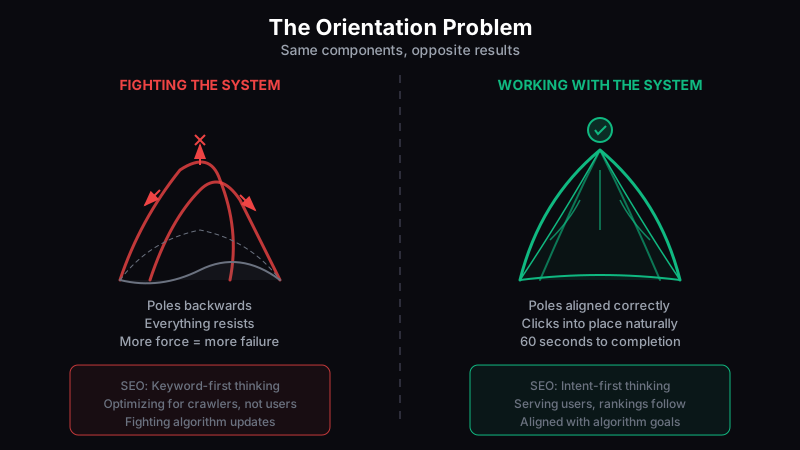
Principle One: Listen to Resistance
Here is a thing that sounds mystical but is actually just physics: systems communicate through resistance. Every time something pushes back, it's providing information. Not punishment. Not arbitrary obstruction. Information. The cyberneticists understood this back in 1943 when Rosenblueth, Wiener, and Bigelow published their foundational paper on behavior, purpose, and teleology. Goal-seeking systems use feedback, signals on deviations from the goal, to direct their behavior. The resistance is the feedback.
The tent clips fighting me weren't being stubborn. They were saying, very clearly if I had been willing to listen, "the pole needs to come THIS way, not THAT way." The resistance was the message. I was just too committed to my interpretation to receive it.
Google's algorithm does exactly the same thing.
When your rankings drop despite doing "all the right things," that's not Google being capricious. That's the system communicating that your strategy is misaligned with what it's actually trying to accomplish. When your content doesn't rank despite being "better" than the competition, that's not unfairness. That's feedback indicating you've misunderstood what "better" means in this specific context. Google now says core updates are a continuous background process, with the December 2025 update being the third named update this year. The system is always communicating. The question is whether you're receiving.
I have spent twenty years watching smart people fight Google the way I fought that tent. Pushing harder when they should be stepping back. Applying more force when they should be questioning their orientation. Blaming the system for resisting instead of asking what the resistance is trying to communicate.
Reading Google's resistance signals
Position fluctuations: testing phase, not punishment. Indexing delays: quality assessment, not technical failure. Traffic drops after updates: intent mismatch, not algorithmic vendetta. Every signal means something. Learn to read the language.
User behavior metrics are the same. High bounce rates aren't visitors being fickle. They're the system telling you there's a mismatch between what people expected and what they found. Low time on page isn't short attention spans. It's feedback that your content isn't doing what the user came for.
I know a consultant who spent six months trying to rank a client's product pages by building links and optimizing content, watching the rankings stubbornly refuse to move, blaming Google's algorithm for being "broken." When he finally stopped pushing and actually analyzed what was ranking for those queries, he discovered that Google wanted comparison content, not product pages. The system had been communicating this the entire time. The resistance was the answer. He just hadn't been listening.
Principle Two: Find the True Foundation
Here is where the tent metaphor gets almost too on the nose for comfort.
I assumed the foundation of my tent was the back corner clip. Logical, right? Start from a fixed point, build outward. That's how you construct things. Except the actual foundation of the NatureHike Cloud Up 2's architecture is the front arch. The back corner isn't where you start. It's where you finish. The entire structure flows from a different origin point than the one I assumed.
My assumed foundation wasn't the real foundation. And once I found the real foundation, everything else fell into place almost automatically.
In SEO, everyone assumes the foundation is keywords. Keyword research first. Identify what people search for. Build content to capture those searches. It sounds so logical that questioning it feels like questioning gravity. It's just how you do SEO.
Except keywords aren't the foundation. User intent is the foundation. Keywords are just the linguistic artifacts of intent. The shadow on the cave wall, not the fire casting it. Current research shows that 52.65% of searches are informational, 32.15% navigational, 14.51% commercial, and only 0.69% transactional. Google processes this intent classification on trillions of queries. When you optimize for keywords without understanding the intent beneath them, you're starting from the wrong corner. You're fighting the architecture of the system.
Diagram 3: Foundation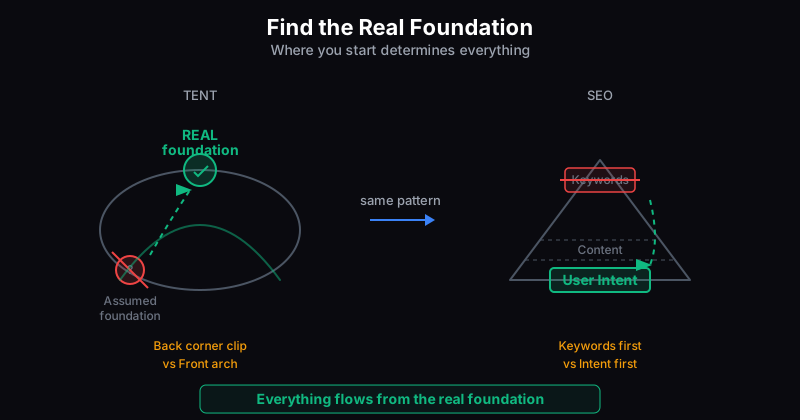
I worked with a fintech startup last year, good product, reasonable domain authority, doing all the "right" keyword optimization. Couldn't break into the top ten for any of their target terms. They were ready to blame Google, blame competitors, blame the alignment of the planets.
We stepped back. Stopped pushing. Asked what the resistance was trying to tell us.
Turned out their entire content architecture was organized around how they thought about their product, not how users thought about their problems. The foundation was wrong. They were trying to rank for "automated invoice processing" when users were searching for "why are my invoices always late." Same solution, completely different entry point.
We didn't optimize harder. We rebuilt from the actual foundation. User problems, not product features. Within three months, the same content that had been stagnant was climbing. The system had wanted to reward them. They just needed to align with what it was actually trying to do.
Finding the real foundation
Ask: What feels natural vs. forced? What enables everything else vs. what requires constant support? Where does the system want to put its energy? The answer to these questions reveals your actual starting point.
Principle Three: Work With Natural Forces
This is where things get philosophical. Stay with me.
The ancient Greeks had this concept called telos, the inherent purpose or goal that things naturally move toward. An acorn's telos is to become an oak tree. A knife's telos is to cut. The telos isn't imposed from outside. It's built into the nature of the thing itself. Aristotle understood that you cannot explain a thing without understanding what it is for.
Tents want to be domes. That's their telos. The poles, the fabric, the clips, the entire architecture is designed to achieve that specific shape. When you work with this natural tendency, the tent practically assembles itself. When you work against it, you spend an hour fighting physics while your dog judges you.
Websites want to serve users. That's their telos, at least as far as Google's algorithm is concerned. Every ranking signal, every quality update, every algorithmic adjustment is pushing toward that goal state. Sites that align with this purpose rise. Sites that fight it fall.
This sounds obvious when you say it out loud, but watch how people actually do SEO. They optimize for crawlers instead of users. They create content for algorithms instead of humans. They treat Google as an adversary to be tricked rather than a system to be aligned with. They're fighting the telos. They're trying to make the tent into a square.
The Helpful Content Update demolished sites that were working against Google's intended direction. By March 2024, Google had integrated the helpful content signal directly into its core algorithm, reducing low-quality content in search results by 45%. Not because Google is arbitrary. Because those sites were fundamentally misaligned with what the system was trying to accomplish. They were fighting the telos. The resistance wasn't a bug. It was the system correcting toward its goal state.
Working with natural forces means accepting what the system is actually trying to do and aligning your strategy accordingly. Not as a tactic. Not as a temporary accommodation. As a fundamental orientation.
What does Google's telos look like in practice?
- Users finding exactly what they're looking for with minimal friction
- Content that genuinely serves the purpose users came with
- Experiences that users would recommend to others
- Sites that earn attention rather than demanding it
Align with these, and the rankings follow. Fight them, and you're bending Y-arms against their design while the clouds gather overhead.
The Philosophy of Release
Somewhere in my third or fourth attempt to force the foundation clip into its wrong position, I had a moment of revelation that I immediately ignored because I was too committed to my failing approach to accept new information. The revelation was this: the clip wasn't connecting because there was too much tension on one side pulling it away from where I wanted it to go.
The solution wasn't more force. It was releasing tension elsewhere so the connection could happen naturally. Rumi, the 13th-century Persian poet, understood this: "What you seek is seeking you." The goal state exists. The system wants to reach it. Your job is to stop blocking the path.
I ignored this insight for another twenty minutes because I am, as previously established, capable of remarkable stubbornness in the face of clear evidence. But the principle stuck with me: sometimes you need to release tension in one area to allow proper connection in another.
In SEO, this looks like keyword cannibalization resolution. You have three pages competing for the same term, and none of them rank well. The instinct is to optimize all three harder, to push more force into the system. But the actual solution is often to release two of them, to consolidate authority into one page, to reduce tension so the remaining page can connect properly with the ranking position it's reaching for.
It looks like removing content that confuses your topical authority. That 50-post archive of tangentially related articles isn't helping you rank for your core terms. It's creating tension that prevents proper connection. Sometimes the right move is deletion, not addition.
It looks like strategic deoptimization. Stop trying to rank for terms that don't convert. Stop fighting for positions that don't matter. Release the tension of pursuing everything, and suddenly your important pages can breathe.
I manage SEO for about twenty sites at any given time, and the ones that perform best are consistently the ones where we've done the most releasing. Pruned the dead weight. Consolidated the cannibalization. Stopped fighting for terms that didn't matter. The portfolio approach works because you can see the pattern across multiple systems: more is often less, and release is often the path to connection.
The counterintuitive move
When a page won't rank despite doing "everything right," ask what tension needs to be released. What competing pages are pulling authority? What irrelevant content is confusing the topical signal? Sometimes the answer is less, not more.
Systems Thinking in Practice
Donella Meadows, the systems scientist who gave us the twelve leverage points for intervening in complex systems, understood something crucial: the most powerful places to intervene are not the obvious ones. Parameters and numbers, the things we obsess over in SEO, are actually the weakest leverage points. The strongest? The mindset or paradigm out of which the system arises. The orientation.
Here is what I know now that I didn't know when I started fighting with that tent:
Every system is trying to tell you how it wants to work. The tent's resistance was information. Google's algorithm resistance is information. Your rankings, your traffic patterns, your user behavior metrics, they're all the system communicating its preferred configuration. Your job is to listen.
The foundation you assume isn't always the real foundation. Start from where the system wants to start, not from where your mental model says it should start. In SEO, this means beginning with user intent and working backward to content, not beginning with keywords and hoping intent follows.
Fighting the telos is exhausting and futile. Work with what the system is naturally trying to do. Align rather than oppose. This isn't submission. It's strategic intelligence. The tent wants to be a dome. Let it be a dome. The search engine wants to serve users. Let it serve users through your content.
Release creates connection. When things won't click into place despite your best efforts, look for tension that needs to be relieved elsewhere. Consolidate. Prune. Simplify. Let go of what's preventing the connections you actually need.
I have spent two decades in this industry watching people work incredibly hard to achieve mediocre results because their orientation was wrong. I have been that person. I have forced keywords into content that didn't want them, fought for rankings that the system didn't want to give, pushed technical optimizations that created as many problems as they solved. I have been the man in the courtyard, bending Y-arms against their design, certain that more force would eventually yield victory.
It doesn't. It never does. The tent doesn't care how hard you push. It has a shape it wants to be, and it will resist anything else until either you figure out the correct orientation or the rain comes and forces you to accept defeat.
The Transformed Perspective
My dog is currently sleeping in his tent. The rain came, as predicted, and he is dry and content in his dome-shaped shelter that assembled itself in sixty seconds once I stopped fighting its architecture. The neighbors have stopped complaining. My wife has stopped using that particular tone. The crisis has passed.
Photo: The completed tent

But something shifted in my understanding that goes beyond tent construction or even SEO strategy.
This framework, this orientation toward systems, it works for everything. Business strategy: is your market approach aligned with what your customers are actually trying to accomplish, or are you forcing them into patterns that serve your model but not their needs? Product development: does your roadmap work with how users naturally want to interact with your tool, or are you fighting user expectations at every turn? Relationship dynamics: are you trying to change people into what you think they should be, or working with who they actually are?
The tent taught me that resistance is the GPS guiding you toward success. Not your enemy. Not the Resistance that Steven Pressfield talks about, that internal force fighting your creative work. This is the good kind of resistance. The informational kind. The kind that's trying to help if you're willing to listen.
Every system, from Google's algorithm to your customer's decision-making process to the architecture of a suspicious Chinese camping tent, is trying to tell you how it wants to work. Your job is to listen.
Mary Oliver gave us instructions for living a life: "Pay attention. Be astonished. Tell about it." That's also pretty good instructions for SEO. Pay attention to what the system is telling you. Be astonished when you finally see what was obvious all along. Tell others what you learned.
Not push. Not force. Not muscle through with sufficient effort and determination. Listen. Observe. Align. Work with the natural forces instead of against them.
One minute to complete success after an hour of struggle. That's what alignment looks like. That's what happens when you stop fighting the system and start understanding it.
For techniques to identify when you're fighting your own content architecture, see Find Cannibalization in 5 Minutes. For understanding what Google's resistance signals actually mean, check out Diagnose Any Traffic Drop in 30 Minutes. For a deeper dive into working with natural search patterns, read Search Intent Mapping.
And the next time you find yourself pushing harder against a system that won't cooperate, stop. Step back. Ask what the resistance is trying to tell you.
The tent knows how it wants to be built. The algorithm knows what it wants to reward. The question is whether you're willing to listen.