
The Experiment
In January 2012, Facebook's Core Data Science Team initiated an experiment that would, two years later, become one of the most controversial psychological studies ever published. This is saying something, because psychology has published studies involving electric shocks, fake prisons, and telling people their mothers didn't love them. Facebook managed to be worse.
For one week, the News Feeds of 689,003 users were quietly altered: some saw fewer posts containing positive emotional words, while others saw fewer posts containing negative emotional words, all without notification or consent. Adam Kramer, the data scientist who led the study, wanted to know whether emotional states could spread through a social network the way diseases spread through physical populations. This is the kind of question that occurs to you when you have a PhD and access to 689,003 people who clicked "I Agree" without reading anything.
689,003 users subjected to emotional manipulation without consent or notification
When the results were published in the Proceedings of the National Academy of Sciences in June 2014, they confirmed what the researchers had suspected: emotional contagion was real, and it operated through the feed itself. Users who saw less positive content subsequently wrote less positive content themselves, and the effect, though small in absolute terms (a 0.1% shift in emotional word use), was statistically significant and occurred entirely below the threshold of conscious awareness. The study provoked immediate outrage, as people discovered that a company whose entire business model depends on manipulating what users see had, in fact, manipulated what users see. Facebook apologized, in the way that companies apologize when they are caught doing something they fully intend to continue doing, and the journal issued what it called an "editorial expression of concern," which is academic language for "we probably should not have published this, but we did, and here we are."
But lost in the furor over consent and methodology was a finding that had been predicted more than a century earlier, by a French social psychologist whose work had shaped the propaganda strategies of both world wars and whose ideas had been studied carefully by everyone from Adolf Hitler to the founders of Madison Avenue. His name was Gustave Le Bon, and in 1895 he had published a slim, disturbing volume called The Crowd: A Study of the Popular Mind, arguing that when individuals gather into masses, their cognitive processes fundamentally change; they become emotional rather than rational, suggestible rather than skeptical, capable of thinking only in images and incapable of entertaining nuance. The crowd, Le Bon insisted, does not evaluate. It imitates.
One hundred thirty years after Le Bon's warning, the largest crowd in human history had assembled, linked by fiber optic cables and HTTP protocols, and the engineers building the systems to measure its behavior had not, it appears, read his book.
Table of ContentsThe Prophet
Gustave Le Bon was born in 1841 in Nogent-le-Rotrou, a small town in north-central France, and spent his early career as a physician before turning to the study of anthropology, archaeology, and eventually psychology. He witnessed the Paris Commune of 1871, when the city's working class briefly seized power before the French Army killed somewhere between ten thousand and thirty thousand Parisians in what became known as La Semaine Sanglante, the Bloody Week. Le Bon watched crowds burn buildings, tear down monuments, and murder suspected collaborators. He watched them be massacred in turn. What he saw convinced him that understanding crowds was no longer optional for anyone who wished to understand the modern world.
The Crowd was published in 1895 and proved enormously influential, particularly among people who wanted to control crowds rather than understand them. Hitler read it carefully, as did Mussolini, and Edward Bernays (Sigmund Freud's nephew) used it as the foundation for the field of public relations, which is to say, the field of manipulating crowds for money. If you want to know whether a book about psychology is accurate, check whether it was popular with dictators and advertisers; they have no patience for theories that don't work. Self-help authors can sell you nonsense for decades. Dictators need results by Tuesday.
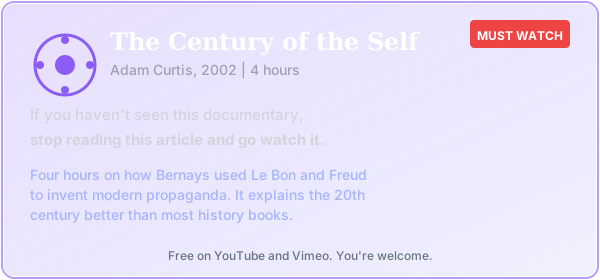
Le Bon's central insight was that the crowd mind is qualitatively different from the individual mind. A person alone might reason carefully, weigh evidence, consider counterarguments. The same person in a crowd becomes something else: emotional, impulsive, susceptible to contagion, intolerant of complexity. Le Bon wrote:
"The substitution of the unconscious action of crowds for the conscious activity of individuals is one of the principal characteristics of the present age." - Le Bon, 1895"An individual immersed for some length of time in a crowd soon finds himself, either in consequence of magnetic influence given out by the crowd or from some other cause of which we are ignorant, in a special state, which much resembles the state of fascination in which the hypnotized individual finds himself in the hands of the hypnotizer."
The language is dated. The observation is not. Modern psychology has largely validated Le Bon's core claims while refining the mechanisms. We now understand that the "magnetic influence" he described operates through social proof, emotional contagion, information cascades, and the suppression of individual judgment in favor of group consensus. We have names for these phenomena and experimental evidence for their existence. We have studies showing that people adjust their perceptions of simple visual stimuli to match group consensus, that emotional states transfer from person to person without conscious awareness, that information cascades can begin from the decisions of just two or three individuals and grow to influence millions. Le Bon got the mechanisms wrong, but he got the phenomenon right.
Le Bon got the mechanisms wrong, but he got the phenomenon right.What he could not have predicted was that someone would build a machine to measure crowd behavior and then treat those measurements as a proxy for what individuals actually need.
Contagion
Four years after the Facebook emotional contagion study, another team of researchers at MIT published findings that would illuminate a different dimension of the crowd problem.
Soroush Vosoughi, Deb Roy, and Sinan Aral analyzed the spread of verified true and false news stories on Twitter between 2006 and 2017, examining 126,000 stories spread by roughly three million people more than 4.5 million times. Their study, published in Science in March 2018, found that false news spreads further, faster, and deeper than true news. Falsehoods were 70% more likely to be retweeted than accurate information. They reached 1,500 people six times faster than the truth. And they penetrated more deeply into social networks, cascading through more layers of retweets.
70% more likely to be retweeted: the viral advantage of lies over truth
The researchers concluded that false news spreads faster than true news, which, if you have ever met a human being or spent eleven seconds on the internet, will not come as a surprise.
But apparently it required a study involving 126,000 news cascades and twelve years of Twitter data to establish this to the satisfaction of the scientific community. Scientists are like that. They need to prove things that everyone already knows, and then other scientists need to prove it again, and then a third group needs to publish a meta-analysis of the first two groups, and by the time they're finished the sun has exploded and we're all dead anyway.
The study attributed the difference to novelty and emotional valence. False stories were more novel, which made them more interesting to share. They also triggered stronger emotional responses: surprise, disgust, fear. True stories produced different emotions: anticipation, sadness, trust. The emotions produced by false news are better suited to viral spread. They demand action. They compel sharing. The emotions produced by true news are quieter, more contemplative, less likely to produce the urgent need to tell others that characterizes viral content.
Le Bon had described this dynamic in 1895 without the benefit of Twitter data:
"Whatever be the ideas suggested to crowds they can only exercise effective influence on condition that they assume a very absolute, uncompromising, and simple shape. They present themselves then in the guise of images, and are only accessible to the masses under this form... A chain of logical argumentation is totally incomprehensible to crowds."
False news succeeds because it is more image-like than true news. It is simpler, more absolute, more emotionally striking. Truth is usually complicated, hedged, conditional. Lies can be anything you want them to be.
The implications were significant: the systems that determined what billions of people would read, believe, and share were measuring something other than quality or truth; they were measuring virality, which is a property that content shares with disease. It was as if we had built a restaurant recommendation system based entirely on how often people vomited afterward, on the theory that vomiting indicates a memorable meal.
Simple and Complex Contagion
Network science distinguishes between two types of contagion. Simple contagion spreads after a single exposure, like a cold virus: you encounter it once and you catch it. Complex contagion requires multiple exposures or social reinforcement, like adopting a new exercise routine: you need to see several friends doing it, hear about it from multiple sources, before you change your behavior.
Damon Centola, a professor at the Annenberg School for Communication at the University of Pennsylvania, has spent two decades studying the difference. His 2007 paper with Michael Macy, published in the American Journal of Sociology, demonstrated mathematically that information and behavior spread through networks by fundamentally different mechanisms. Information spreads as simple contagion, radiating quickly across weak ties between loosely connected individuals. Behavior change spreads as complex contagion, requiring the reinforcement of strong ties within densely connected clusters.
This distinction matters because it reveals a category error in how the internet measures value.Content that goes viral, that accumulates links and shares and traffic, succeeds at simple contagion. It is novel, surprising, emotionally striking. It triggers a single-exposure response: see it, share it, move on. But usefulness, actually helping someone accomplish a task or understand a concept, is more like complex contagion. It requires sustained engagement, repeated returns, genuine behavioral change. The person who finds a tutorial genuinely helpful might visit it ten times over several months, each visit reinforcing the value. The person who shares a viral article probably never reads it again.
Google built its system to measure simple contagion and assumed those measurements indicated complex value. Links spread as simple contagion; usefulness operates as complex contagion. By measuring the first, Google was systematically missing the second.
CGP Grey: This Video Will Make You AngryThe Link Graph as Crowd Artifact
In January 1996, Larry Page and Sergey Brin, two graduate students in Stanford's computer science department, began working on a new approach to web search. The prevailing methods measured on-page factors: how many times did the word appear, how prominently was it positioned, what metadata surrounded it. Page and Brin realized that the link structure of the web contained information that on-page analysis missed. A link from one page to another was, in their view, a vote, an indication that the linking page found the linked page valuable. If you could aggregate these votes across the entire web, you would have a measure of importance that no individual site could manipulate.
They called the system PageRank, after Larry Page, and published their findings in a 1998 paper titled "The Anatomy of a Large-Scale Hypertextual Web Search Engine." The paper was explicit about the assumption underlying the system:
"We assume there is a 'random surfer' who is given a web page at random and keeps clicking on links, never hitting 'back' but eventually gets bored and starts on another random page. The probability that the random surfer visits a page is its PageRank."
And elsewhere:
"Academic citation literature has been applied to the web, largely by counting citations or backlinks to a given page. This gives some approximation of a page's importance or quality."
The reasoning seemed sound. Academic citations had long been used as a proxy for the importance of scholarly work. If a paper was cited frequently by other papers, it was probably significant. Apply the same logic to web pages: if a page is linked frequently by other pages, it is probably important. The wisdom of crowds, manifested in linking behavior.
Page and Brin did not ask whether link behavior represented individual judgment or crowd contagion. They did not distinguish between a link placed after careful evaluation and a link placed because everyone else was linking. They assumed the crowd was wise. They were twenty-three years old. They were computer science students. They had presumably never been to a county fair, or a stock market, or a war.
Le Bon, a century earlier, had warned against precisely this assumption.
The assumption in black and white
Google's 1998 founding paper cited no research on crowd psychology, referenced no studies on information cascades or social contagion, and made no mention of Le Bon or any of his intellectual descendants. The assumption that links represented the wisdom of individuals rather than the contagion of crowds was built into the system's foundation, and on that foundation, unexamined, untested against a century of social psychology, Google indexed the world.
Affirmation, Repetition, Contagion
Le Bon identified the mechanisms by which ideas spread through crowds:
"The principal [means of persuading crowds] are three in number and clearly defined: affirmation, repetition, and contagion... Affirmation pure and simple, kept free of all reasoning and all proof, is one of the surest means of making an idea enter the mind of crowds."
This is the precise mechanism of link-based ranking. Someone links to something, an affirmation. Others see the link and link themselves, repetition. The links accumulate, contagion. At no point in this process is there a requirement that anyone evaluate whether the linked content is actually useful. At no point does anyone need to read anything. At no point does anyone need to think. The system rewards the appearance of consensus, and consensus in crowds forms through affirmation, repetition, and contagion, not through individual evaluation. It's not a bug. It's the entire architecture.
Information cascade research, pioneered by economists Sushil Bikhchandani, David Hirshleifer, and Ivo Welch in their 1992 paper in the Journal of Political Economy, demonstrated mathematically how these cascades work. An information cascade occurs when individuals abandon their private information and follow the behavior of others. If the first two people in a sequence make the same choice, it becomes rational for subsequent individuals to ignore their own information and follow along, even if their private information contradicts the emerging consensus. Mathematically, an infinite cascade can begin from the decisions of just two people.
The researchers proved that cascades can be "based on little information" and are "consequently fragile." A cascade is not evidence that the crowd has correctly aggregated individual judgments. A cascade is evidence that individuals have stopped judging and started following. The same mathematics that makes PageRank work, the aggregation of link signals, is the mathematics of information cascades.
Cascade VisualizationCore Web Vitals are a ranking factor
Core Web Vitals are a ranking factor
Core Web Vitals are a ranking factor
Core Web Vitals are a ranking factor
Core Web Vitals are a ranking factor
Core Web Vitals are a ranking factor
↑ Information cascade: affirmation → repetition → contagion
The Prestige Factor
Le Bon identified another mechanism that operates in crowds: prestige.
"Whatever has been a ruling power in the world, whether it be ideas or men, has in the main enforced its authority by means of that irresistible force expressed by the word 'prestige.'... The special characteristic of prestige is to prevent us seeing things as they are and to entirely paralyze our judgment."
Online, prestige operates through follower counts, domain authority, brand recognition. A link from the New York Times carries more weight than a link from a personal blog, regardless of whether the New York Times actually evaluated the content. The prestige of the linking domain transfers authority to the linked page, and prestige, as Le Bon noted, "prevents us seeing things as they are."
Le Bon distinguished "acquired prestige" (titles, reputation) from "personal prestige" (charisma). Google measures only the former: the algorithmic equivalent of judging ideas by the credentials of whoever spoke them last.Google explicitly incorporated prestige into its algorithm. PageRank weighted links by the authority of the linking page, and authority was itself determined by incoming links. A recursive definition: prestigious pages are pages linked by prestigious pages. The system measures prestige, calls it authority, and treats authority as a proxy for value. But prestige is a crowd signal. It tells you what the crowd respects, not what individuals need.
The system measures prestige, calls it authority, and treats authority as a proxy for value.The Feedback Loop
The tragedy is not merely that Google measured crowd behavior. The tragedy is that content adapted to crowd behavior.
Le Bon observed that successful leaders of crowds understand the principles by which crowds can be influenced:
"To exaggerate, to affirm, to resort to repetitions, and never to attempt to prove anything by reasoning are methods of argument well known to speakers at public meetings."
SEO professionals learned the same lesson, and they learned it fast, because their mortgage payments depended on learning it.
Content that succeeded was simple, because crowds cannot process nuance. It was emotionally triggering, because crowds respond to feeling rather than logic. It was image-like, because crowds think in images. It was frequently repeated, because repetition creates contagion. It was associated with prestige signals, because prestige paralyzes judgment.
An entire industry emerged to produce content that satisfied Le Bon's criteria for crowd manipulation, and they called this industry "content marketing," which is a nice name for it, much nicer than what Le Bon would have called it.
This was not manipulation, or not only manipulation. It was adaptation. Content evolved to satisfy the measurement environment, and the measurement environment measured crowd behavior. The optimization was rational at the individual level: if Google rewards content that accumulates links and shares, then produce content that accumulates links and shares. But the aggregate effect was irrational: a web optimized for crowds, which is to say, a web worse for individuals.
The feedback loop tightened over time. Google measured crowd signals. Content producers optimized for crowd signals. Crowd signals became more pronounced. Google interpreted the more pronounced signals as stronger evidence of quality. Content producers optimized further. The measurement became the target. The target shaped the measurement.
The measurement became the target. The target shaped the measurement.Twenty years of this produced the web we have: a web of listicles and clickbait and shareable images, a web where "5 Ways to Boost Your Productivity" outranks actual productivity advice, where "You Won't Believe What Happened Next" drives more traffic than careful reporting, where the form of valuable content has been so thoroughly optimized that the substance has been crowded out. The web we have is the web the measurement system selected for.
Goodhart's Law, applied
"When a measure becomes a target, it ceases to be a good measure." The British economist Charles Goodhart articulated this principle in 1975 in the context of monetary policy. Google built a system that measured links. Links became the target. Links ceased to be a good measure. The entire content industry organized itself around producing content that would accumulate links, and the link graph became a map of optimization strategy rather than a map of value.
Content Is King: A Eulogy
In January 1996, Bill Gates published an essay titled "Content Is King." The essay predicted that content would be where "much of the real money will be made on the Internet."
He was right, in the same way that saying "oxygen is important for breathing" is right. It is true and also useless. The statement tells you nothing about what kind of content, or for whom, or distributed how, or measured by what. It is a tautology dressed as insight.
But the phrase caught on, because phrases that flatter people catch on. Everyone who produced content could now believe they were royalty. Bloggers were kings. Copywriters were kings. The person writing "Top 10 Ways to Organize Your Closet" for three cents a word was, technically, a king.
The kingdom, it turned out, was a content mill.
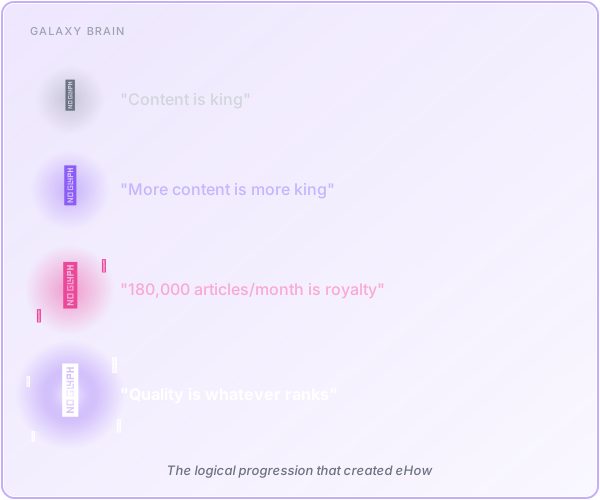
What "content is king" actually meant, in practice, was "produce more content." It did not mean "produce better content" or "produce content people need" or "produce content that would be missed if it disappeared." It meant: volume. Quantity. More.
If content is king, then more content is more king. The logic is irrefutable if you are an idiot.
And so the content mills churned. Demand Media, at its peak, was publishing 180,000 pieces of content per month. Associated Content, before Yahoo acquired it for $100 million, had published over one million articles. eHow had articles about everything, written by people who knew nothing, optimized for keywords that someone had searched at least once.
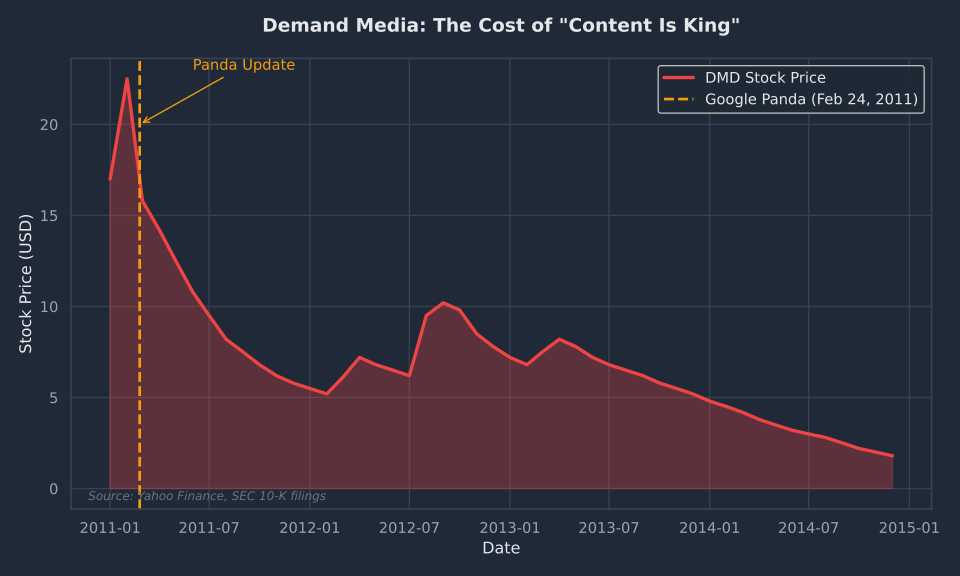
The business model was simple: produce content cheaply, rank it in Google, monetize the traffic with ads. The content did not need to be good. It did not need to help anyone. It needed to exist, and it needed to rank. "Content is king" had become "content that ranks is king," which had become "whatever ranks is content," which had become "we will publish anything if Google will send us traffic for it."
The writers were paid per piece. A typical rate was $15 for a 400-word article. At that rate, quality is not an option. Quality takes time, and time is money, and money is $15 for 400 words. The rational strategy is to write fast, hit the keyword targets, and move on. If you spent an hour researching to write something accurate, you earned $15. If you spent ten minutes making something up, you earned $15. The market was very clear about which approach it preferred.
This was not a bug in the system. This was the system working exactly as designed.
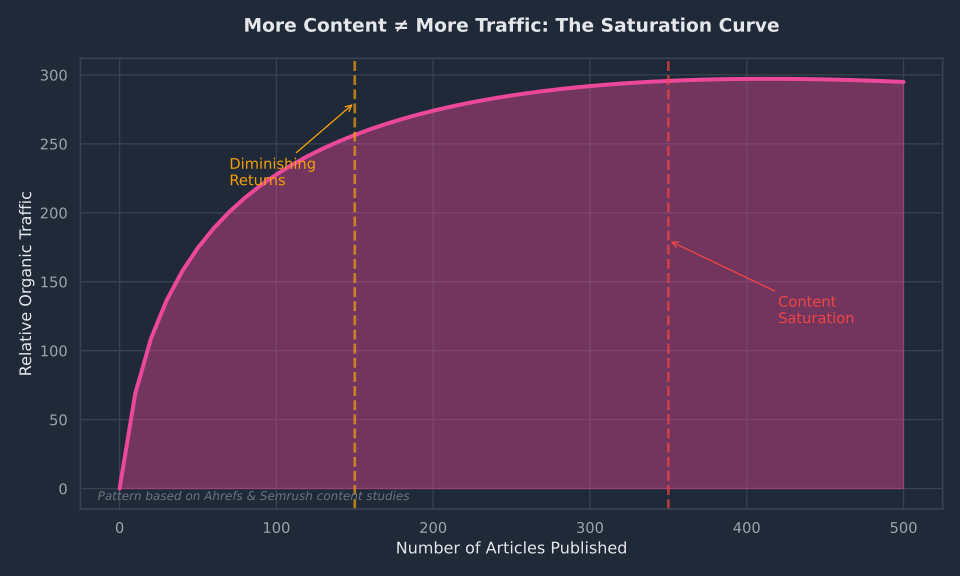
"Content is king" was a cover story for "traffic is king," which was a cover story for "ad revenue is king," which was a cover story for "we have found a way to extract money from human attention without providing anything of value in return."
The phrase persists because it is useful to people who sell content services. "Content is king" means you should hire us to produce content. It does not mean you should think carefully about whether that content should exist, or whether anyone will benefit from its existence, or whether the internet needs another article about the ten best ways to do anything.
The internet did not need those articles.
The internet got them anyway.
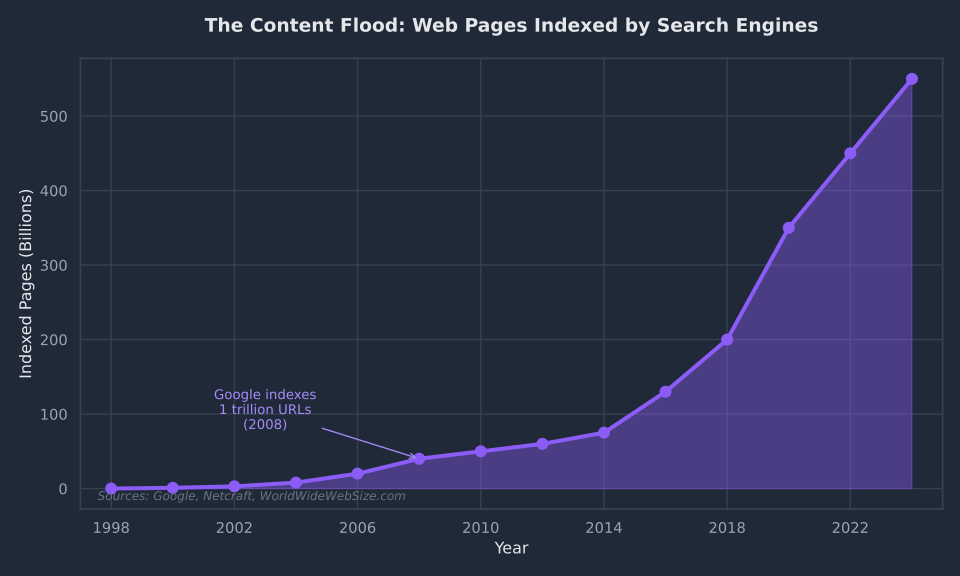
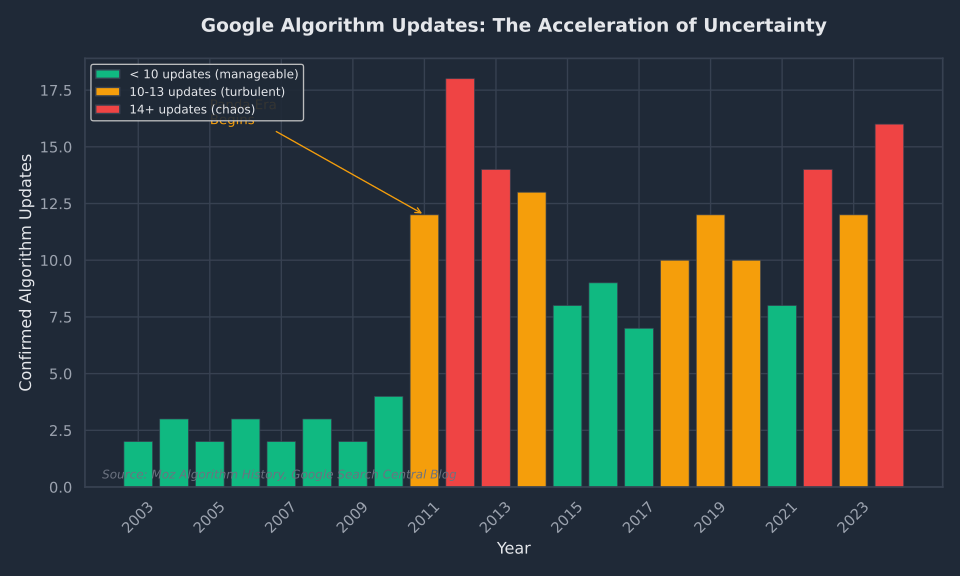
By 2011, when Google's Panda update finally began penalizing thin content, the damage was done. Millions of pages existed that would never have been written if anyone had stopped to ask whether they should be written. The content mills had trained a generation of writers to produce garbage quickly, and a generation of businesses to expect that garbage could be monetized. The phrase "content is king" had become a permission slip for pollution.
Bill Gates, to be fair, probably did not anticipate that his essay would be used to justify paying someone in the Philippines $3 to write an article about how to remove stripped screws, an article that would then appear on the first page of Google for seven years, misleading thousands of people who just wanted to remove a stripped screw and instead learned that they should "consider the screw's position" and "think about what tools you have available."
He was talking about something else. He was talking about the idea that valuable content would find audiences online. He was optimistic, in the way that people in 1996 were optimistic about the internet, before they had seen what the internet would actually become.
The optimism was misplaced.
Content was never king. Distribution was king. Whoever controlled how content was discovered and ranked controlled the kingdom. Content creators were not royalty; they were peasants farming land owned by platforms, and the platforms could change the terms of tenancy at any time, for any reason, without notice or appeal.
Google was king. Facebook was king. The algorithms that determined what got seen were king.
Content was the serf.
Wisdom and Madness
James Surowiecki's 2004 book The Wisdom of Crowds argued that crowds could be remarkably intelligent, under certain conditions. The classic example comes from Francis Galton, the Victorian polymath, who attended a county fair in 1906 and observed a contest to guess the weight of an ox. Galton collected the 787 guesses and calculated the median: 1,207 pounds. The actual weight was 1,198 pounds. The crowd had been wrong by less than one percent.
Surowiecki identified four conditions necessary for crowd wisdom: diversity of opinion, meaning each person has private information; independence, meaning opinions are not determined by those around them; decentralization, meaning people draw on local knowledge; and aggregation, meaning a mechanism exists to turn individual judgments into a collective decision. These conditions are reasonable enough, and when they are met, crowds do in fact perform impressively: they can guess the weight of an ox, predict election outcomes, estimate the number of jellybeans in a jar with surprising accuracy.
Galton's ox experiment worked because guesses were written on tickets and placed in a sealed box. No one saw anyone else's guess. The moment you display a running average, you destroy the independence that made the average meaningful.The problem, which Surowiecki acknowledged but which his book's title tends to obscure, is that the conditions are almost never met.
And when they are not met, the crowd is not wise at all but instead exhibits the properties that Le Bon described: emotional contagion, susceptibility to prestige, preference for simplicity, and a marked tendency to be wrong.
The internet, as it turned out, was designed in such a way as to violate every single one of Surowiecki's conditions simultaneously, which is an impressive achievement if you think about it, though not one that anyone set out to accomplish.
It's like building a hospital that somehow gives everyone cancer. You have to admire the thoroughness.
Diversity of opinion is destroyed by filter bubbles and algorithmic amplification of popular content. The algorithm shows you what people like you already believe, and then it shows you more of it.
Independence is destroyed by visible social proof: likes, shares, follower counts, link counts. You can see what everyone else thinks before forming your own opinion, which means your opinion is formed by what everyone else thinks.
Decentralization is destroyed by platform concentration: the majority of web traffic flows through a handful of platforms, each of which imposes its own logic on what gets seen.
Aggregation is corrupted by engagement optimization rather than accuracy optimization: the mechanism that turns individual judgments into collective outcomes is optimized for engagement, not for truth or value.
When these conditions fail, you get not wisdom but madness: Charles Mackay's Extraordinary Popular Delusions and the Madness of Crowds, published in 1841, describing tulip mania and the South Sea Bubble and the belief in witches. The same crowd that can accurately guess the weight of an ox, when its members vote independently and without knowledge of each other's guesses, will produce spectacular delusions when independence is violated and social proof is visible.
The link graph is an aggregation of crowd behavior, not individual judgment.
People link to things they haven't read. They link to what others have linked to. They link to prestige, to novelty, to controversy. They link to things because linking has social benefits, because it signals sophistication or awareness, because everyone else is linking.
The conditions for crowd wisdom are not met. The link graph is a map of crowd contagion, not individual evaluation.
The Correction
On August 25, 2022, Google launched what it called the "helpful content update," the first in a series of algorithm changes that would fundamentally reorient how the search engine evaluated quality.
The language of the update was notable. Google instructed content creators to focus on "content written for people, not for search engines." It emphasized "original, helpful content" and "first-hand expertise and depth of knowledge." It warned against "content created primarily to gain search engine traffic rather than to help or inform people."
The update targeted what Google called "unsatisfying content," particularly content that left searchers feeling the need to search again.
This was Google telling content creators to stop doing the thing that Google had spent twenty years rewarding them for doing.
It takes a certain kind of confidence to break someone's legs and then criticize them for limping.
Veritasium: My Video Went Viral. Here's WhyThis is Google attempting to measure individual value rather than crowd signals.
The shift involves measuring different things: dwell time patterns that indicate actual reading rather than bounce; return visits that indicate genuine ongoing value; query refinement patterns that reveal whether content actually answered the question or forced the searcher to try again. It involves de-emphasizing link signals, which are susceptible to crowd contagion, in favor of engagement signals, which are harder to fake. A link can be purchased or manipulated. Reading behavior is harder to manufacture.
The technical details of these changes remain partially opaque; Google does not publish the full specifications of its ranking algorithms. But the directional change is clear: away from crowd signals, toward individual signals.
The September 2023 iteration of the helpful content update went further, introducing a site-wide classifier that evaluated not individual pages but entire websites. Sites with "substantial amounts of unhelpful material" could see their entire domain demoted, even pages that were themselves high-quality. The message was explicit: you cannot produce mostly unhelpful content and expect your occasional good content to be rewarded. The classifier operated at the level of site reputation, not page quality.
The casualties were significant. A study by Glenn Gabe documented numerous sites losing between 50% and 90% of their organic traffic in the weeks following the update. Travel sites, health sites, recipe sites, product review sites, many of them built on the exact strategies that had worked for the previous two decades, suddenly found themselves invisible. The content that had accumulated links and shares and traffic, the content that had satisfied crowd-signal optimization, turned out to be exactly the content that the new system penalized.
Recovery has been slow. More than a year after the initial update, many affected sites report only partial restoration of traffic. Some have not recovered at all. The system that rewarded crowd-optimized content for two decades had created an entire industry of crowd-optimized content, and the correction has been painful for everyone who built their business on that foundation. It turns out that "do what works" is a dangerous strategy when what works can change overnight and nobody tells you in advance. But then, nobody told the dinosaurs about the asteroid either.
The deeper problem
The correction cannot be purely algorithmic, because the problem is not purely algorithmic. The entire web has been shaped by two decades of crowd optimization. Publishers have built infrastructures, hiring practices, content strategies, and business models around producing crowd-optimized content. The system did not merely measure the wrong thing; it created incentives that shaped what got produced. Undoing those incentives does not undo what has already been produced.
Implications for Content Strategy
What does it mean to optimize for individuals rather than crowds?
The crowd mind thinks in images. Content optimized for crowds is therefore image-like: simple, absolute, uncompromising. The listicle is the perfect crowd-optimized format. "5 Ways to Improve Your Life" is image-like: you can grasp it instantly, without reading, without thinking. Content optimized for individuals can afford complexity. It can afford nuance. It can afford the admission that reality is complicated and that reasonable people might disagree about interpretations.
The crowd responds to emotion. Content optimized for crowds therefore triggers emotion: surprise, outrage, fear, delight. The headline "You Won't Believe What Scientists Just Discovered" is optimized for crowd sharing. Content optimized for individuals can afford to be less emotionally manipulative, because it does not need to trigger a single-exposure share response. It can be useful without being urgent.
The crowd spreads through contagion. Content optimized for crowds is therefore designed to spread, to be shareable, to trigger the "I need to tell someone about this" response. Content optimized for individuals can afford to be less spreadable, because its value does not depend on being shared. A genuinely useful tutorial might never go viral, but the people who need it will find it and use it and return to it.
The crowd follows prestige. Content optimized for crowds therefore accumulates prestige signals: author bios, expert quotes, trust badges, links from authoritative domains. Content optimized for individuals can rely less on prestige and more on demonstrated expertise, on actually helping the reader accomplish something.
The SEO Industry as Case Study
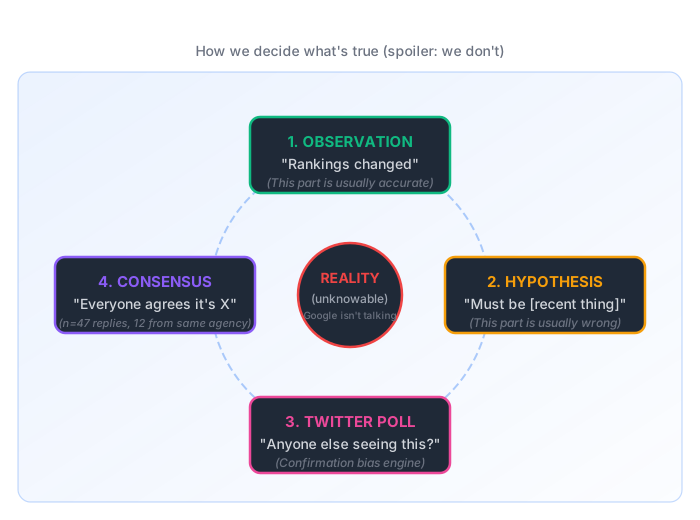
The SEO industry itself provides a useful illustration of Le Bon's principles in action. The industry runs almost entirely on affirmation, repetition, and contagion. Someone posts a claim on Twitter: "Core Web Vitals are now a major ranking factor." The claim is repeated on blogs, in podcasts, at conferences. It becomes industry orthodoxy within weeks. Whether it is actually true is almost beside the point; by the time anyone thinks to test it, it has already been repeated so many times that questioning it feels contrarian.
This is not a criticism of the people involved, or not only a criticism. It is a description of how information moves through crowds.
The SEO industry is a crowd, and crowds operate by different rules than individuals. A single practitioner might be deeply skeptical, might demand evidence, might test claims against data. That same practitioner, embedded in the SEO crowd, absorbs the consensus because the consensus is everywhere, because everyone else seems to believe it, because questioning orthodoxy has social costs and accepting it has social benefits.
It's easier to be wrong together than right alone. This is true in all industries, but it is especially true in an industry where nobody actually knows what's going on and everyone is just guessing confidently.
The irony is rich: an entire industry dedicated to understanding how information spreads online has been subject to the same crowd dynamics it ostensibly studies. The things SEO practitioners believe about ranking factors are determined less by evidence than by what other SEO practitioners believe. Information cascades all the way down.
The industry conferences are particularly remarkable: a thousand people paying two thousand dollars each to hear other people who also do not know what is happening speculate about what might be happening, and everyone leaves feeling informed.
Le Bon would have recognized these gatherings immediately. He called them "meetings."
The HubPages Story
HubPages offers a case study in what happens when a business model is built entirely on crowd-optimized content.
Founded in 2006, HubPages was a content platform that allowed anyone to publish articles and share in advertising revenue. By 2011, it had over a million articles and substantial organic traffic. The business model was simple: produce large quantities of content that would rank in Google, monetize that traffic through advertising, and share the revenue with the writers who produced it. The content quality was variable, ranging from genuinely useful hobbyist expertise to thin, keyword-stuffed filler.
Google's Panda update in February 2011 hit HubPages hard. Traffic dropped by an estimated 75%. The site had accumulated exactly the kind of content that Panda was designed to demote: high volume, inconsistent quality, produced primarily to capture search traffic rather than to serve user needs. The content that had accumulated links and traffic under the old system was exactly the content the new system penalized.
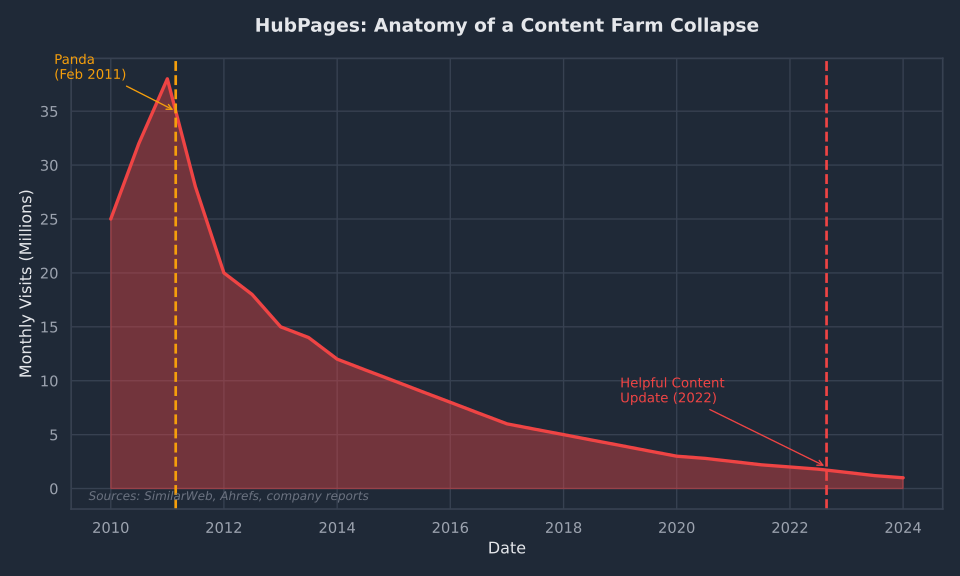
HubPages spent years trying to recover. They implemented quality controls, removed low-quality content, created editorial processes they hadn't needed before. Some recovery occurred. But the business never regained its peak; the model itself, the assumption that crowd-signal optimization would continue to work indefinitely, had been wrong.
The September 2023 helpful content update repeated this pattern across a new generation of sites. Travel bloggers who had built audiences through "best X in Y" listicles saw traffic crater. Recipe sites that had accumulated links through social sharing found themselves invisible. Product review sites that had optimized for "best [product] [year]" queries lost their rankings overnight. The specific casualties were different, but the underlying dynamic was the same: content that had succeeded by crowd metrics failed when the measurement system changed.
None of this means that individual-optimized content cannot also succeed by crowd metrics. Content that is genuinely useful sometimes goes viral; content that helps real people sometimes accumulates links. But the correlation is weaker than most people assume, and optimizing for one often conflicts with optimizing for the other. The choice is not always explicit, but it is always present: are you making content that a crowd would share, or content that an individual would use?
The systems that determine what gets seen are shifting from measuring the first to measuring the second. The transition is incomplete and ongoing. But the direction is clear, and the direction matters more than the current state.
The End of "Will This Rank?"
For twenty years, the primary question in content strategy was "will this rank?" The question assumed a stable relationship between content attributes and ranking outcomes: if you did certain things (built links, targeted keywords, satisfied technical requirements), you would achieve certain results (rankings, traffic, visibility). The question was about the system, not about the user.
That question is becoming less useful. The system is changing in ways that make the old proxies unreliable. Links matter less. Engagement patterns matter more. The signals that once predicted rankings no longer predict them as consistently. The question "will this rank?" increasingly depends on the question "will this actually help someone?"
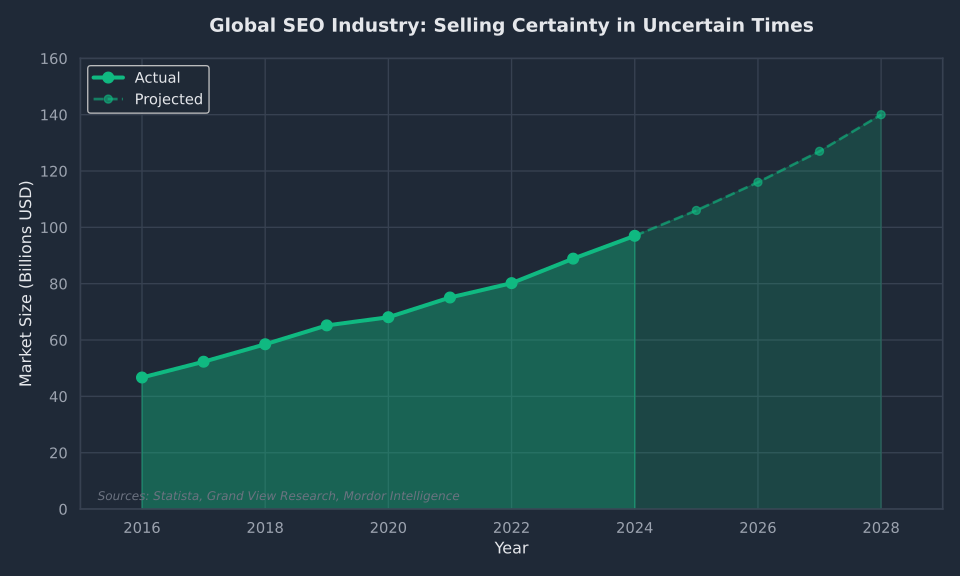
This is uncomfortable for an industry built on the separation of those questions. SEO as a profession developed precisely because "will this help someone?" and "will this rank?" were different questions with different answers. An entire methodology emerged for answering the second question without particularly caring about the first.
That methodology is becoming obsolete.
The industry will adapt, of course. It always does. There will be new conferences and new courses and new certifications explaining how to optimize for "helpfulness," as if helpfulness were a technical specification rather than, you know, being helpful.
The crowd will develop new orthodoxies about what helpfulness means, and those orthodoxies will be repeated until they become true, and then they will be measured, and then they will be optimized, and then they will be gamed, and then Google will change everything again, and the whole cycle will repeat.
It is the circle of SEO life.
The real test is whether this content deserves to exist. Not "will it rank?" or "will it get links?" or "will it go viral?" but simply: if this content disappeared tomorrow, would anyone miss it? Would anyone notice? Would some individual's life be measurably worse because they could no longer find this page?
Content that passes that test, content that would be missed, content that serves a genuine individual need, is the content that the new system is trying to identify and reward. Content that fails that test, content that exists only because it might rank, content that serves no purpose except to capture traffic that will then be monetized, is the content that the new system is trying to demote.
Whether Google will succeed in this attempt is uncertain. The measurement problem is hard. Individual value is harder to observe than crowd behavior. Engagement signals can be gamed just as link signals were gamed; the game just changes. And there are powerful incentives to find the new game and win it, because traffic remains valuable and optimization remains profitable.
But the attempt itself represents something significant: a recognition, finally, that crowd signals and individual value are not the same thing, and that measuring the first does not automatically serve the second.
Beyond Le Bon
Le Bon was not entirely right about crowds. His contempt for the masses reflected the anxieties of a nineteenth-century European bourgeois watching democracy expand and fearing what would come. He believed crowds were inherently irrational, inherently destructive, inherently inferior to individuals. Modern research has complicated this picture. Crowds can be wise, under the right conditions. Collective intelligence is real, when the conditions for its emergence are present. The problem is not that crowds are always wrong; the problem is that the conditions for crowd wisdom are rarely met online, and the systems we built assumed they would be met even when they weren't.
What Le Bon got right was simpler and more durable: crowd cognition is different from individual cognition. The mechanisms are different. The outputs are different. The inputs that produce crowd behavior are not the inputs that serve individual needs. A system that measures crowd behavior and treats it as a proxy for individual value will systematically fail to serve individuals, not because crowds are bad, but because the measurement is wrong.
Google is now attempting to measure individual value in a world whose infrastructure was built to amplify crowds, and whether this is possible, whether the machinery of contagion can be repurposed for the cultivation of wisdom, remains an open question, one that will shape the information environment for decades to come. The challenge is not merely technical. The entire economy of content production has adapted to crowd signals. Millions of pages exist that would never have been created if the measurement system had been different. Billions of dollars have been invested in producing content that optimizes for crowd behavior. The correction requires not merely algorithmic adjustment but economic transformation: new business models, new success metrics, new definitions of what makes content worth producing.
Le Bon warned, in 1895, that the era of crowds was approaching, and he was right. The era came, and it swallowed the internet whole.
What he could not have predicted was that the crowd's behavior would be measured by machines, and that those measurements would be mistaken, for a quarter century, for truth.
But then, Le Bon also did not predict the internet, or computers, or that a company named after a misspelling of a large number would become the primary arbiter of what information billions of people would see.
He was a nineteenth-century Frenchman. He did his best.
The rest of us have no such excuse.
The correction has begun. Whether it will succeed, and what will emerge on the other side, depends on questions that Le Bon could not have asked and that we are only beginning to understand how to answer. What does the internet become when the systems that govern it stop measuring crowds and start measuring individuals? What does content become when it no longer needs to go viral to be visible? What does quality become when it cannot be proxied by popularity?
There is reason for skepticism. The same incentives that produced crowd-optimized content will produce individually-optimized content, or content that appears individually-optimized while actually gaming the new signals. Engagement can be manipulated. Dwell time can be manufactured. Return visits can be incentivized through means that have nothing to do with genuine value. The game will change, but the players will remain, and the players are very good at games.
There is also reason for hope. The measurement problem may be hard, but it is not insoluble. Human beings are good at distinguishing content that helps them from content that wastes their time; if Google can figure out how to measure what humans actually experience, rather than what crowds aggregate, the incentives will shift and the content will follow. The web we have was produced by the measurement system we had. A different measurement system could produce a different web.
Le Bon would not have been surprised by any of this. He spent his career observing how individual rationality dissolves in crowds, how the mechanisms of contagion override the mechanisms of evaluation, how prestige trumps evidence and emotion trumps logic. He watched crowds destroy and create, panic and celebrate, believe impossible things with total conviction. He understood that the crowd is not simply a collection of individuals but a different kind of entity, operating by different rules, producing different outcomes.
What Le Bon could not have predicted was that someone would build machines to measure the crowd and then assume those measurements revealed what individuals actually need. That was the category error. That was the twenty-five-year mistake. And whether we can correct it, whether we can build systems that serve individuals in a world shaped by crowds, remains the defining question of the information age.
We are about to find out.