
The e-commerce site had 12,000 products. The homepage linked to all of them through a carousel that rotated 50 products at a time. "Everything is within one click of the homepage," the marketing director said, proud of this architectural achievement.
None of the product pages ranked. Not a single one.
Meanwhile, their competitor had products buried four, five, six clicks deep. Products that required navigating through category, subcategory, and filter pages before you could reach them. "Terrible user experience," the marketing director said.
Those buried products ranked on the first page for their target keywords.
This is the story of almost every site architecture conversation I have. People have absorbed a set of rules about site structure that sound reasonable, feel logical, and are completely disconnected from how Google actually works. (Technical SEO is often a distraction, but architecture is the exception.)
The 3-Click Rule is Cargo Cult
You've heard it, probably multiple times, from multiple sources: "Every page should be within three clicks of the homepage," a piece of wisdom that gets repeated at conferences, written into SEO audits with confident authority, and treated as foundational truth by people who've never stopped to ask where it came from or whether it even applies to search rankings.
Where did it come from? Usability research from the 1990s about user frustration, back when someone noticed that users got annoyed if they had to click too many times to find something, which was a perfectly valid observation about human psychology and website navigation but had absolutely nothing to do with how search engines evaluate and rank content.
Google doesn't count clicks, has never counted clicks, and almost certainly never will count clicks as a ranking factor, because Google counts link paths and link equity, which are related concepts but fundamentally different in ways that matter enormously for how you should structure your site - a page buried five clicks from your homepage that receives strategic internal links from high-authority pages will outrank a page sitting one click from your homepage that shares that precious link with 200 other pages, every single time.
The 3-click rule isn't wrong because it's bad for users - it might actually be fine for users, that's debatable - it's wrong because people apply it to SEO when it has nothing to do with SEO, flattening their site structure to satisfy a rule that was never about rankings in the first place, and in doing so, they destroy their ability to rank for anything competitive.
Diagram: Myth vs Reality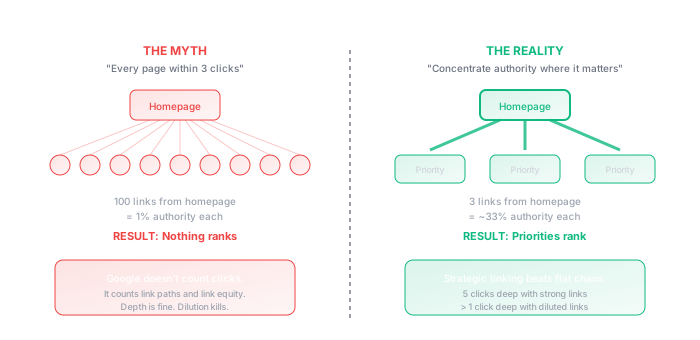
What Architecture Actually Does
Here's the truth nobody wants to hear, the unsexy reality that doesn't fit neatly into a conference talk or a listicle: site architecture is fundamentally a PageRank distribution problem, a question of where you want your limited authority to flow and in what concentrations.
Every internal link passes authority, which means your homepage, which typically receives the most external links and therefore has the most authority to pass, becomes a kind of weapon, and every link you place on that homepage divides its firepower among all the linked pages - link to 10 pages and each gets roughly 10% of the authority, but link to 200 pages and each gets roughly 0.5%, which is almost nothing, a rounding error that will never move the needle on competitive keywords.
The math is brutal and simple and doesn't care about your feelings or your UX preferences: when you "flatten" your architecture to get everything within three clicks, you dilute authority across so many links that no individual page gets enough to rank for anything that matters.
The site with products buried six clicks deep understood something the flat-architecture site didn't: depth concentrates authority. Their homepage linked to 8 main categories. Each category got ~12% of homepage authority. Each category page linked to subcategories. Authority flowed predictably through well-defined channels.
Their priority products eventually received concentrated authority from the pages above them. The "buried" products ranked because the architecture concentrated power rather than spraying it everywhere.
Diagram: Authority Flow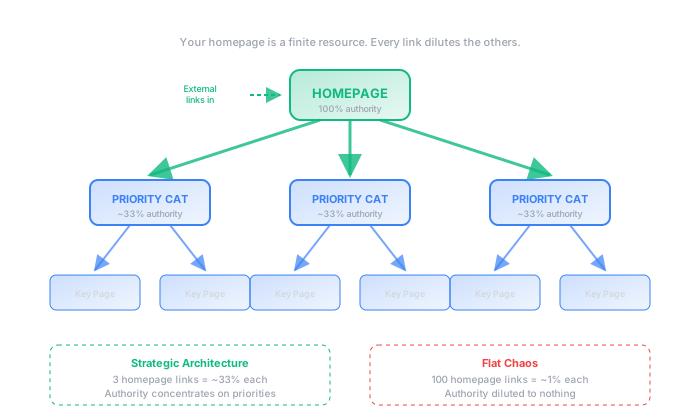
Your Homepage is a Finite Weapon
I watch companies agonize over getting one external link from a DR 70 site, spending weeks on outreach and negotiation and relationship-building, then casually add 50 links to their homepage footer without a second thought, never realizing they just diluted the very authority they worked so hard to earn.
Your homepage is your most powerful page, the one that receives the majority of external links for most sites, the one with the most authority to distribute, and every link you place there is a strategic decision whether you treat it that way or not - what should you link from your homepage? Your 5-10 most important priorities, your main category pages, your flagship products or services, your most critical conversion pages, and that's it.
What shouldn't be there? Everything else, the "latest blog posts" widget that seems helpful but sprays links everywhere, the rotating product carousel that links to 50 different items, the mega-footer with 60 links to every possible page, all of which dilute authority away from your actual priorities while giving you the illusion of thoroughness.
"But users need to navigate!" you might protest, and you're not wrong that users need to find things, but users have your search bar, users have your main navigation, users can absolutely find what they're looking for without your homepage linking to every page on the site, and Google doesn't need your homepage to link to everything either - Google needs your homepage to tell it what matters most.
The Topic Cluster Trap
The pillar-cluster model became SEO gospel around 2017: create a "pillar" page, link it to "cluster" pages, link cluster pages back to the pillar, arrange everything in neat little thematic bubbles, and watch the rankings roll in - sounds neat, sounds logical, sounds like exactly the kind of tidy framework that appeals to marketing teams who want clear rules to follow.
When implemented rigidly, though, it creates authority islands, isolated pockets of content that can't benefit from each other because someone decided that clusters shouldn't cross-pollinate - I've audited sites where the marketing team built beautiful topic clusters with zero cross-linking between them, where the "SaaS metrics" pillar and its clusters had no connection whatsoever to the "SaaS pricing" pillar and its clusters, two islands floating in the same ocean, authority unable to flow between them.
This isn't how knowledge works, and it isn't how good content works either: topics connect, ideas relate to each other, and when cluster A mentions something relevant to cluster B, it should link there, because the purpose of internal linking is editorial, a way of saying "if you're interested in this, you might also find that useful," and artificial silos prevent exactly this kind of natural, helpful connection.
The better model isn't rigid silos but priority-based hierarchy with natural cross-linking: have clear categories, concentrate authority on priority pages within those categories, but when content in one section is genuinely relevant to content in another section, link them anyway, because Google doesn't reward artificial isolation and neither do users.
The silo mistake
Rigid silos trap authority in isolated islands. When you prevent natural cross-linking between related content, you fragment your site's overall power instead of concentrating it.
URL Structure is Mostly Cosmetic
People spend weeks debating URL structure, holding meetings about whether it should be /category/subcategory/page or /page, wondering whether the hierarchy visible in the URL somehow affects rankings in ways that matter - not really, no, it almost certainly doesn't.
URL structure is for humans and for your own organizational sanity, a way to keep track of what's where and give users some sense of where they are in your site, but Google figures out your actual hierarchy from your internal linking patterns, not from slashes in URLs, which is why I've seen flat URL structures rank beautifully while "perfect" hierarchical URLs fail miserably, and vice versa - the URL matters for usability and sharability, for looking professional when someone copies it into an email, but it matters almost nothing for rankings.
What actually matters is the linking pattern: if your flat URLs are supported by a clear internal linking hierarchy that concentrates authority where it belongs, you'll rank, but if your perfect hierarchical URLs sit in a flat linking structure where everything links to everything with equal weight, you won't - stop debating URLs and start auditing link flows.
The Decision Framework
Architecture decisions reduce to one question: where do you want authority to flow?
Diagram: Decision Framework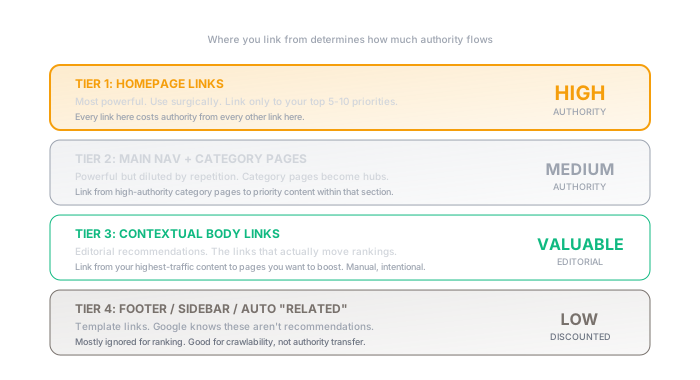
Homepage links are your most powerful. Reserve them for your 5-10 priorities. These pages will receive concentrated authority.
Main navigation appears on every page, so it's diluted, but still valuable. Use it for your main categories or sections. These pages become authority hubs for their areas.
Contextual body links are editorial recommendations. Link from your highest-traffic content to pages you want to boost. This is where the real internal linking strategy lives.
Footer and sidebar links are mostly ignored by Google. Use them for legal pages, utilities, and navigation backup. Don't expect them to pass meaningful authority.
The Practical Audit
Open Screaming Frog or your crawler of choice, pull the internal link data, and answer these questions honestly, even if the answers make you uncomfortable:
What does your homepage link to? List every single page it links to, and ask yourself honestly: is this your top 5-10 priorities, the pages that actually matter for your business, or did someone spray links everywhere because it seemed helpful at the time?
What are your most-linked pages? Usually it's your homepage first, then your main nav pages, which is fine, but are your priority content pages in the top 20? If your blog archive page has more internal links than your money pages, your architecture is actively working against you, funneling authority to pages that don't convert while starving the ones that do.
Where do your priority pages sit? Pull link counts for your most important pages and look at where those links come from: are they receiving internal links from high-authority pages that actually pass meaningful authority, or are they orphaned, linked only from low-value sidebars and footers that Google probably ignores?
Can you trace authority flow? Pick an external link pointing to your site, any one will do, and follow the internal links from that page: where does the authority flow? Does it eventually reach your priorities, or does it dissipate into blog archives and utility pages and dead ends that do nothing for your business?
The quick test
Count internal links to your top revenue page. If it's not in your top 20 most-linked pages, your architecture is actively hurting your business.
The Fix is Usually Simple
For most sites, the architectural fix is boring, unsexy, and straightforward, which is probably why so few people do it:
1. Clean up your homepage by removing the low-value links that have accumulated over time, the widgets and footers and carousels that seemed like good ideas but are really just diluting your authority, and keep only the links to your actual priorities.
2. Add contextual links from your highest-traffic content to your priority pages, and I mean real contextual links, manual editorial in-body links that make sense in context, not automated "related posts" widgets that spray links everywhere without discrimination.
3. Make sure your main categories link prominently to their priority content rather than equally to everything, because equal linking is the same as saying nothing is more important than anything else.
4. Stop adding more, because every new footer link, every new sidebar widget, every new "latest posts" module dilutes your architecture a little bit more, and before adding anything new, ask yourself honestly: is this more important than what's already linked?
The sites that rank well aren't the ones with the cleverest architecture or the most sophisticated linking schemes - they're the ones that made clear decisions about what matters and built their linking patterns to concentrate authority on those decisions, which is simple to understand and hard to execute because it requires saying no to things that seem helpful.
Architecture is declaration, a statement of priorities made in links rather than words: every link says "this matters," and if you link to everything with equal weight, you've declared that nothing matters more than anything else, and Google hears you loud and clear, treating your pages accordingly.