I have been doing search engine optimization for about twenty years now, and I have to tell you, the longer I do it, the more I find myself looking at farmland listings on Zillow. Not in a casual, "wouldn't it be nice" kind of way. In an urgent, "I could grow turnips" kind of way. I find myself zooming in on the soil. Looking for south-facing slopes. Reading about crop rotation with the intensity of a man who has discovered religion.
I don't even like turnips, having had one exactly once, in 2003, at a restaurant that no longer exists, and I remember thinking at the time that this tastes like a potato that went to therapy and came back worse, but lately I can't stop thinking about them, about their simple and honest lifecycle, the way you plant a turnip seed and water it and wait and then a turnip grows, because nobody at Turnip Headquarters is going to push an update at 3 AM on a Thursday that makes your turnips disappear from the ground while simultaneously releasing a statement about how this change is designed to "surface more helpful turnips for users," which is, I should clarify, not how the SEO industry works at all.
The Economics of Air
My grandmother, may she rest in peace, had a word for businesses built on nothing, which she called luftgeschäft, meaning air business, and she used this word to describe my uncle Morrie, who had a series of ventures in the 1970s that involved, as far as anyone could tell, buying things and then selling them to people who didn't want them, and Morrie drove a nice car and wore nice suits and was always on the phone making deals, though nobody could ever explain what Morrie actually did, and when Morrie died he left behind a storage unit full of eight thousand promotional yo-yos printed with the name of a restaurant that had closed in 1978, which was his estate, the physical residue of a life spent in the luftgeschäft.
The SEO industry is the largest luftgeschäft in human history, and Morrie would have been amazed, Morrie would have wept.
Now, I want to be careful here, because I am in this industry and I have rent to pay and I would like to continue paying it with money earned from this industry rather than with turnips, which most landlords do not accept, so let me be precise: SEO is real, the underlying mechanics are real, you can do things to websites that make them rank higher in search results and this can generate enormous value, and I have done these things, I have generated this value, the work is real.
What I am suggesting is that approximately 97% of what the SEO industry talks about and writes about and conferences about and podcasts about and tweets about and argues about has absolutely nothing to do with making websites rank higher, and is instead a kind of elaborate group hallucination, a shared dream that thousands of people are having simultaneously in which things are constantly happening even though nothing is happening, in which knowledge is being created even though nothing is being learned, in which careers are being built on foundations of pure, crystallized nothing.
My grandmother would have understood immediately, would have looked at SEO Twitter and said "Ah, luftgeschäft" and then gone back to making soup, because my grandmother had no time for nonsense and also she made excellent soup.

The Update Industrial Complex
Google releases algorithm updates, this is true, they release quite a lot of them actually, thousands per year if you count the small ones, and they name the big ones like hurricanes: Panda, Penguin, Hummingbird, BERT, the Helpful Content Update, and I keep waiting for them to name one after a skin disease, the Shingles Update, the Rosacea Refresh, because it feels inevitable.
Each named update triggers a precise sequence of events in the SEO industry, as predictable as the stages of grief and considerably less useful:
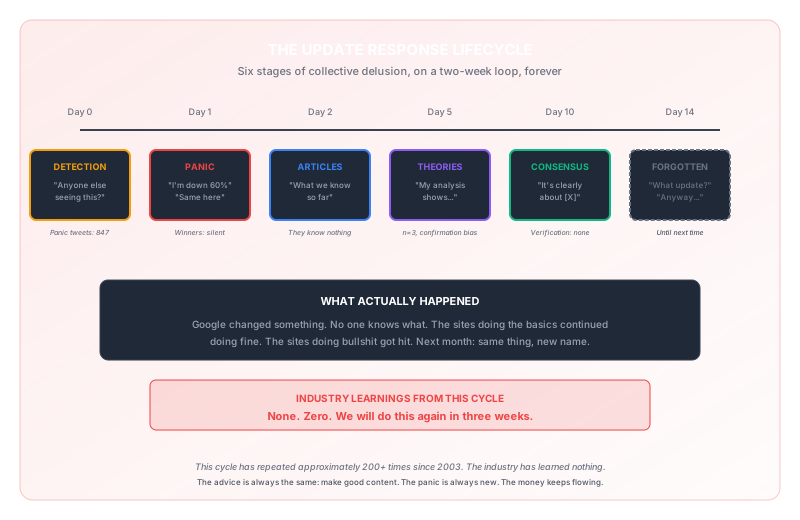
Stage One: Detection. Someone notices that their rankings changed and posts on Twitter asking "Anyone else seeing movement?" which is the SEO equivalent of "Did you feel that earthquake?" except the earthquake might be imaginary, or might be real but caused by something completely unrelated to what everyone is about to spend two weeks discussing.
Stage Two: Confirmation. Other people check their rankings, and some have gone up and some have gone down and some are the same, and everyone who went down responds to the original tweet while everyone who went up stays quiet because this is not the time for celebration, this is a time of mourning, and also because if you say your traffic went up someone will accuse you of being "part of the problem," a phrase that here means "successful in a way that makes me uncomfortable."
Stage Three: The Articles. Within twenty-four hours, the SEO news sites have published their pieces with titles like "What the [Update Name] Means for Your Business" and "27 Things We Know About the [Update Name] So Far" and "Is Your Website Ready for the [Update Name]?" and these articles have already been written, you understand, existing in template form and waiting for someone to fill in the name and hit publish, the content the same every time: "Google has released an update, some sites went up, some sites went down, focus on quality content, build natural links, prioritize user experience," which is the SEO news equivalent of a horoscope, technically not wrong because it is not specific enough to be wrong, because you cannot be wrong if you do not say anything.
Stage Four: The Theories. Now the thought leaders weigh in, having analyzed the data (they have not analyzed the data, there is no data, Google doesn't release data), having identified patterns (they have identified coincidences and declared them patterns), having developed frameworks for understanding what happened (they have made things up and put them in a bulleted list), and the theories are shared widely and discussed on podcasts and presented at webinars, becoming through repetition a kind of provisional truth, not because anyone has verified them but because enough people have repeated them that it feels weird to disagree.
Stage Five: The Consensus. A dominant narrative emerges: "The Penguin Update targeted link spam," "The Panda Update rewarded quality content," "The Helpful Content Update penalized AI-generated text," and these narratives may or may not be accurate, no one can verify them because Google doesn't confirm or deny anything specific, but they feel true, and in an industry built on luftgeschäft, feeling true is as good as being true, often better actually.
Stage Six: The Return to Baseline. Two weeks later everyone has forgotten, the rankings have stabilized mostly, the panic has subsided, the articles have been archived, the podcasts have moved on, nothing has changed, the sites that were doing well are still doing well, the sites that were struggling are still struggling, and the fundamental dynamics of the industry remain exactly what they were before the update because the fundamental dynamics haven't changed in twenty years, because there's nothing to change, because it's still just make a good website, get links to it, don't be annoying, that's it, that's the whole thing.
But you can't publish three blog posts a day about "make a good website, get links to it, don't be annoying." So instead we have the Update Industrial Complex, churning out content about events that may or may not have happened, analyzing data that doesn't exist, producing takes that are indistinguishable from last year's takes because nothing is different, because nothing is ever different, because this is the luftgeschäft and we are all just rearranging air.
The High School Cafeteria
There's a myth in SEO that anyone can succeed, that the industry is meritocratic, that good work speaks for itself, that you don't need credentials or connections but just results, and this is, technically, true in the same way that it's technically true that anyone can become a movie star, you just need talent and luck and the right face and to be in the right place at the right time and to know the right people and to not give up during the fifteen years when nothing is happening, simple, except the reality is that SEO is a high school cafeteria with better vocabulary.
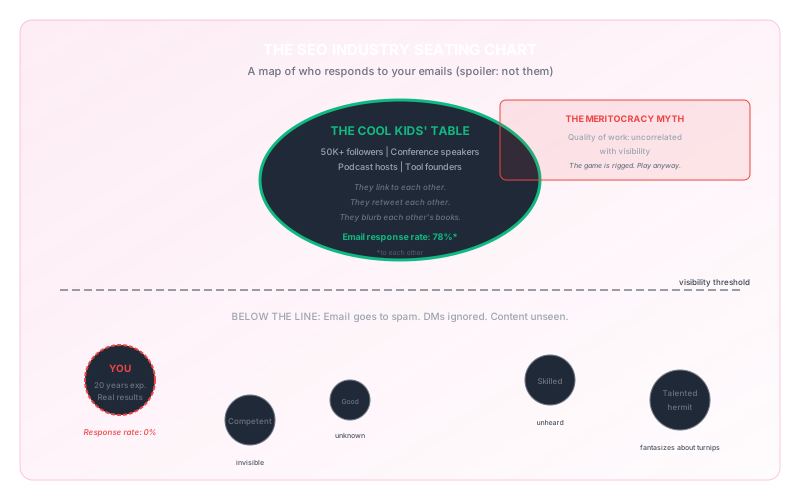
There is a cool kids' table, and the people at the cool kids' table have large Twitter followings and newsletter subscribers and podcast appearances and conference keynotes, and they know each other and have known each other for years, linking to each other's content, retweeting each other's posts, blurbing each other's books, appearing on each other's podcasts, forming a closed loop of mutual amplification that presents itself as open discourse.
If you're at the cool kids' table, the industry looks warm and welcoming and collaborative, where people respond to your emails and share your content and want to connect with you because being connected to you makes them more visible and visibility is the currency of this particular cafeteria, but if you're not at the cool kids' table, and most people are not, the industry looks rather different.
I have been doing SEO for twenty years, twenty years, and I have produced results that, if I wrote them up as case studies, would make excellent case studies, having helped companies double their organic traffic, triple their organic traffic, in one case increase their organic traffic by a factor of eight over eighteen months, which is to say I am not bad at this and am, by most reasonable measures, pretty good at it.
And yet, when I email the people at the cool kids' table, to collaborate, to share insights, to simply introduce myself, I am met with a silence so complete it approaches the philosophical, not rejection, because rejection would be something, rejection would be a response, but instead the absence of response, the particular silence of people who receive so many emails that they've developed filters, and I am not passing the filters because I am not already known, because I am not already at the table, because I am just some guy out here in the wilderness with my turnip fantasies and my twenty years of experience and my unread emails.
I used to take this personally, used to think there was something wrong with me, that maybe I was approaching it wrong, that maybe my emails were bad, that maybe I needed to be warmer or cooler or more professional or more casual or something.
Then I realized that there's nothing wrong with me, that the system is working exactly as designed, that the people at the cool kids' table have no incentive to respond because responding to me doesn't increase their traffic and linking to my content doesn't boost their authority and acknowledging my existence doesn't get them speaking invitations, so they don't, because they are rational actors in an irrational system, optimizing for their own visibility in an attention economy, and I am not a useful input in that optimization.
This is not a complaint, well, okay, it's a little bit of a complaint, but it's mostly an observation about incentives, because the SEO industry talks constantly about "community" and "giving back" and "helping each other rise," and some people do these things, genuinely, but the incentive structures push in the opposite direction, rewarding insularity, mutual promotion, the consolidation of attention among people who already have attention, which is how the incentive structures produce a high school cafeteria.
My grandmother would have understood this too, having survived some things that I won't go into here, and one of the lessons she drew from those experiences was to pay attention to incentives, because people will tell you all kinds of things about what they believe and what they value, but you should look at what they do, look at what the system rewards, because that tells you what's actually happening, and the SEO industry rewards people who are already visible, not people who are good at SEO, which are different things that sometimes overlap but often don't.
The Google Problem
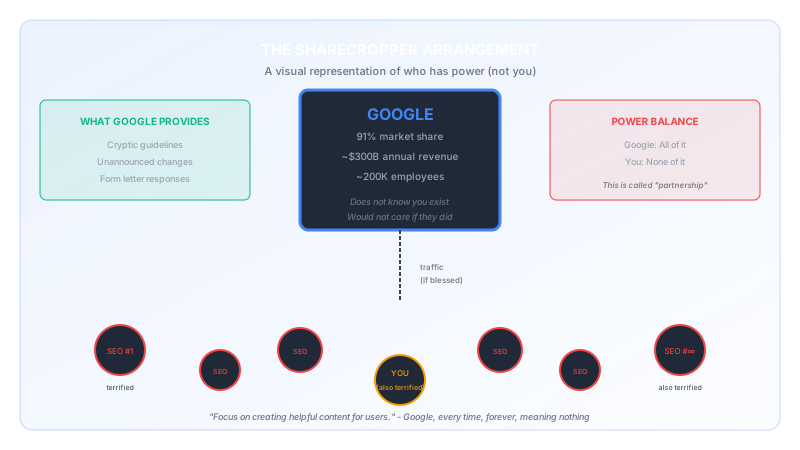
Here is a fact that the SEO industry does not like to discuss at parties: we are all sharecroppers on Google's land.
Google controls 91% of search, ninety-one percent, which in most industries would be called a monopoly but in this industry is called "the ecosystem," and we don't call it a monopoly because calling it a monopoly would require us to confront what it means that our entire livelihoods depend on a single company that does not know we exist, does not care that we exist, and could eliminate our careers with a single algorithmic decision that they would not bother to explain or even announce.
I have thought about this a lot, too much probably, and here's the analogy I keep coming back to:
Imagine you're a medieval peasant who doesn't own land but works land that belongs to a lord, and the lord provides the land while you provide the labor, and in a good year you grow enough to feed your family and pay your tithe but in a bad year you don't, and the lord doesn't really know who you are because the lord has thousands of peasants and you are a rounding error in the lord's accounting, but your entire life, your family's survival, your children's future, depends on decisions the lord makes about land allocation and tithe rates and which crops are acceptable and which aren't.
Now imagine the lord is an algorithm, and the algorithm changes without warning, and when you ask why the algorithm changed you get a form letter that says "we don't discuss specific algorithmic decisions, but we encourage you to focus on creating helpful content for users," and you don't know what "helpful content" means because the algorithm won't tell you, and every time you think you've figured it out the algorithm changes again and you're back to square one, staring at a field that used to grow crops and now grows nothing, and the lord is not available for comment.
This is SEO, this is the job, we are digital peasants working land we don't own, subject to a landlord that won't speak to us except through cryptic pronouncements and occasional visits from company representatives who assure us that everything is fine, the system is working as intended, just keep creating helpful content, whatever that means.
And the wild thing is that we defend this arrangement, call it an "ecosystem," talk about "best practices" and "alignment with Google's guidelines" as if these are neutral technical terms and not the language of submission, having internalized the landlord's perspective so thoroughly that we evaluate ourselves by the landlord's standards, asking "Is this content helpful?" where "helpful" means "the kind of thing Google wants to rank," not "actually useful to human beings," which is a different thing, though the SEO industry has worked very hard to convince everyone they're the same.
My grandmother had a lot to say about this kind of situation, but most of it isn't suitable for print.
The Hypocrisy Section, in Which I Acknowledge That I Am Part of the Problem
I am aware, as I write this, that I am participating in the very system I am criticizing, that this essay is content which will be published on my website and optimized for search and shared on whatever social media platforms I can tolerate, which is none of them currently, which is part of my problem, but that's a different essay.
I am a hypocrite, standing inside the luftgeschäft and pointing at the air and saying "look at all this air," as if I am not also breathing the air, as if I am not also selling the air, as if my rent is not paid with air-money.
Here is my defense, which is not a good defense but it's the only one I have, which is simply that I don't know what else to do, because I am good at SEO, not good at many things but good at this, and after all this time I'd better be, and being good at SEO means, paradoxically, understanding that most of the SEO industry is nonsense but also participating in the nonsense because the nonsense is where the clients are, and without clients there is no rent, and without rent there is homelessness, and homelessness seems bad.
So I write articles and publish them on my website and try to get people to read them, which is what I am doing right now, which is what you are reading right now, and we are both participating in the system, congratulations, we're complicit together.
The alternative is... what, cold emailing, which I have tried and which is a special kind of hell where you spend hours crafting personalized messages and then send them into a void from which no response ever emerges, and I have sent cold emails that I thought were pretty good, warm but not too warm, professional but not stiff, specific about why I was reaching out, respectful of the recipient's time, and these emails vanished into the ether like prayers to a god who has better things to do.
Social media, then? But I don't have social media, being temperamentally unsuited for it, finding the performance of it exhausting with its constant posting and engagement farming and parasocial relationships that aren't really relationships and platforms designed to make you feel bad so you keep using them, and also I'm pretty sure LinkedIn shadowbanned me for reasons I've never been able to determine, though I have my suspicions, which mostly involve having opinions.
Networking? But I am a hermit, having become a hermit gradually and then all at once, and I used to go to conferences and stand in hallways trying to talk to people, but I was not good at it because I am not a hallway person, I am a "sitting alone in a room thinking about things" person, and the "sitting alone in a room thinking about things" economy is unfortunately quite small.
So here I am, writing essays about how the SEO industry is nonsense, publishing them on my SEO-optimized website, hoping that someone reads them and decides I'm worth hiring, which is my marketing strategy, and it is not a good marketing strategy, but it is the only one I can execute without wanting to die, and that counts for something.
The Farm in Vermont
There is a specific farm I look at, eighty-seven acres in Vermont about twenty minutes from a town that has a grocery store, and the listing says "needs work," which is realtor-speak for "the previous owner gave up on several things simultaneously," and there's a farmhouse from 1847 that has been "partially updated," meaning someone started renovations in 1987 and then stopped, and there's a barn that is "structurally sound," which I choose to interpret optimistically even though I know better, and there are fields that have not been farmed in at least a decade, which means they're basically wild at this point, which means I would be starting from scratch.
The listing has been up for three years, and no one wants this farm, which is concerning for reasons I try not to think about, possibly the soil is bad, possibly there's a contamination issue, possibly the ghosts of 1847 are still there farming spectral crops and don't want company, I don't know, I've never visited, I just look at the photos and imagine a different life.
In this life, I wake up early, not because I have to check Search Console for ranking drops but because there are animals that need feeding, and I don't know what kind of animals yet, probably chickens, because chickens seem manageable and I've read that chickens are basically dinosaurs that we've bred into stupidity, which I find comforting, because I could handle stupid dinosaurs.
I go outside with soil under my fingernails and muscles that hurt from actual physical labor rather than from sitting in a chair for twelve hours, and I plant things and they grow, not because an algorithm decided they should grow but because that's what plants do when you put them in dirt and give them water and sunlight, and the relationship between input and output is clear, legible, honest.
Nobody emails me asking if I've seen the latest turnip update, nobody slides into my DMs asking if I want to collaborate on a carrot strategy, nobody posts think pieces about how the rutabaga landscape is shifting and you need to adapt or die, because the vegetables don't have a thought leadership ecosystem, the vegetables just grow.
I know this is a fantasy, know farming is hard, know farmers deal with uncertainty too in the form of weather and pests and markets and climate change slowly making everything worse, and I know that if I actually bought this farm I would probably fail because I have no experience and no skills and no tolerance for discomfort and also I am forty-three years old, which is not the ideal age to reinvent yourself as a subsistence farmer.
But the fantasy persists, gets stronger every time I read an article about the latest Google update, pulses in my chest every time I send an email that gets no response, and the fantasy is a small door in my mind, and behind it is Vermont and chickens and a life where the word "algorithm" never comes up in conversation.
I probably won't go through the door, probably don't have the courage, but I need it to be there, need to know that there's an exit even if I never use it, because the farm is my emergency exit from the luftgeschäft, my proof that other ways of being exist, and the turnips are waiting, if I ever want them.
What I Actually Know
After two decades, here is what I actually know, not what I've read, not what I've heard, not what the thought leaders say at conferences, but what I have verified through direct experience, repeatedly, across hundreds of projects:
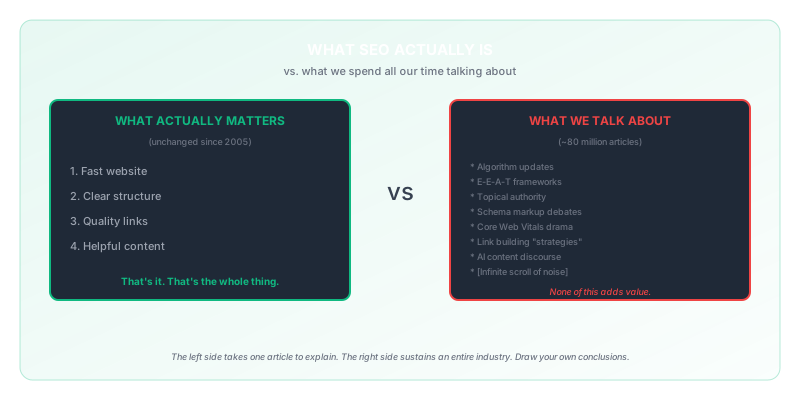
Speed matters more than almost anything, so make your website fast, not "pretty fast" but fast, because if your page takes more than two seconds to load you've already lost, and I don't care what your developer says about "acceptable load times" or what your designer says about "necessary assets," because everything else is built on the foundation of fast.
Clarity matters, meaning what is this website about, and if a person can't answer that question within three seconds of landing on any page you have failed, and if a search engine can't answer that question by looking at your HTML you have failed, so say what you are, say it clearly, say it in the places where saying it makes sense, which is not complicated, though we have made it complicated because complicated justifies consulting fees.
Links matter, meaning other websites linking to your website matters, which has mattered since 1998 and still matters now, and getting these links is difficult and there is no trick, you just create things worth linking to and tell people about them and sometimes they link to you and most of the time they don't and you do it anyway, and anyone who tells you there's a shortcut is either lying or about to get you penalized.
Content matters, but not the way people think, because "content" is not "words on a page" but "the answer to a question someone is asking," and if no one is asking the question your content answers then your content is noise, and if someone is asking the question but your content doesn't actually answer it then your content is noise, so write things that answer questions people have, which is obvious but also apparently very difficult because most content on the internet is noise.
Everything else is noise, all of it, the schema markup discourse and the "E-E-A-T" frameworks and the "topical authority" theories and the technical SEO rabbit holes that developers love because they're more comfortable with technical problems than content problems, and some of this stuff helps at the margins but most of it doesn't matter, because if your website is fast and clear and has good links and answers real questions you will rank, and if it doesn't you won't, and the rest is decoration.
I could have told you this twenty years ago, and someone probably did tell you this twenty years ago, and the industry has generated approximately eighty million pieces of content since then, none of which have added anything to the four paragraphs above, which is the thing that makes me want to farm.
The Actual End
I will probably not buy the farm in Vermont, because the farmhouse probably has mold and the barn probably will collapse in the next heavy snow and the ghosts of 1847 probably have strong opinions about my agricultural methods and will make their displeasure known in subtle, unsettling ways.
I will probably continue doing SEO, will probably continue writing articles like this one which exist in the uncomfortable space between criticism and participation, which are themselves a kind of content marketing, which makes me a hypocrite, which I have already acknowledged, which does not make it less true.
I will probably continue sending emails that go unanswered, will probably continue watching the cool kids' table from across the cafeteria and wondering what they're laughing about, suspecting it's nothing, knowing that even if I got a seat there I would probably not enjoy myself because I don't enjoy most things, because I am the kind of person who fantasizes about turnips as an escape from professional dissatisfaction.
But maybe you read this, maybe you're nodding along because you also think the industry is mostly luftgeschäft, maybe you're also tired of the updates and the takes and the thought leadership and the feeling that you're running on a treadmill that someone else controls, maybe you also look at farmland listings when you should be looking at Search Console.
If so, I see you, I'm here too, and we're in this together, you and I, standing in the fields of air, pretending to harvest crops that don't exist, waiting for weather that never comes.
The turnips would be easier, the turnips would make sense, but we're here instead, so we might as well do what we can: make the website fast, make it clear, get some links, answer real questions, ignore everything else, and keep an eye on Zillow, just in case.
The farm will be there when you need it, and the turnips can wait.