
The first hard drive I ever killed was a Seagate Barracuda, 40GB, in 2003. I dropped it four inches onto a carpeted floor while it was spinning.
Four inches is the height of a coffee cup, and also the distance between having a job and explaining to your boss why the company's only customer database backup is making the click of death.
If you've never heard a dying hard drive, it sounds like a tiny clock insisting on a time that doesn't exist anymore. Tick. Tick. Tick. The read head hunting for data that's been scraped off the platter like frost off a windshield. The drive was still warm in my hands. It had been alive thirty seconds ago. Now it was an expensive paperweight that cost me my job.
I stood there holding it and thought: this is what everything is.
Every website. Every ranking. Every search result you've ever seen. It's all just this: spinning metal and electrical impulses and physical objects that can be destroyed by a four-inch drop onto carpet.
I've spent twenty years in SEO, and the most useful thing I've learned has nothing to do with keywords or backlinks. It's that the entire internet is a physical object, and it's more fragile than anyone wants to admit.
There Is No Such Thing as Software
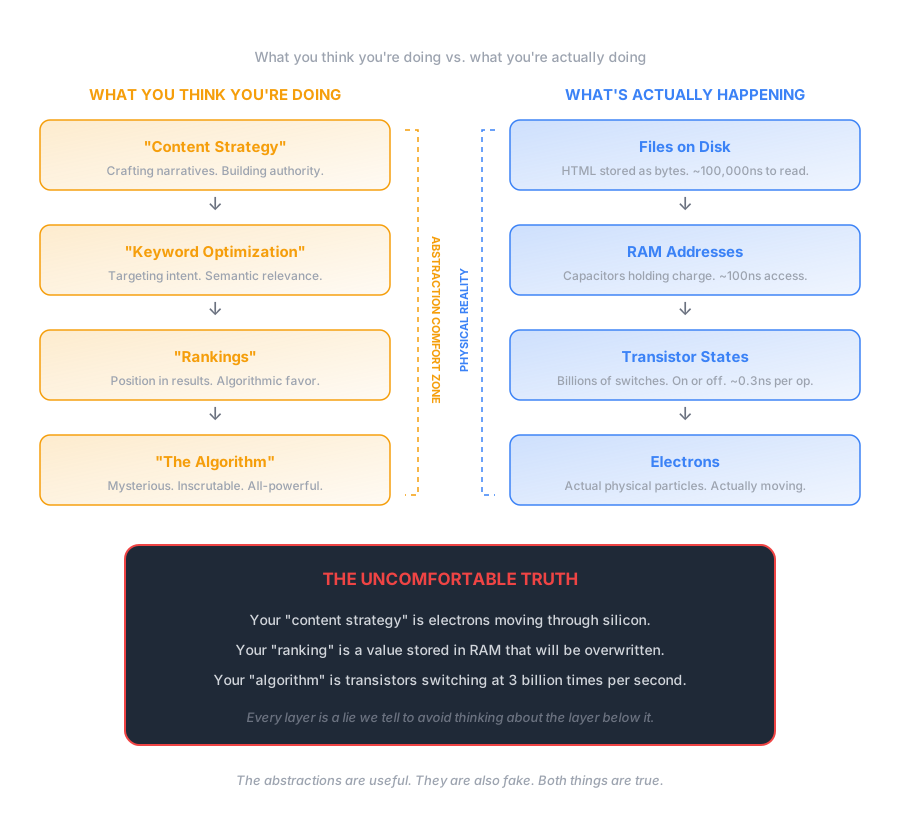
Here's something programmers know that SEO people don't think about: software doesn't really exist. When you "upload" a website, you're not putting anything anywhere. You're causing specific capacitors in specific RAM chips in a specific server in a specific building to hold specific electrical charges. When someone "visits" your website, photons travel through glass fibers, electrons move through copper, transistors flip between states, and eventually a screen emits light that hits a human retina.
There's no "digital realm." There's just physics wearing a clever disguise.
The interesting part is that all the constraints of SEO come from this physical layer. But we never talk about it because we've built an entire industry on top of an abstraction and we've collectively forgotten that the abstraction is a metaphor.
Light is Slow
The speed of light is 299,792,458 meters per second. In a vacuum, it could circle the Earth seven times in one second. Seems fast enough, right?
Here's the thing: light doesn't travel in a vacuum on the internet. It travels through glass fibers at about two-thirds that speed. The fibers don't go in straight lines; they follow roads, railway tracks, ocean floors, taking detours around mountains and through switching stations. Every junction adds latency. Every router adds latency.
New York to London, theoretical minimum: 56 milliseconds one way. Round trip: 112ms. In practice, with all the routing overhead: about 150ms on a good day.
150 milliseconds. That's how long a human blink takes. The fastest possible round-trip communication between two points 5,500 kilometers apart is one blink. And that's just the network. That's before any server does any work.
Now think about what Google has to do in that time.
8.5 billion searches per day. 98,000 per second. For each one, Google has to: parse your query, search an index of hundreds of billions of pages, score them against hundreds of signals, assemble the results page, and send it back. Total budget: 200-400 milliseconds. Half of that is already eaten by the speed of light.
Every Google engineer who works on search is fighting against physics itself. The algorithm isn't slow because they're bad at their jobs. The algorithm is slow because light is slow, and that's a problem you can't optimize your way out of.
Why Computers Are Both Fast and Slow
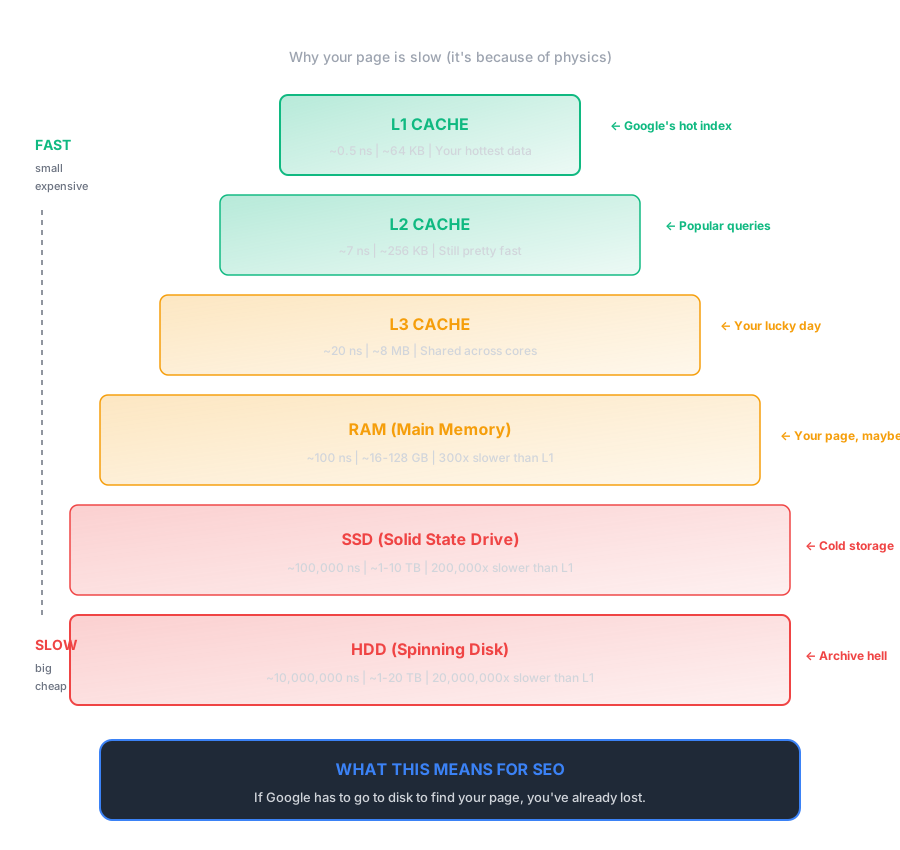
A CPU can add two numbers in 0.3 nanoseconds, which sounds fast until you realize that fetching data from RAM takes 100 nanoseconds, about 300 times longer than the operation itself. It's like a chef who can cook in one second but waits five minutes for someone to bring the ingredients.
And RAM is the fast storage. An SSD takes 100,000 nanoseconds, and a spinning hard drive takes 10,000,000 nanoseconds, which is thirty million times slower than the CPU operation. Light could travel from New York to LA in the time it takes a hard drive to find one piece of data.
The solution is caching: keeping copies of frequently-needed data in progressively faster (and smaller) memory. Your CPU has L1 cache (0.5ns), L2 (7ns), L3 (20ns), then RAM (100ns), then disk. The whole game is staying out of disk, staying out of RAM if you can help it, keeping everything in cache where it's actually fast. This is how Google works, and it's how you should think about SEO.
What Google Actually Is
Google has somewhere between 2-3 million servers across 35 data centers on six continents. Each data center consumes enough electricity to power a small city. One in Finland uses seawater for cooling. One in Taiwan uses an ocean current. "The cloud" is enormous buildings full of humming machines, radiating heat, staffed by thousands of technicians replacing failed components around the clock.
When you search Google, here's what happens physically:
Your query travels through WiFi, copper, fiber, cell towers, switching stations until it reaches an edge server relatively close to you (speed of light, remember). The edge server checks its cache, and if you're searching for something popular, the result is probably sitting in RAM already, ready to send back in milliseconds.
But if your query is unusual? The edge server talks to an index server, which contains a fragment of the inverted index mapping every word to every page containing that word. The index server retrieves millions of potentially relevant pages and sends them to a ranking server.
The ranking server is where "the algorithm" lives, scoring pages against hundreds of signals: PageRank, relevance, freshness, authority, engagement. But it can't actually examine every page fully because the 200ms budget is ticking, so it uses pre-computed signals, cached values, approximations. What you get back isn't a definitive assessment of page quality so much as a fast guess, a compromise between accuracy and physics.
This is the thing I want you to understand: Google's algorithm is hardware-bound. It has to produce answers within a physical time budget using physical components that fail constantly. The algorithm is shaped by the hardware. In a very real sense, the hardware is the algorithm.
Crawl Budget is CPU Budget
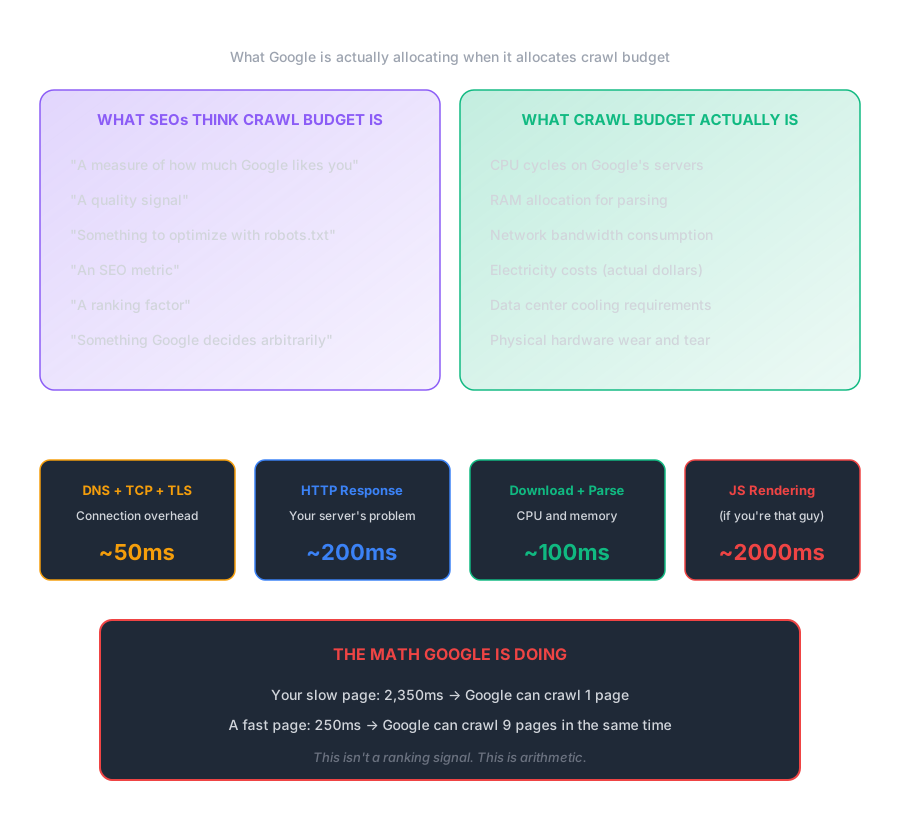
SEOs talk about "crawl budget" like it's some mysterious quality signal, but really it's just CPU cycles.
Google has to crawl hundreds of billions of pages while also serving 98,000 searches per second, training AI models, running YouTube, Gmail, Cloud. All on the same hardware. Every page Googlebot crawls costs actual CPU cycles on actual servers that consume actual electricity that costs actual money.
When Google allocates crawl budget to your site, it's not making an editorial judgment. It's solving a resource allocation problem: how to distribute finite compute across infinite demand.
Think about what crawling one page costs:
- DNS lookup (network latency, CPU)
- TCP connection (round trips, CPU for handshake)
- TLS negotiation (CPU-intensive crypto)
- HTTP request/response (bandwidth, your server's CPU)
- HTML parsing (CPU to build DOM)
- JavaScript execution if needed (CPU, memory, time)
- Link extraction (CPU, memory for crawl queue)
- Content extraction (CPU, memory)
- Storage (disk I/O, the slowest part)
Every step costs money. When Google decides not to crawl a page, it's not because an algorithm judged it unworthy. It's because the hardware had to go do something else.
This is why slow sites get crawled less, and it's not punishment, just arithmetic: if your page takes 5 seconds instead of 0.5 seconds, it occupies a Googlebot connection 10x longer, which means Google can crawl 10 fast pages in the time it takes to crawl 1 slow one, so it crawls fewer of your slow pages. The math doesn't care about your content strategy.
A Brief Meditation on Heat
Google's data centers consume 18.3 terawatt-hours of electricity per year. That's as much as New Zealand. All of it becomes heat eventually.
I think about this sometimes. Every search query, every crawl, every ranking calculation: electricity flowing through silicon, silicon getting warm, heat radiating out into the world. Somewhere in Oregon or Finland or Iowa, a fan is spinning right now, pushing air across copper heatsinks, carrying away the thermal evidence of someone's search for "best pizza near me."
There's something almost beautiful about it. Your website exists as a pattern of electrical charges that generate heat when they're read. Your ranking is the residue of a billion tiny thermal events. The physical price of being found.
I don't have a point here. I just think about it sometimes, when I'm staring at Search Console at 2am, wondering why traffic dropped. Somewhere, a server is warm because of my website. Somewhere, a cooling system is working slightly harder because I exist on the internet.
It's kind of nice, actually. To know you've made something warm.
So What Do You Do About It?
Okay, you might say. Interesting. But what do I actually do with this information?
Fair. Here's the practical part:
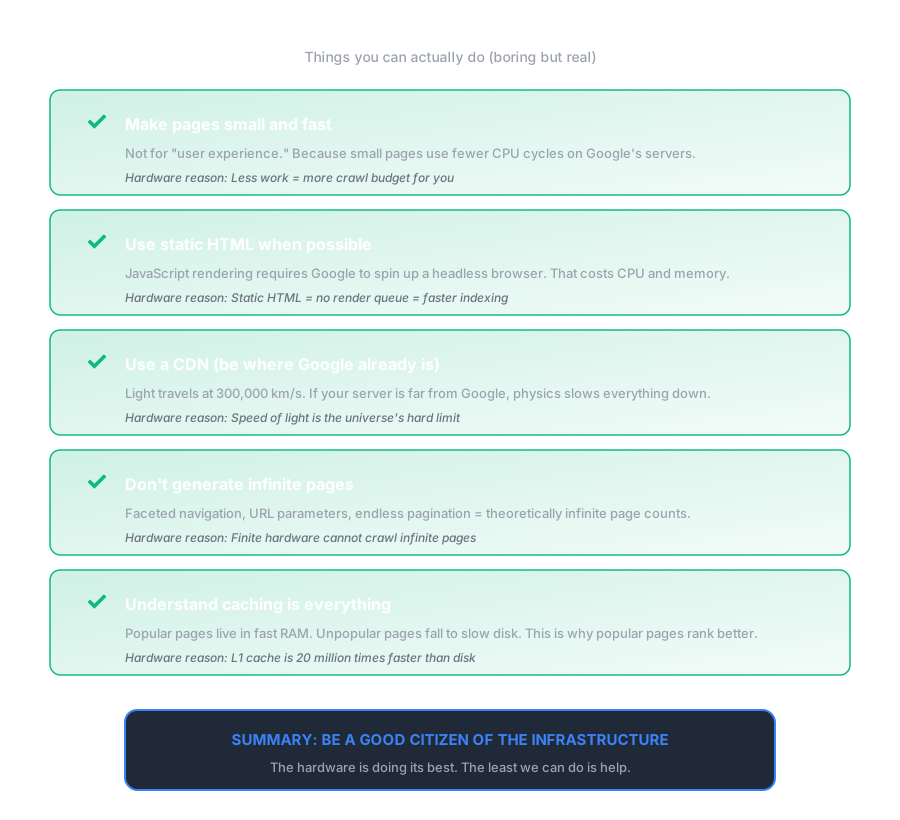
Make your pages small and fast. Not because "page speed is a ranking factor" (though it is). Because small pages use fewer CPU cycles on Google's servers. They get crawled more efficiently, indexed more easily, served from cache more reliably. You're not optimizing for an algorithm. You're being a good citizen of the physical infrastructure.
Use HTML, not JavaScript. Every JS-rendered page requires Google to spin up a headless browser, allocate memory, execute code, wait for network requests. Google can process a million static HTML pages in the time it takes to render a hundred React SPAs. If your content can be HTML, make it HTML.
Use a CDN. If your server is on a different continent from Google's nearest crawler, every request travels thousands of miles at the speed of light. Put your content physically close to Google's infrastructure. Photons are fast but not instant.
Don't generate infinite pages. Faceted navigation, URL parameters, endless pagination: these create theoretically infinite page counts. Google can't allocate finite crawl budget across infinite pages. If you want everything crawled, have a finite (and small) number of pages.
Popular pages win physically, not just socially. Google caches aggressively. Popular pages live in RAM. Unpopular pages fall to disk. Your obscure pages live in cold storage, waiting for a crawl that may never come.
The Servers Will Die
Let me tell you about a hard drive in Council Bluffs, Iowa.
I never saw it. I don't know its model number or serial number or which rack it sat in. I only know it existed because of what happened when it stopped existing.
The drive was part of a RAID array for a small search engine, one of the many that existed before Google won. I was doing SEO for sites that wanted to rank on it. Then, one day, the drive failed.
RAID is supposed to handle this. Data spread across multiple drives; if one fails, the others reconstruct it. But there was a bug in the controller firmware. The failure corrupted not just the dead drive but the parity data on the others. The redundancy didn't work.
The search engine lost 40% of its index, not because of an algorithm update or because content was deemed unhelpful, but because a physical object made of metal and glass and magnetic coating decided to stop working. My clients' sites disappeared from results through no fault of their own, just because the physical substrate that held their rankings had failed.
They recovered eventually, rebuilt from backups and crawler logs over the course of weeks. The search engine died anyway, years later, unable to compete with Google, and became a footnote in the history of search.
But I never forgot. Rankings aren't ideas. They're physical states of physical machines, as real and as fragile as a 40GB Seagate Barracuda dropped four inches onto carpet.
The servers that hold your rankings will die.
Not might die. Will.
They're dying right now, constantly,
being replaced as they fail,
a continuous cycle of death and replacement.
Your rankings exist on servers that will be decommissioned,
recycled, their rare earth metals extracted,
reused in new servers
that will also die.
The average server runs five years.
The data centers have lifespans too.
Renovated. Expanded. Shut down.
The buildings where your rankings live
are temporary structures,
subject to leases and land deals
and the same entropy that claims everything.
This isn't a metaphor for impermanence, it's the literal situation: your rankings are stored on metal that rusts, in buildings that decay, powered by grids that fail. The infrastructure is mortal, and the abstraction layer pretends otherwise even though the hardware knows better.
What Changes When You See the Hardware
When you start seeing the internet as physical infrastructure instead of magic, a few things shift:
You stop panicking about algorithm updates. The algorithm runs on servers that fail, maintained by humans who push bugs to production, and it's as fragile as everything else. When you understand that rankings are physical states of physical machines, the mystery dissolves, because it turns out there's no inscrutable god, just hardware running software and trying its best.
You start thinking about resilience. Hardware engineers know every component will fail, and they design for it, which is what you should do too. Don't build a business that dies if one ranking factor changes, and don't put all your traffic in one keyword basket, because failure is coming and you might as well plan for it.
You develop a weird kind of respect. The internet works. Billions of devices, millions of servers, countless network links, and somehow you get an answer in 200 milliseconds. This is an engineering miracle, maintained by thousands of people you'll never meet, solving cooling problems and redundancy problems and latency problems, every day, forever, just to keep the lights on.
Somewhere right now,
in Council Bluffs or The Dalles or Hamina,
a technician is replacing a failed drive.
They don't know about your rankings.
They don't care.
They're just doing their job,
keeping the electrons flowing,
holding back entropy for one more day.
Everything is temporary, of course: the servers will fail, the data centers will close, the rankings will be overwritten. But not today.
Today the servers are running, and your website exists as a pattern of electrical charges in a building you'll never see, maintained by people you'll never meet. When someone searches for what you've made, photons race through glass at two-thirds the speed of light, transistors flip, heat radiates, and somewhere a fan spins a little faster, and your page appears. If you think about it for too long, it starts to seem genuinely miraculous.
So make your pages fast and keep your HTML clean. Be a good citizen of the infrastructure that makes all of this possible, because the hardware is doing its best and the least we can do is help.