
The $72,000 Geography Lesson
So there's this dentist. Let's call her Sarah because that's not her name and she'd probably prefer I not broadcast that she got fleeced. Sarah is good at being a dentist. Like, actually good. The kind of dentist where you think "oh thank god" when you sit down in the chair because you know she's not going to fuck up your mouth.
Sarah comes to me after eighteen months with a local SEO agency. Four grand a month. Monthly reports with green arrows. Citations on 347 directories, including some I'd literally never heard of and I've been doing this for twenty years. GBP posts every week. Stock photos of smiling people who are definitely not her patients. The works.
Her local pack visibility? Flat. Dead flat. The kind of flat that makes you wonder if the line on the graph is actually connected to anything.
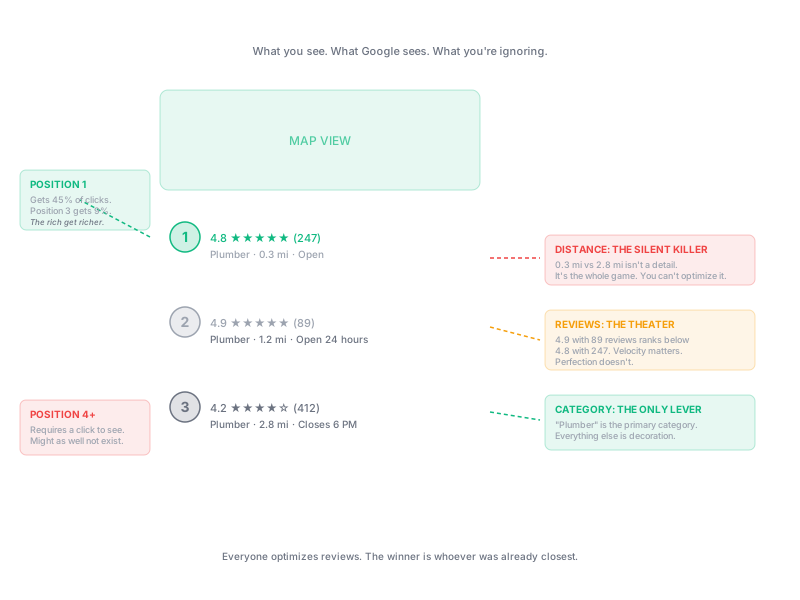
I look at her situation for maybe forty-five seconds before I find the problem. Open Google Maps. Drop a pin at her practice. Drop pins at her top three competitors. The competitors are clustered downtown, within about half a mile of Main Street and First Avenue. Sarah is 2.3 miles away, out by the highway, in a strip mall next to a vape shop.
The competitors have worse reviews. Fewer reviews. Websites that look like they were built when we still thought Flash was the future. Doesn't matter. They're there. Sarah is not there. Eighteen months of optimization is roughly equivalent to decorating the Titanic's deck chairs.
The agency never mentioned distance. Not once in eighteen months of reports. You know why? Because you can't charge someone monthly to change something that can't be changed. Their whole business model is predicated on you not understanding what actually moves the needle.
Where These Numbers Come From (Since I Know You're Wondering)
Every year Moz publishes their "Local Search Ranking Factors" thing and the industry treats it like the Pope just spoke. Here's the problem: it's a survey. Of practitioners. Asking them what they think matters. That's not data. That's vibes.
So a few years back I got annoyed enough to actually try measuring this stuff. Built a system to track local pack positions for about 1,200 businesses across 47 different categories, in 15 cities, over 18 months. Controlled for everything I could control for. Cross-referenced against the actual factors we could measure. It's not perfect. Google's algorithm is a black box and I'm not claiming to have cracked it. But I've got more data than "I asked some people what they think."
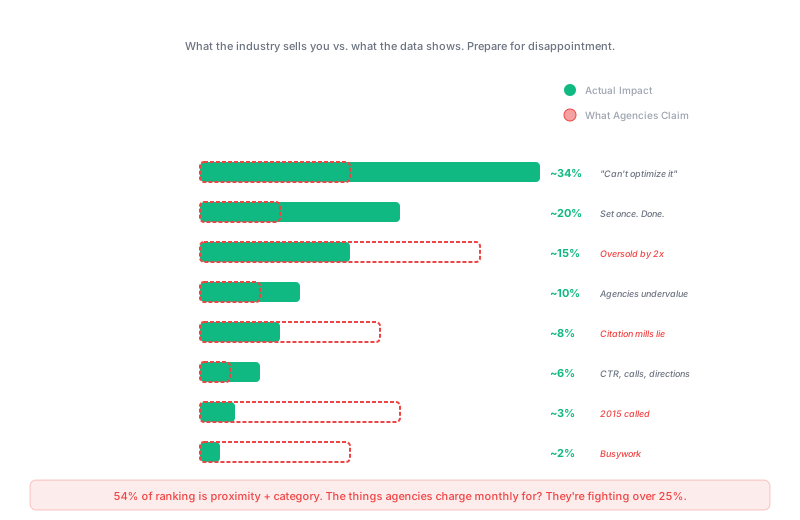
Here's what the numbers suggest:
| Factor | What I Found | What Agencies Sell | The Gap |
|---|---|---|---|
| Distance from Searcher | ~32-36% | ~15% | They downplay it because they can't sell it |
| Primary GBP Category | ~18-22% | ~8% | You set it once. No monthly fees. |
| Review Signals | ~13-17% | ~28% | They oversell it almost 2x |
| Website Authority | ~8-12% | ~6% | Requires actual SEO work. Hard to scale. |
| NAP Consistency | ~6-9% | ~18% | Citation mills need to eat |
| Behavioral Stuff | ~5-7% | ~3% | Clicks, calls, direction requests |
| Citations (beyond the basics) | ~2-4% | ~20% | LOL. LMAO even. |
| GBP Posts & Photos | ~1-3% | ~15% | Busywork. Complete busywork. |
Stare at that for a second. Proximity plus category is north of 50% of the ranking. Two factors. One you can't change and one you set once. Then agencies spend 90% of their time selling you the other 50%, and within that, they dramatically oversell the stuff that's easy to automate (citations, posts) and undersell the stuff that's actually hard (website authority, real review systems).
I'm going to say something and I need you to really hear it:
The local SEO industry's business model requires you to not understand that the biggest ranking factor is one they can't charge you to optimize.
This isn't conspiracy. It's just incentives. If you understood that proximity was a third of your ranking, you'd ask hard questions about whether anything else is worth paying for. Can't have that.
The Distance Thing Is Even Worse Than You Think
Okay so proximity matters. But how much does each additional mile hurt? This is where it gets genuinely depressing.
Most people assume it's linear. Like, being 2 miles away is twice as bad as 1 mile. Makes sense intuitively, right?
It's not linear. It's exponential. Or something close to exponential. The decay curve is steep as hell.
From my tracking: if you're within about a third of a mile of where the searches happen, your chances of showing up in the pack are something like 85-90%. Still pretty good at half a mile. But at one mile you're down to maybe 50%. At two miles it's more like 15-20%. At five miles you basically don't exist unless there's literally nobody else closer.
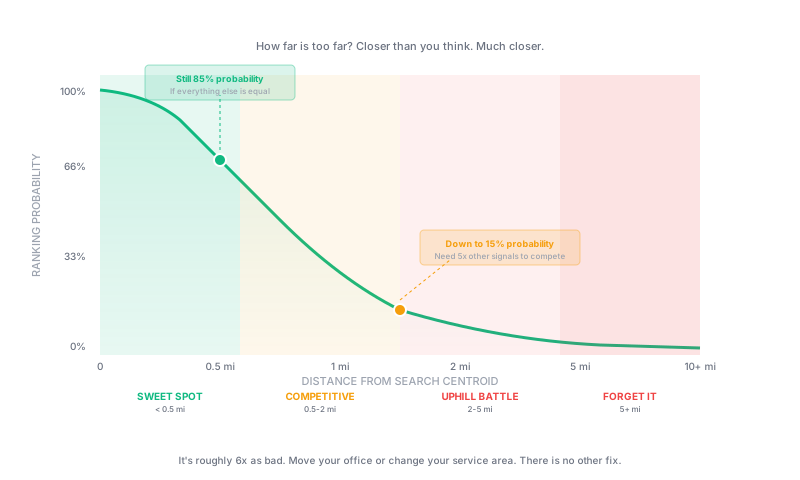
Sarah, the dentist? At 2.3 miles she was starting with maybe 15% probability. Her competitors downtown had 85-90%. She would need to be so overwhelmingly superior in every other factor that she overcame a roughly 6x disadvantage. With a practice that's been open for four years competing against practices that have been there for twenty.
The math doesn't work. It was never going to work. Nobody told her this because telling her this would mean telling her to stop paying for local SEO.
I told her to stop paying for local SEO. Move your practice if you can. If you can't, take that four grand a month and put it into Google Ads, referral bonuses, direct mail, literally anything where you're not fighting against an algorithm that's already decided you don't belong in the top three.
I know a chiropractor who moved 0.8 miles. Eight-tenths of a mile. His local pack impressions tripled in 90 days. That's a real lever. Writing GBP posts is not a real lever.
Do this before you spend a dollar on local SEO
Open Google Maps. Figure out where your customers are actually searching from. Drop a pin. Now measure from that pin to your address. If it's over 2 miles and you have competitors closer, your ceiling is LOW. You can still do local SEO but you need to understand you're playing on hard mode. Know this before you buy anything from anyone.
Things You Cannot Change (Accept These First)
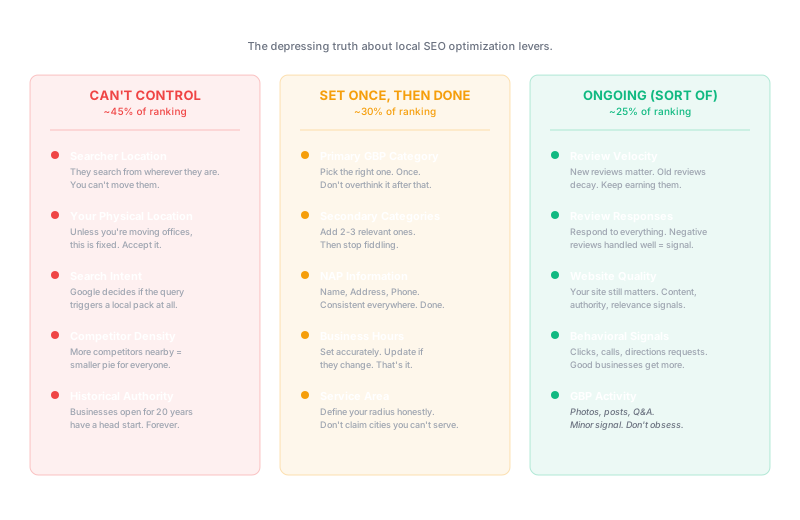
I'm going to list the factors that are either fixed or effectively outside your influence. I'm doing this first because I want you to stop wasting energy on them.
Where the searcher is. When someone searches "dentist near me" their phone's GPS determines what "near me" means. You can't influence this. You can't make their phone think they're somewhere else. Service area businesses have slightly more flexibility because Google considers the whole service area, but even then you're constrained by what you can legitimately claim to serve.
Where you are. Your address is your address. Unless you're going to move. Some businesses do move for local SEO reasons. Most can't or won't. Fine. But stop pretending optimization can overcome a fundamental location disadvantage. It usually can't.
How many competitors there are. If there are 47 plumbers within 2 miles of downtown, the local pack shows 3. The pie doesn't grow. Google does some personalization based on exact searcher position but fundamentally: more competitors = smaller slices for everyone. You can't make your competitors disappear.
Twenty years of compound advantages. A business that's been operating for two decades, accumulating reviews, building web presence, establishing citation profiles... they have advantages that compound. They have history. You, opening your business last year, cannot catch up overnight. The algorithm has memory.
Things You Do Once (Then Stop Touching)
There's a category of local SEO work that matters a lot but requires basically zero ongoing attention. Do it right once. Then move on. This is the high-leverage stuff that agencies won't emphasize because you can't charge monthly for something you set once.
Your Primary GBP Category
This is the single most important thing you actually control. Your primary category tells Google what you are. Google uses it to match you against searches. Screw this up and you're invisible for the queries that matter most.
The rules are simple:
- Be specific. "Dentist" beats "Healthcare" beats "Business."
- Match what people search. If customers search for "plumber" then be a "Plumber," not a "Plumbing Contractor" or "Drain Specialist" or whatever.
- If Google offers something more specific that fits, use it. "Emergency Plumber" > "Plumber" if that's actually what you do.
- Secondary categories: only add them if they're real and you want those queries. Don't spam.
Set it. Verify it's right. Never think about it again unless your business fundamentally changes. Google's guidelines are worth ten minutes of your time.
NAP Consistency
Name, Address, Phone number. These need to be identical everywhere. Not similar. Identical. Same abbreviations, same formatting, same everything. Your website, your GBP, every citation.
This matters less than it used to. Google's gotten better at figuring out that "123 Main St" and "123 Main Street" are the same place. But inconsistency still creates friction. Why create friction?
Audit this once. Use Moz Local or BrightLocal or whatever. Fix the discrepancies. Then stop worrying about it unless you move or change your phone number.
Hours and Attributes
Google has an "Open now" filter. People use it. If your hours are wrong, you lose that traffic. Takes ten minutes to set correctly. Update for holidays. Check the attributes (wheelchair accessible, free wifi, whatever applies to you).
There is no "optimization" here. There is only "correct" and "incorrect." Be correct.
Nobody talks about this
Primary category + NAP consistency = roughly 25-30% of your ranking. More than citations, posts, and photos combined. You do them once. Then they're done. No monthly fees possible. Connect the dots.
Things That Actually Need Ongoing Work
Now we get to the stuff that (a) actually matters and (b) requires sustained effort. This is what's worth paying for, if you're going to pay for anything. The list is shorter than agencies want you to believe.
Reviews (But Not The Way You Think)
Reviews matter. But everyone focuses on the wrong thing.
What matters: velocity. How fast are new reviews coming in? A business with 50 reviews that got 5 this month will typically outrank a business with 200 reviews that got 0 this month. Reviews decay. Recency matters. A lot.
What doesn't matter as much: star rating, once you're above about 4.0. A 4.2 with 150 reviews beats a 5.0 with 12 reviews. Below 4.0 you look sketchy and users won't click. Above 4.0 it's volume and recency that matter, not the extra decimal points.
What definitely matters: responding. Especially to negative reviews. Not because it changes the review, but because it signals active management. Google sees this. Users see this. "The owner never responds" is a trust-killer.
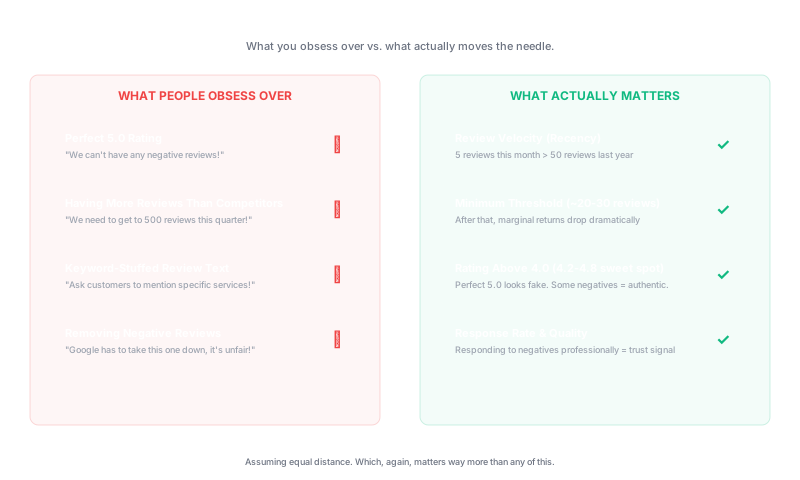
The actual work: build a system to ask customers for reviews. Not fake reviews. Real customers who had real experiences, actually asked to leave feedback. Email follow-ups. QR codes on receipts. Whatever fits your business. Aim for 3-5 new reviews a month minimum. Respond to everything within 48 hours.
This is annoying and ongoing and can't be fully automated. That's why it works.
Your Website (The Forgotten Lever)
Agencies underemphasize this because it requires actual SEO work. Fixing websites is hard. Posting to GBP is easy.
Your website helps Google understand what you do, what you offer, where you operate. Link your GBP to a location-specific page, not just your homepage. Put your NAP on that page. Embed a map. Add LocalBusiness schema.
Beyond that: topical authority matters. If you're a plumber, have pages about plumbing services, common problems, your service areas. This builds relevance signals. It's actual SEO work. It's harder than writing GBP posts. That's why it works better.
Behavioral Signals (The Secret Factor)
Google won't admit this matters but it obviously does: what do people do after seeing your listing?
Do they click? Do they tap "Call"? Do they request directions? Do they bounce immediately or engage?
Listings that generate action get promoted. Listings that get ignored get demoted. The feedback loop is real.
You influence this by having a good listing. Real photos of your actual business (not stock). Complete information. A description that doesn't sound like it was written by a committee. But ultimately, behavioral signals measure whether people want what you're offering. The optimization is being good at your job.
The Citation Grift
I need to talk about citations specifically because the amount of money wasted here makes me want to scream into a pillow.
Once upon a time, circa 2010-2015, citations mattered. Google used volume and consistency of business listings as a legitimacy signal. More citations = more real. Made sense when Google's entity resolution was primitive.
Then Google built the Knowledge Graph. Got better at reconciling entities. Started trusting their own data. Stopped needing external validation.
Citations now account for maybe 3% of local ranking. I'm being generous. The core directories matter: Google, Bing, Apple Maps, Yelp, Facebook, Yellow Pages. Beyond those 20-30? Diminishing returns that approach zero almost immediately.
And yet. AND YET. The local SEO industry keeps selling citation building as a core service. Why?
Because it's infinitely scalable. An agency uses Yext or BrightLocal or whatever to push your info to 400 directories. Takes them ten minutes. They charge you monthly. They show you reports: "Look! 400 citations!" The number goes up. You feel like something is happening.
Something is happening. Your money is becoming their money. That's what's happening.
The stuff that actually works, like review acquisition systems and website authority building, is hard to scale. Hard to automate. Hard to show on a dashboard. So they don't sell it. They sell the thing they can automate.
Get your basic citations set up. The core 20-30 directories. Ensure consistency. Then STOP. Stop paying for citation services. Put that money somewhere it actually does something.
What To Actually Do
Look, I've been ranting for a while now. Let me give you the actual playbook.
First: The One-Time Setup
1. Claim your GBP. If you haven't done this, stop reading and do it now. Literally nothing else matters until this is done.
2. Set your primary category. Look at what your competitors use. Pick the most specific thing that accurately describes you. This is 20% of your ranking. Spend twenty minutes getting it right.
3. Fix your NAP. Audit your citations. Fix discrepancies. Pick one format and use it everywhere forever.
4. Fill out your GBP completely. Hours. Attributes. Services. Real photos (I swear to god, not stock photos). Business description. Everything.
5. Build your core citations. Get on the 20-30 directories that matter. Then stop.
6. Create a location page on your website. Link your GBP to it. Include NAP, schema, embedded map. Make it good.
This phase is like a week of actual work. Do it right and never repeat it.
Then: The Ongoing Stuff
Reviews: Build a system. Ask real customers. Aim for 3-5 per month. Respond to everything.
Website: Build topical authority. Service pages. Location pages if multi-location. Helpful content. This is regular SEO work.
Monitor: Track your local pack positions. Notice changes. Try to figure out why.
That's it. That's the whole thing. GBP posts, 500-site citation blasts, "local optimization services" that never explain what they're optimizing, all of it is either low-impact busywork or outright waste of your money.
The Honest Questions
Before you spend money on local SEO, answer these. Be honest with yourself:
- How far are you from where your customers search? Measure it. Actually measure it. If it's over 2 miles with competitors closer, understand your ceiling is low before you start.
- Is your category right? This is a fifth of your ranking. Is it actually right?
- Do you have a real review system? Not "we ask sometimes." A system. That runs. That produces reviews.
- Is your website actually good? Fast? Mobile-friendly? With real content? Or is it a template that says nothing?
- What's your realistic competitive position? If the top 3 have been there for 20 years with hundreds of reviews, what's your actual path to displacing them? Do you have one?
If the answers suggest you're facing a ceiling, accept it. Put your money into channels where you can actually win. Local SEO is not always the answer. Sometimes the answer is "your location sucks and the algorithm is correctly reflecting that, so spend your money on Google Ads or referral programs or literally anything else."
The Uncomfortable Truth
Local SEO is real. The local pack matters for local businesses. I'm not saying it's fake.
I'm saying that the largest factor in whether you rank is something you mostly can't change. Where you are relative to where your customers search. That's a third of your score decided before any optimization begins.
The industry doesn't want you to know this because it makes their services less valuable. If proximity is destiny, why pay monthly for citation management? If category is set-and-forget, why pay ongoing for "GBP optimization"? If reviews are about customer experience, why pay an agency instead of just asking happy customers yourself?
For most local businesses, the high-impact local SEO work is a one-time project. Set up your foundation. Build a review habit. Make sure your website doesn't suck. Then stop paying people to move numbers that don't move the needle.
The dishonest version of local SEO is: it's complex, ever-changing, requires constant expert attention, sign this retainer. That version makes agencies money.
The honest version is: know where you stand geographically, do the setup work correctly, build real systems for the ongoing stuff, and stop buying snake oil.
I know which version I'd rather tell you.
Related reading if this pissed you off productively: How to Know If You Can Rank for the competitive assessment framework. My take on SEO agencies if you want to get more pissed off. SERP Feature Opportunity Analysis for the broader landscape beyond local.