
The Death of Position
Let me tell you about a client who ranked #1 for their most valuable keyword and watched their CTR drop by 40% over eighteen months while maintaining that position.
Forty percent. Position unchanged. Traffic hemorrhaging.
The explanation was visible to anyone who bothered to look at the actual search results page instead of the rank tracker dashboard: Google had inserted a featured snippet (sourcing someone else), a "People Also Ask" box that expanded to consume half the viewport, a video carousel with three YouTube thumbnails the size of postage stamps (but larger than any organic result), and a knowledge panel on the right rail that answered the query well enough that many users never scrolled at all. My client's #1 position was now, functionally, position 7 -visible only to users patient enough to scroll past the baroque assembly of boxes that Google had decided were more helpful than any mere webpage could be.
This is not an aberration. This is the search results page in 2025. And the SEO industry has, with characteristic slowness, largely failed to adapt.
The mental model most practitioners still carry -ten blue links, positions 1 through 10, fight for the top -is a historical artifact. It describes a world that stopped existing around 2015. The search results page is now a layout problem as much as a ranking problem, a question of which boxes Google chooses to show and how much vertical real estate each consumes, and if you're not analyzing this, you're flying blind over terrain that changed while you were reading your instruments.
Diagram: The Modern SERP
A Taxonomy of the Boxes
Before we can audit opportunities, we need a shared vocabulary. The SERP features that matter -meaning the ones that consume real estate, steal clicks, or offer acquisition opportunities -break into roughly twelve categories. (Twelve. This is what we're dealing with. The search results page has become a complex system with more moving parts than most practitioners realize, and the interaction effects between features matter as much as the features themselves, and I will get to that, but first the taxonomy.)
The Click-Stealing Features
Featured Snippets. The "position zero" you've heard about. A box at the top that extracts an answer from a webpage and displays it directly. The source page gets a link, but many users get their answer without clicking. Ahrefs found featured snippets appear for 12.3% of queries. When they appear, they dominate. Paragraph snippets, list snippets, table snippets -each with its own acquisition dynamics.
People Also Ask (PAA). Expandable question boxes that spawn more questions when clicked, a fractal of curiosity that keeps users on the SERP. Moz's data shows PAA appearing on 65% of SERPs now. Each expansion loads more questions, more answers, more reasons to never visit your site. Getting into PAA is both an opportunity (visibility) and a trap (answer displayed without click).
Knowledge Panels. The boxes on the right (desktop) or top (mobile) that display entity information pulled from Google's Knowledge Graph. If you're a business, a person, or a concept with sufficient web presence, you might have one. If you don't control it, someone else's information might be displayed next to searches for your brand.
AI Overviews. Google's newest extraction mechanism, now appearing on an expanding subset of queries, synthesizing information from multiple sources into a summary that sits above everything else. If featured snippets were a siege weapon, AI Overviews are a thermonuclear device. The click-through implications are still being measured, but early data is not encouraging for publishers.
The Media Features
Video Carousels. A horizontal scroll of video thumbnails, almost exclusively YouTube. For queries with video intent, this can push organic results below the fold entirely. Winning here means being on YouTube, which means accepting Google's terms on a different platform.
Image Packs. A row or grid of images that expands to Google Images. For visual queries, this is the primary result. Your webpage's ranking matters less than whether your images appear in this pack.
Top Stories. The news carousel for queries with newsworthiness. If you're a publisher, this is table stakes. If you're not, it's irrelevant. The inclusion criteria are opaque but seem to weight recency, authority, and Google News inclusion.
The Commercial Features
Shopping Results / Product Grids. For commercial queries, product images with prices. Merchant Center feeds are required. If you're in e-commerce and not in these results, you're ceding ground to competitors who are.
Local Packs. The map and three-business listing for queries with local intent. An entirely different optimization game involving Google Business Profile, reviews, citations, and proximity. I won't cover local SEO in depth here -it deserves its own treatment -but know that for "near me" queries and location-implicit searches, organic rankings are nearly irrelevant.
The Trust Features
Sitelinks. The indented sub-pages that appear under your result for branded queries. Not something you can directly acquire, but influenced by site structure, internal linking, and click patterns. When you have them, you dominate the SERP for your brand. When you don't, you look smaller than you are.
Review Stars. The rating snippets that appear with product and business listings. Driven by structured data markup. The CTR impact is substantial -BrightLocal found that star ratings increase click-through by 25% on average.
FAQ Dropdowns. When you implement FAQ structured data, questions and answers can expand directly in the SERP. This is one of the few features where your content appears more prominently without you losing the click.
Diagram: Feature Taxonomy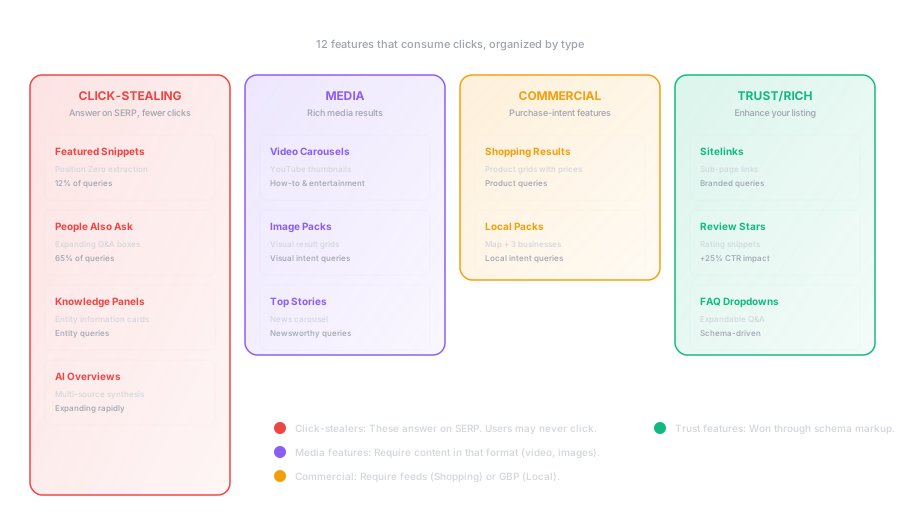
Position is not visibility. Visibility is not clicks. Clicks are not traffic. Traffic is not revenue. The map is not the territory, and your rank tracker is lying to you by omission.
The Economics Nobody Discusses
Here is the central heresy: ranking #1 for a keyword is less valuable than it was five years ago, and will be less valuable still next year, because Google is systematically capturing more of the query resolution on the SERP itself.
This is not speculation. This is measurable.
SparkToro and Datos found that 65% of Google searches in 2024 ended with no click to any website. Zero-click searches. The user's query was satisfied -or satisfied enough -by the information Google displayed directly.
Let me say that again: two-thirds of searches generate no traffic to any website.
Now. Does this mean SEO is dead? No. (The death of SEO is announced quarterly; the industry continues.) What it means is that the type of query that generates traffic has shifted, and the position on SERP that generates traffic has shifted, and if you're not adjusting your strategy accordingly, you're optimizing for a metric that no longer connects to business outcomes.
The queries that still generate clicks are:
- Commercial queries where the user needs to complete a transaction
- Complex informational queries that can't be answered in a snippet
- Navigational queries where the user is looking for a specific site
- Queries where the SERP features don't resolve the intent
The queries that no longer generate clicks (or generate far fewer):
- Simple factual queries ("what time is it in Tokyo")
- Definition queries ("what is a mortgage")
- How-to queries with simple answers ("how to tie a tie")
- Entity queries where Knowledge Panel suffices ("Microsoft CEO")
The strategic implication is this: before you try to rank for anything, you need to understand what the SERP looks like, what features appear, and whether traffic is even available to be captured. Some SERPs are simply closed. The information is provided. Nobody needs to click.
The hidden metric nobody tracks
Most SEO dashboards show you "ranking position." Very few show you "SERP click opportunity" -the estimated percentage of searchers who will click any organic result at all. For some queries, this is 80%. For others, it's 5%. If you're not measuring this, you're targeting keywords that may never generate traffic regardless of where you rank.
The Audit: How to Find Your Opportunities
Enough theory. Let's do the work.
A proper SERP feature opportunity analysis has three phases: (1) feature presence mapping, (2) competitive gap identification, and (3) acquisition feasibility scoring. I will walk through each with specific methods. By the end, you will have a ranked list of feature opportunities you can actually pursue.
Phase 1: Feature Presence Mapping
For your target keywords, you need to know which SERP features appear. This is more complicated than it sounds, because features are not static. They vary by device, location, time of day, personalization, and Google's ongoing testing. But directionally, we can get close enough.
Method 1: Manual Inspection
The stupid, slow, correct approach. For your top 50 keywords:
1
Open an incognito window. Log out of Google. Use a clean browser profile. Personalization distorts results.
2
Search each keyword. Record what appears. Screenshot if you want evidence. Note: Featured Snippet (Y/N, what type), PAA (Y/N, how many questions), Video Carousel (Y/N), Image Pack (Y/N), Knowledge Panel (Y/N), Local Pack (Y/N), Shopping Results (Y/N), AI Overview (Y/N).
3
Note who owns each feature. For Featured Snippets: what domain? For PAA: expand each, what domains are sourced? For Video: what channels? This is your competitive intelligence.
4
Check mobile separately. The SERP is different. Feature presence differs. Mobile-first indexing means mobile SERP is the primary reality.
This takes time. It is correct. No tool fully replicates it because SERP features are live-rendered and constantly tested.
Method 2: Tool-Assisted
For scale, you need automation. The major rank tracking tools now include SERP feature data:
- Ahrefs: Keywords Explorer shows SERP feature presence and which domains hold Featured Snippets
- Semrush: Position Tracking includes "SERP Features" column; Organic Research shows feature ownership
- Moz Pro: Tracks SERP feature presence in rank tracking; SERP Analysis tool in Keyword Explorer
- STAT: Best-in-class for SERP feature tracking at scale, shows historical trends
The output of Phase 1 is a spreadsheet that looks something like this:
| Keyword | Volume | F. Snippet | PAA | Video | Images | AI Overview |
|---|---|---|---|---|---|---|
| how to calculate CAC | 5,400 | hubspot.com | 6 Qs | Y | N | N |
| customer acquisition cost | 12,000 | investopedia.com | 8 Qs | N | N | Y |
| CAC formula | 2,900 | - | 4 Qs | N | Y | N |
| reduce CAC | 880 | profitwell.com | 5 Qs | Y | N | N |
Phase 2: Competitive Gap Identification
Now that you know what features exist, you need to know where you have opportunities. An opportunity exists when:
- A feature is present (duh)
- You don't currently own it
- The current owner is beatable (or the feature is unowned)
The third criterion is where most audits fail. Identifying that a Featured Snippet exists is easy. Identifying whether you can win it requires competitive analysis.
For Featured Snippets: Compare the current snippet holder's domain authority, page authority, and topical authority against yours. Look at the content format -is it a paragraph, list, or table? Can you create content in the same format, but better? (More complete, more accurate, better formatted?) Ahrefs research shows that pages ranking 2-5 have the highest probability of capturing snippets when they optimize for them. If you're ranking 50, you're unlikely to leap directly to position zero.
For PAA: Expand each question. Note the source. PAA slots rotate more than Featured Snippets -Google pulls from multiple sources depending on query variation. If different domains own different questions, there's room for you to claim some. Target questions where the current answers are thin, incomplete, or from low-authority sources.
For Video Carousels: Check who ranks. Is it dominated by channels with millions of subscribers, or are smaller players represented? If the latter, video content is viable. If the former, you need a realistic assessment of whether you can build video presence sufficient to compete.
For Knowledge Panels: If you don't have one for your brand, that's your gap. If you do, check whether the information is accurate and whether you can influence it (more on this below).
Diagram: Opportunity Matrix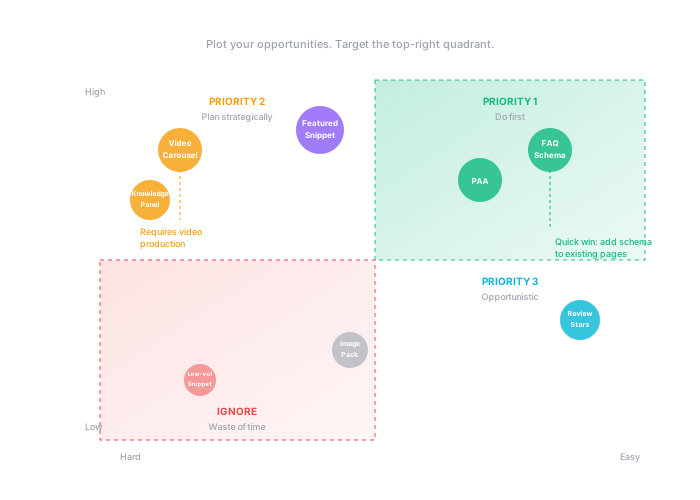
Phase 3: Acquisition Feasibility Scoring
For each identified opportunity, score it on two axes:
Axis 1: Traffic Value
- Keyword search volume
- Feature position (above vs. below fold)
- Estimated CTR impact of owning the feature
- Commercial intent of the keyword
Axis 2: Acquisition Difficulty
- Current owner's authority relative to yours
- Your existing ranking position
- Content gap to fill
- Technical requirements (schema, video production, etc.)
Score each opportunity 1-10 on both axes. Multiply for a composite score. Sort descending. You now have a prioritized list of SERP feature opportunities.
The quick wins are in PAA
Featured Snippets get the attention, but PAA is often easier to win and scales better. Each PAA box contains 4+ questions initially, expanding to many more. If you can answer three questions in one PAA box, you've captured three visibility slots with one content effort. Target the questions nobody's answering well.
Acquisition Strategies by Feature Type
You have your prioritized list. Now, how do you actually acquire these features? Each type has its own mechanics. I'll give you the specific tactics for the features that matter most.
Winning Featured Snippets
The Featured Snippet is Google extracting content from your page and displaying it at position zero. The key insight is this: Google is looking for content that answers the query in a specific format that can be extracted and displayed.
Optimization tactics:
1. Format matching. Look at the current snippet type. If it's a paragraph snippet, you need a 40-60 word paragraph that directly answers the query. If it's a list snippet, you need H2/H3 headers that can be extracted as list items, or an actual <ol> or <ul> list. If it's a table, you need a well-structured HTML table. Semrush's research shows format match is the strongest predictor of snippet capture.
2. Query-answer proximity. The answer should appear near the query restated. If someone searches "what is CAC," your page should have a section that includes the phrase "CAC is..." or "Customer acquisition cost is..." followed immediately by the definition. Google's extraction algorithm looks for this pattern.
3. The "is" structure. For definition snippets, structure your answer as "[Query term] is [answer]." This simple pattern dramatically increases extraction probability. "Customer acquisition cost is the total cost of acquiring a new customer, including marketing spend, sales costs, and related expenses."
4. Position requirement. You generally need to rank on page 1 already to win a Featured Snippet. If you're not ranking, focus on traditional SEO first. If you're ranking 6-10, snippet optimization can leapfrog you past positions 1-5.
Example snippet-optimized content structure:

## What Is Customer Acquisition Cost (CAC)?

Customer acquisition cost (CAC) is the total cost a company
incurs to acquire a new customer. This includes all marketing
expenses, sales team costs, and related overhead, divided by
the number of customers acquired in a given period.

### How to Calculate CAC

CAC = Total Sales & Marketing Costs / Number of New Customers

For example, if you spend $100,000 on sales and marketing
in a quarter and acquire 500 customers, your CAC is $200.
This structure gives Google extractable content for multiple query variations: "what is CAC," "CAC formula," "how to calculate CAC."
Winning People Also Ask
PAA is more forgiving than Featured Snippets and offers more surface area. The strategy:
1. Identify the questions. For each target keyword, expand all PAA questions. Document them. These are your content targets.
2. Answer on your existing pages. If you have a page ranking for the main keyword, add sections that explicitly answer the PAA questions using the question as an H2 or H3 and a concise answer immediately following.
3. Create dedicated Q&A content. FAQ pages structured with FAQ schema markup are particularly effective for PAA capture. Each question-answer pair should be self-contained and extractable.
4. Answer the "also asked" questions. When you click a PAA question, more questions load below it. These second-level questions are lower competition and often overlooked. Target them.
Diagram: PAA Content Structure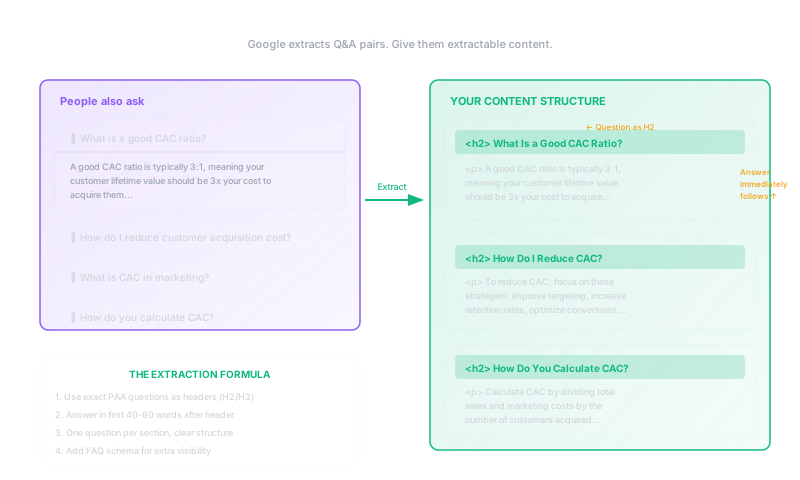
Winning Knowledge Panels
Knowledge Panels are different. You don't win them through content optimization. You win them through entity establishment.
1. Establish entity presence. You need to be in Google's Knowledge Graph. This means consistent information across authoritative sources: Wikipedia, Wikidata, LinkedIn, Crunchbase, industry databases. Google's documentation on Knowledge Panels emphasizes the importance of corroborating sources.
2. Claim your panel. If you have a Knowledge Panel, you can claim it through Google's verification process. This gives you some control over the information displayed.
3. Structured data. Implement Organization schema or LocalBusiness schema on your site. This helps Google understand your entity attributes.
Getting Into Video Carousels
Simple but not easy: you need video content on YouTube that ranks.
1. Create videos for your target keywords. Search the keyword. If a Video Carousel appears, there's video intent. Create video content that addresses the query.
2. YouTube SEO basics. Keyword in title, description, and tags. Engaging thumbnail. Retention matters: watch time is YouTube's primary ranking signal.
3. Embed on your site. Videos embedded on pages that rank organically sometimes get pulled into carousels. Double exposure potential.
4. Accept the platform tradeoff. Video Carousel wins send traffic to YouTube, not your site. The visibility is valuable, but the traffic mechanics differ from organic. Measure accordingly.
Structured Data Features (Review Stars, FAQ, How-To)
These features are won through markup implementation:
Review Stars: Implement Review schema or AggregateRating schema on product and service pages. You must have legitimate, first-party reviews.
FAQ Dropdowns: Implement FAQPage schema on pages with Q&A content. Questions expand directly in the SERP, taking up more real estate for your result.
How-To: Implement HowTo schema on instructional content. Steps can display as rich results with images.
Structured data abuse will get you penalized
Google has explicit policies against marking up content that isn't visible, fake reviews, or schema that doesn't match page content. Manual actions for structured data spam are real. Don't game this.
The Prioritization Framework
You now have acquisition strategies for each feature type. The final step is prioritization. Not all opportunities are equal, and you have limited resources.
I use a quadrant model:
Diagram: Prioritization Quadrant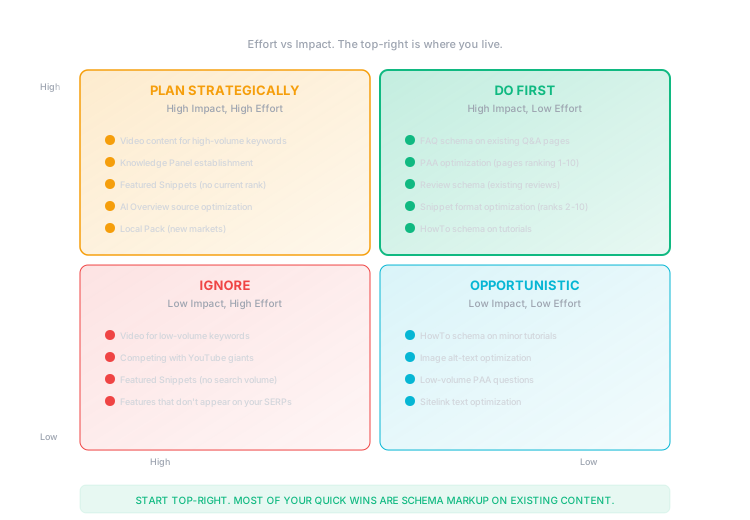
Quadrant 1 (High Impact, Low Effort): Do First
- FAQ schema on existing pages with Q&A content
- PAA optimization on pages already ranking top 10
- Review schema on product pages with existing reviews
- Featured Snippet reformatting of pages ranking 2-10
Quadrant 2 (High Impact, High Effort): Plan Strategically
- Video content creation for high-volume keywords
- Knowledge Panel establishment for your brand
- Featured Snippet capture for keywords you don't yet rank for
Quadrant 3 (Low Impact, Low Effort): Opportunistic
- How-To schema on existing instructional content
- Image optimization for Image Pack inclusion
Quadrant 4 (Low Impact, High Effort): Ignore
- Competing for Video Carousels dominated by major publishers
- Chasing Featured Snippets on low-volume keywords
- Building presence for features that don't appear on your target keywords
Measurement: Proving This Works
Feature acquisition is wasted if you can't measure the impact. The measurement stack:
1. Feature ownership tracking. Your rank tracker should show which features you own, not just position. STAT, Semrush, Ahrefs all support this. Track feature ownership week-over-week.
2. CTR by position and feature. In Google Search Console, segment CTR by query. Compare CTR for queries where you hold a feature vs. don't. This is your impact proof.
3. Traffic delta analysis. When you acquire a feature, measure the traffic change to the specific page. Control for seasonality and other variables. Did feature acquisition actually drive incremental traffic?
4. Revenue attribution. If you can, connect the traffic delta to conversion and revenue. Feature acquisition that generates visits but not value is vanity work.
The Uncomfortable Conclusion
I've given you the audit method, the acquisition tactics, and the prioritization framework. Now let me be honest about what this means.
The game is getting harder. Google is extracting more value on the SERP itself. Zero-click searches are increasing. AI Overviews will accelerate this. Every feature Google adds is a feature that potentially steals a click you might have gotten.
The response is not to give up. The response is to adapt. If Google is going to extract content to display, make sure it's your content being extracted. If features dominate above the fold, win the features. If video is eating text, make video. If Knowledge Panels matter for brand queries, build your Knowledge Panel.
This is not a complaint. It's a strategic reality. The companies that thrive in search will be the ones that understand the SERP as a complex system, audit it systematically, and acquire the positions that matter -which are increasingly not "position 1" in the traditional sense.
The audit takes a few hours. The acquisition work takes longer. But if you're still tracking rank without tracking features, you're measuring the wrong thing. And in SEO, as in life, you get what you measure.
So. Do the audit. Build the spreadsheet. Score the opportunities. Execute on the high-value wins. Measure the impact. Repeat.
The clicks nobody fights for are still there. They're just in different places than they used to be.
If you want to understand how SERP features interact with broader ranking dynamics, read How to Know If You Can Rank. For the technical foundation that makes feature optimization possible, see The Technical SEO Checklist (The Real One). And if you're wondering whether this is all worth the effort, read my take on what SEO tools actually sell you. Spoiler: it's often permission to do work you already knew how to do.