
Every SEO conference has the same guy. You know the one. He's on stage talking about "earning links through exceptional content" and "building relationships with webmasters" and everyone's nodding like this is wisdom instead of the content-marketing equivalent of "have you tried being taller?"
The truth they won't say from the stage, because it doesn't sell courses: most high-DA backlinks are acquired through systematic exploitation of bureaucratic neglect.
That sounds cynical. It's not. It's just how large organizations work. A Fortune 500 company doesn't have "a website." It has seventeen websites, forty-three microsites, six acquired company domains they forgot to redirect, a scholarship program from 2019 that's still live, and an integration marketplace that hasn't been audited since the Obama administration.
Each of these is a door. Most are unlocked. Some have the key under the mat.
(If you want to understand what happens when you try to shortcut this with paid links, read the testicular catastrophe story. Different lesson, same principle: the system has rules, and the rules are enforced unevenly.)
Diagram: The Fortune 500 Link Ecosystem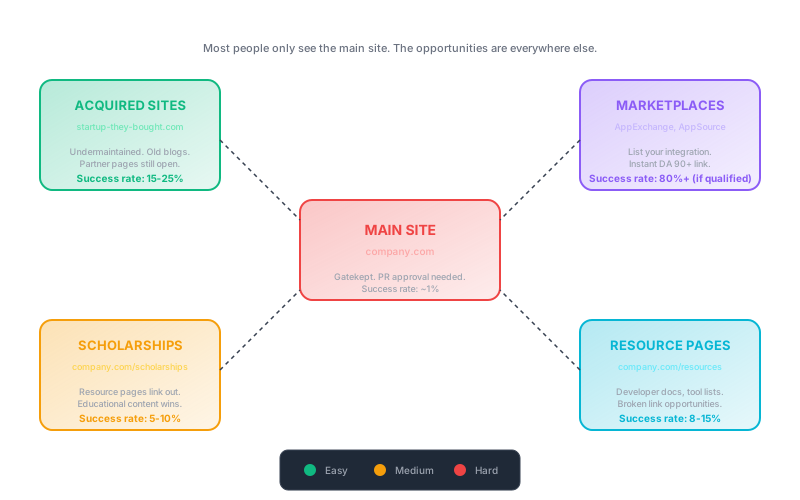
The Prevailing Delusion
The SEO industry has constructed an elaborate mythology around backlinks. In this mythology, links are "earned" through "outreach" to "relevant webmasters" who evaluate your "content quality" and bestow upon you the sacred href.
This is, and I cannot stress this enough, almost entirely fictional.
What actually happens: someone at IBM's developer relations team needs to update a resource page. They Google "best API documentation tools," click the first three results, add them to the page, and go to lunch. No relationship was built. No content was evaluated beyond "does this look legitimate enough that I won't get yelled at." The link was not earned. It was found, by someone doing the minimum required to complete a task before their 1pm.
Understanding this changes everything. You're not trying to impress an editorial board. You're trying to be present at the moment someone, somewhere, is filling a slot.
The link was not earned. It was found, by someone doing the minimum required to complete a task before their 1pm.
Method 1: The Acquisition Graveyard
Here's something nobody talks about: when a Fortune 500 company acquires a startup, they almost never properly handle the SEO migration.
The acquisition closes. Press releases go out. The brand team argues about whether to keep the startup's name. Engineering starts "integrating" the codebase (read: rewriting it from scratch while maintaining the fiction of integration). Legal worries about contracts. HR worries about retention.
You know who's not in that room? The person responsible for the startup's website.
So it just... sits there. For months. Sometimes years. The SSL cert gets renewed automatically. The hosting bill gets paid by some finance system that outlived three reorgs. The blog from 2021 is still live. The "Partners" page still accepts submissions. The "Resources" section still links to external tools that the original marketing manager thought were cool.
These aren't abandoned properties. They're undermaintained properties. The distinction matters.
Someone still owns them. Usually it's a marketing ops person or a junior brand manager who inherited the domain during some reorg. They're not actively managing it, but when a form submission lands in their inbox, they see it. And here's the key: they don't have the same gatekeeping instincts as the main corporate site. There's no PR review. No legal approval chain. No brand committee. Just someone who has access and wants to clear their inbox.
"Sure, I'll add your tool to the resources page" is an easy yes. It takes two minutes and makes the request go away. That's the mechanism. You're not emailing into a void hoping a ghost links to you. You're reaching someone with the access but not the institutional caution.
How to find them:
1
Pick your target. Choose a Fortune 500 company in your industry. Tech is easiest because they acquire constantly.
2
Find their acquisition history. Crunchbase, Wikipedia's M&A lists, or just Google "[Company] acquisitions list." You want acquisitions from 2-5 years ago. Fresh enough to still be live, old enough to be forgotten.
3
Check if the old domains are live. Visit them. Are they redirecting? Parked? Or still serving the old site? You want option three.
4
Crawl for link opportunities. Look for: resource pages, partner directories, blog posts with external links, "tools we use" pages, documentation that references third-party services.
5
Reach out. Contact forms still work. The info@ email forwards to whoever inherited it. Your request lands on the desk of someone with edit access and no approval process. Make it easy for them to say yes.
Diagram: Acquisition Graveyard Method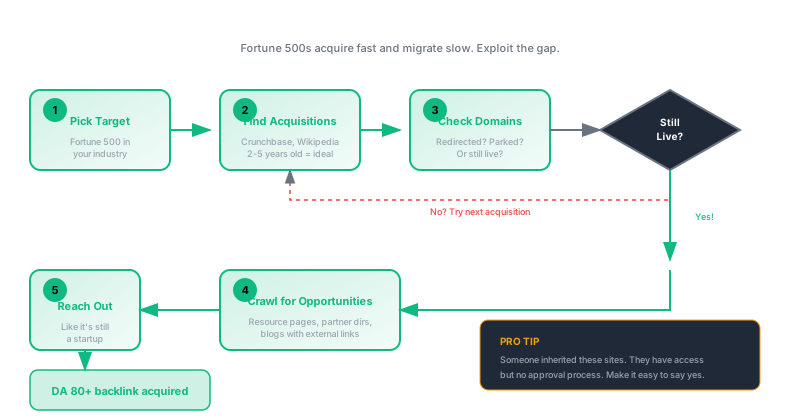
Example in the wild
Salesforce has acquired 70+ companies. Many of their older acquisitions (Buddy Media, ExactTarget, Demandware) had resource sections that remained semi-maintained for years. Some still have working submission forms. This is not a secret. It's just work most people won't do.
Method 2: The Scholarship Play
This one's been around forever, which means two things: it works, and most people execute it badly.
The setup: Fortune 500 companies run scholarship programs as PR/recruiting plays. These programs have web pages. These web pages need to link to "educational resources" to look legitimate. Your job is to be an educational resource.
The bad version of this: create a thin "scholarship guide" page and blast emails to every .edu domain you can find. This worked in 2014. It does not work now.
The good version: create something actually useful about a topic adjacent to the company's scholarship focus, then reach out with a genuine reason why it belongs on their page.
The execution:
First, find scholarship pages that link out. Not all do. You want the ones with a "Resources" or "Learn More" section. Search site:microsoft.com scholarship resources or similar.
Second, study what they already link to. This tells you the editorial standard. If they're linking to government .gov sites and university .edu pages, your WordPress blog isn't getting on there. If they're linking to industry publications and nonprofit resources, you have a shot.
Third, create something better than the weakest link on the page. Not better than everything. Just better than the worst thing they already deemed acceptable.
Fourth, reach out to the scholarship program manager (usually findable on LinkedIn) with a specific, non-automated message. Something like:
The hit rate on this is maybe 5-10%. Which sounds low until you remember that one link from Microsoft's scholarship page is worth approximately forty-seven guest posts on blogs you've never heard of.
Method 3: Integration Marketplaces
This is the most overlooked one, possibly because it requires you to have an actual product.
Every enterprise software company has a marketplace: Salesforce AppExchange, Microsoft AppSource, HubSpot App Marketplace, Atlassian Marketplace, Shopify App Store, and on and on. These are directories of third-party apps that integrate with their platform.
When you list on these marketplaces, you get a backlink from a DA 90+ domain. It's that simple.
"But I don't have a SaaS product."
You might be surprised how low the bar is. Zapier integration? That counts. Chrome extension that works with their platform? Sometimes counts. Open-source tool that complements their ecosystem? Some marketplaces accept those.
The specifics vary by marketplace. Some require revenue share. Some require security audits. Some will list anything with a working OAuth flow. Do the research. The point is: this door exists and most people walk past it.
Diagram: Link Quality Comparison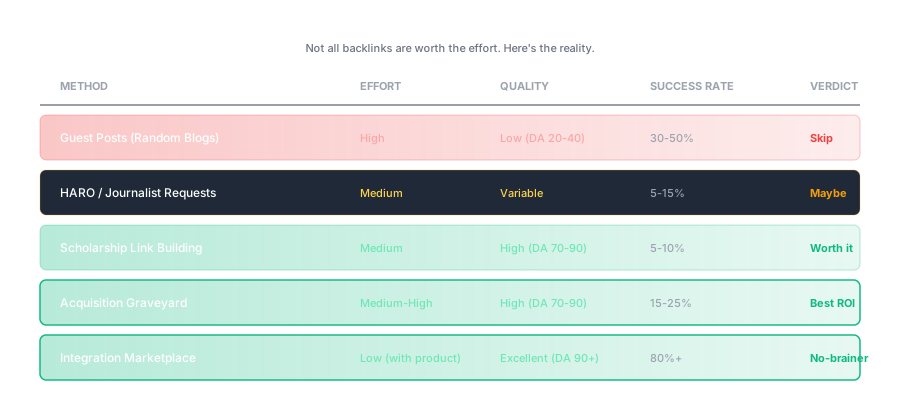
Method 4: The Broken Link Resurrection
Ancient technique. Still works. Particularly well on Fortune 500 sites, because Fortune 500 sites are vast, undermaintained, and full of links to startups that pivoted, shut down, or got acqui-hired into oblivion.
The process:
1
Crawl resource pages for broken links. Screaming Frog, Ahrefs, or even a simple Chrome extension. You're looking for 404s on outbound links.
2
Check the Wayback Machine. What was the dead page about? This is your blueprint.
3
Create a replacement. Doesn't need to be identical. Needs to serve the same purpose the original link served on that page.
4
Reach out with the fix. "Hey, noticed this link on your [page] is broken. We have a similar resource at [URL] if you're looking for a replacement."
You're not asking for a favor. You're solving a problem they didn't know they had. Different energy. Better response rate.
What This Actually Teaches You
I've laid out four methods, but the methods aren't the point. The point is the underlying principle: large organizations are fractured, forgetful, and full of seams.
The mythology of SEO imagines a world where links are carefully curated by discerning editors. The reality is a world where links are added by interns, forgotten by managers, and maintained by no one. The resource page you're trying to get on was last updated by someone who quit two years ago. The scholarship program is run by an HR coordinator who has seventeen other responsibilities. The integration marketplace is maintained by a developer relations team that's already over capacity.
This isn't a criticism. It's just how things work at scale. And once you understand it, you stop waiting for permission and start looking for openings.
A note on ethics
Everything in this article is legitimate link building. You're creating real resources, reaching out to real people, and providing genuine value. The "exploitation" is of bureaucratic inefficiency, not people. If your pitch is "please link to my garbage," this won't work. If your pitch is "here's something useful for your page," it might. The difference is whether you've actually made something worth linking to.
The Work Nobody Wants to Do
I'll tell you why most people won't do any of this: it's tedious.
Finding zombie acquisitions requires research. Analyzing scholarship pages requires patience. Building integrations requires product work. Fixing broken links requires crawling. None of this is glamorous. None of this can be fully automated. None of this scales infinitely.
That's exactly why it works.
The tactics that "scale" are the tactics everyone uses, which means they're the tactics that stop working. The tactics that require elbow grease are the tactics most people skip, which means they're the tactics that still work.
This is the secret that isn't a secret: in SEO, as in most things, the returns accrue to those willing to do the work that others find beneath them.
The Fortune 500 link isn't behind a gate. It's behind a spreadsheet, a few hours of research, and the willingness to send emails that might not get answered.
That's the whole trick. There's no trick.