
Let me tell you about the Hemingway Editor, that helpful little web app that highlights your sentences in yellow and red to indicate they're too long, too complex, too difficult for your eighth-grade reader, that theoretical semi-literate child-adult hybrid who apparently constitutes the entirety of your audience.
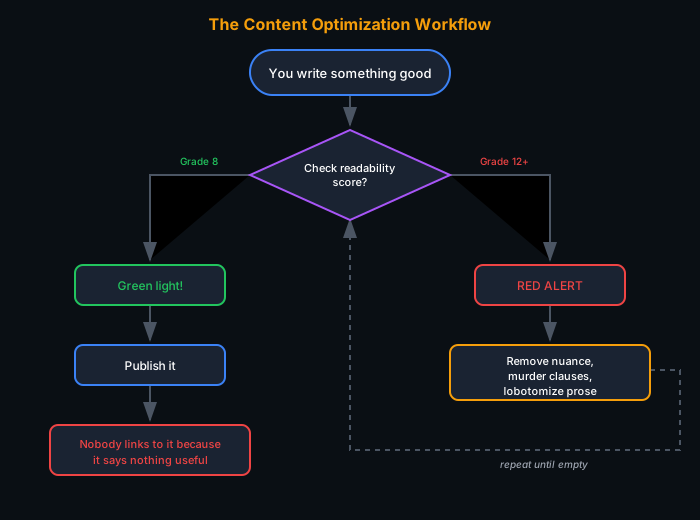
You paste in your carefully crafted paragraph. The screen bleeds crimson. "Grade 14," it pronounces, as if announcing a terminal diagnosis. You dutifully hack at your prose, fragmenting compound sentences, murdering subordinate clauses, excising every polysyllabic word that survived the content marketing style guide's first purge. You check again. "Grade 8." Success. Your writing now reads like a ransom note assembled from a Dick and Jane primer.
Congratulations. You have optimized.
I know this ritual intimately because I performed it for years. Here's the story that broke me of the habit.
Years ago I wrote a guide on web hosting for beginners. The original explained bandwidth allocation, the difference between shared and VPS environments, why "unlimited" is a marketing lie, how to evaluate uptime guarantees, what questions to ask about security. It assumed readers were capable of learning new concepts. Flesch-Kincaid score: around 12.
The feedback came back: too technical. Simplify for beginners. So I simplified. "Bandwidth" became "how much stuff can flow through the internet pipe." "Server uptime" became "how often the website works." I replaced a paragraph explaining the tradeoffs between shared hosting resource contention and VPS isolation with "shared hosting is cheaper but slower." The score dropped to 8. The green light appeared.
The dumbed-down version taught nothing. A reader who finished it would know exactly as much about choosing web hosting as when they started, which is to say: nothing actionable. They'd know that some things are "important" and other things are "good to have." They'd have consumed content without gaining knowledge. Meanwhile, the technical guides that actually explained the concepts got linked, bookmarked, and referenced by people making real hosting decisions.
I learned something that day about who readability tools think your audience is, and how little respect that assumption shows them.

The Flesch-Kincaid Industrial Complex
Here is how Flesch-Kincaid calculates "readability": it counts syllables per word and words per sentence, that's it, that is the entire intellectual apparatus, a formula from 1975 developed for the U.S. Navy to assess training manuals now somehow arbitrating the quality of your content marketing, and the formula has no concept of whether your writing makes sense, no understanding of whether your ideas connect, no awareness of whether your sentences build toward anything or simply exist one after another like cars in a freight train that never arrives anywhere, it knows only: short good, long bad.
And yet, and yet, an entire industry has calcified around this metric, because Yoast SEO, the plugin that has done more damage to web writing than perhaps any other single piece of software, surfaces readability scores like they matter, content agencies promise "optimized readability" as a deliverable, style guides mandate grade-level targets, writers genuinely believe they are doing something meaningful when they achieve that green light, but they are not, they are performing a cargo cult ritual, imitating the form of good writing without understanding its substance.
The Categorical Error
Let us be precise about what is happening here, because precision matters even when (especially when) we are discussing imprecision, and the readability industry has made a categorical error, confusing simplicity of expression with clarity of thought, which are not the same thing, are not even close to the same thing, because you can write extremely simple sentences that communicate nothing, and you can write complex sentences that communicate with perfect clarity.
Observe: "The thing is important. You should do it. Results will happen. These are good." versus "When you implement structured data markup (and I mean actually implement it correctly, not just slap some JSON-LD in the header and pray) Google can better understand the entity relationships on your page, which manifests as enhanced search features that measurably improve click-through rates."
The first example achieves a Flesch-Kincaid grade level of approximately 2 while the second scores around 18, and yet the second communicates a specific, actionable idea while the first communicates nothing at all, being empty calories, linguistic filler, existing only to not be long, and this is the core absurdity: we have optimized for the absence of difficulty rather than the presence of meaning.
What Readability Actually Is

Real readability, the kind that actually matters, the kind that determines whether a human being will comprehend and retain your ideas, has almost nothing to do with sentence length, having instead to do with:
Coherence. Does each sentence follow from the previous one, is there a logical thread connecting your paragraphs, can a reader following along at normal pace predict roughly where you're going, because this is what linguists call "given-new structure" where each sentence introduces new information while anchoring it to information already established, and when this structure breaks down readers get lost, not because your sentences are long but because your ideas don't connect.
Concreteness. Are you writing about actual things or about abstractions of abstractions, because "we leverage synergies to drive outcomes" is perfectly readable by Flesch-Kincaid standards and perfectly incomprehensible by human standards while "we combined two sales teams and revenue went up 30%" is concrete, the reader can see it, the specificity is what makes it readable, not the grade level.
Rhythm. Good prose has music, short sentences punch while longer ones create flow, build momentum, carry the reader through complexity with a cadence that makes even difficult ideas feel manageable, and monotonous sentence length (all short, all long, doesn't matter which) creates fatigue while variation creates engagement, but variation cannot be measured by counting syllables.
Anticipation. Does your reader know why they're reading each sentence, have you established a question that needs answering, a tension that needs resolving, because the most readable content in the world is content the reader wants to read, and that has nothing to do with grade level, having everything to do with whether you've given them a reason to care.
The Paradox of Expertise
Here's where the readability obsession becomes actively destructive: it punishes expertise, because technical content, the kind that actually helps specialists solve real problems, requires technical language, not because writers want to sound smart but because technical language does work, making distinctions that matter, compressing complex ideas into handleable chunks, allowing experts to communicate efficiently with other experts.
When you write about "crawl budget optimization" you are using jargon, yes, but you are also communicating in two words a concept that would require a paragraph to explain from first principles, and that's not obfuscation but efficiency, the jargon increasing readability for the intended audience while decreasing it for general audiences, but the Flesch-Kincaid police don't distinguish between audiences, they see polysyllabic words and mark them red, they see subordinate clauses and demand sacrifice, they want you to write "make Google visit your pages more" instead of "crawl budget optimization."
And so we get content that is technically "readable" by algorithmic standards and practically useless for anyone who actually needs to solve a technical problem, the eighth-grader being happy while the senior developer has left to find documentation written by adults.

The Voice Flattening
Now we arrive at the real crime, the sin that cannot be measured but cannot be ignored: readability optimization destroys voice.
Voice is what makes writing human, the texture of thought made audible, the rhythm that tells you before you've registered the words who's speaking, the particular way this specific person arranges ideas, emphasizes points, digresses and returns, personality in prose, the thing that makes you want to read more from someone even when the topic doesn't inherently interest you, and voice requires deviation from the norm, requiring long sentences and short ones, complex constructions and simple declarations, technical vocabulary and vernacular slang, requiring the writer to sound like themselves, which means sounding different from everyone else, which means violating whatever "best practices" the readability tools demand.
Run Joan Didion through Hemingway Editor and you'll see red lines everywhere, run David Foster Wallace through it and the app would probably crash, run any writer worth reading through it and watch the screen bleed, because these writers are readable, profoundly and compellingly readable, because they have voice, and voice is exactly what the tools optimize away, the result being what I call content voice: that eerie, personality-free uniformity that characterizes modern web writing, which you've read a thousand times, which sounds like no one, which sounds like an algorithm trained on ten thousand marketing blogs, which increasingly is exactly what it is, committing no readability sins and also no readability virtues, it exists, and that's the best you can say for it.
The Google Question
"But wait," says the SEO person reasonably, "doesn't Google care about readability?" and the answer is yes, but not in any way that Flesch-Kincaid captures, because Google cares whether users engage with your content, whether they stay on the page, whether they find what they're looking for, whether they trust you enough to return, and these are the real signals, shaped by all the things actual readability comprises: coherence, concreteness, rhythm, anticipation.
Google does not have a Flesch-Kincaid threshold, there's no algorithm that says "reject if grade level exceeds 12," there can't be, because the same document that's impenetrable to a general audience is perfectly accessible to a specialist audience, context determining readability, audience determining readability, the algorithm understanding this even if the SEO industry doesn't.
What Google does penalize, indirectly, is content that users bounce from, content that doesn't answer their questions, content that wastes their time, and this is where the readability obsession becomes self-defeating: in the quest for simplified sentences, writers strip out the substance that would actually make users stay, so the 300-word blog post with perfect Flesch-Kincaid scores and zero useful information sees users bounce while the 3,000-word technical deep-dive with complex sentences and comprehensive coverage sees users engage, Google notices, and the simple content loses to the complex content, not despite its complexity but because of it, because complexity deployed in service of comprehensiveness is readability for the right audience.
The Actual Optimization

Fine, you say, I'm convinced, Flesch-Kincaid is bullshit, but my content still needs to be readable, so what do I actually optimize for, and here is the work, the real work, the work that can't be automated:
Know what you're actually saying. Before you write a single sentence, articulate the core idea in one paragraph, because if you can't then you don't understand it well enough to write about it readably, muddy thinking producing muddy writing, no amount of sentence-shortening fixing conceptual confusion, so figure out your point first.
Structure before style. Readable content has visible architecture, headers that actually describe what follows, paragraphs that each advance one idea, a logical flow from setup to development to conclusion, and if you get the structure right the sentences almost write themselves, but get it wrong and no sentence-level optimization will save you.
Front-load the value. Put the important information at the beginning of sections, beginning of paragraphs, beginning of sentences, which journalists call "inverted pyramid" and cognitive scientists call "reducing working memory load" and readers call "not wasting my time," the reader being able to scan and still understand, read deeply and understand more.
Vary your rhythm. Some sentences should be short, others should sprawl across the page accumulating detail and nuance and qualification and building toward a conclusion that feels earned precisely because you took the time to get there properly, monotony being the enemy, variation being engagement, and you should read your writing aloud, because if you're bored your readers are bored.
Cut what doesn't earn its space. Every sentence should either communicate information or create effect, and if it does neither, if it's just there because you felt like you needed more words, delete it, this not being about short versus long but about necessary versus unnecessary, complex ideas being able to require complex sentences, but throat-clearing and hedging and filler needing to go.
Test on actual humans. Not readability tools but humans, people who match your target audience, give them your content and watch, where do they stop, where do they re-read, where do they lose the thread, because this is information a formula cannot provide, this being the only readability metric that actually matters.
A Confession
I should confess something: this piece you're reading scores terribly on Flesch-Kincaid, I just checked, somewhere north of 14, sentences averaging too many words, paragraphs that would make Hemingway Editor weep blood-red tears, and you're still here.
You're still here because the ideas connect, because there's a point that's building, a position being staked, an argument being made, because I told you up front that I was going to challenge your assumptions about readability and I've been doing exactly that sentence by sentence whether those sentences were short or long, and that's readability, not syllable counts, not grade levels, but connection, clarity of purpose, the sense that someone has something to say and knows how to say it.
The tools can't measure this, they probably never will, but you can feel it, every reader can feel it, because it's the difference between writing that flows and writing that merely exists, so close the Hemingway Editor, ignore the Yoast traffic light, fire the content agency that promises "optimized readability," then sit down and figure out what you actually want to say, say it as clearly as you can with as much or as little complexity as the idea demands, read it aloud, revise until it flows, and that's the whole secret, that's all there ever was.
The irony, of course, is that truly readable content, content that actually communicates, often requires more effort than content that merely scores well. Simple is hard. Clear is hard. Having a point and making it stick is very, very hard. The readability industry sells shortcuts to people who don't want to do the work. Like most shortcuts, it gets you there faster and leaves you somewhere you didn't want to be.