Content Calendars Are the Problem
I wrote about this in Content Calendars Kill Content. The typical approach is to fill a spreadsheet with topics, assign dates, and churn out whatever fits the schedule. Three posts a week, regardless of whether you have anything worth saying.
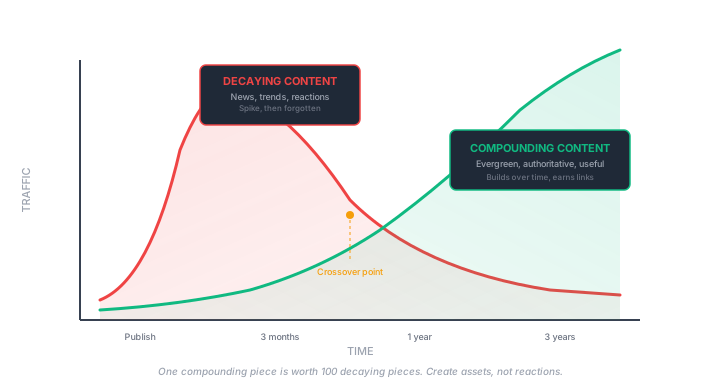
This produces mediocre content at scale. Google is drowning in mediocre content. Your mediocre content won't rank because it's competing against everyone else's mediocre content.
Good content strategy isn't about volume. It's about creating fewer pieces that are significantly better than what exists. It's about finding the gaps where you have something to say that nobody else is saying well.
How I Build Content Strategies
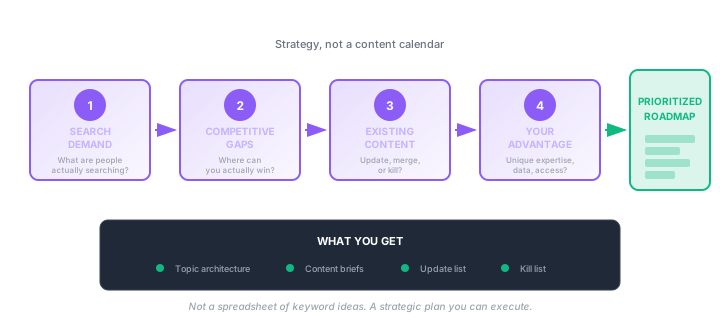
1. Search Demand Analysis
What are people actually searching for in your space? Not just the obvious head terms, but the long-tail queries, the questions, the specific problems. I analyze search data to map out what people actually want.
2. Competitive Gap Mapping
For each topic cluster, who's ranking? How good is their content? Where are they weak? Some topics are dominated by excellent content from authoritative sites. Others have surprisingly poor coverage. The gaps are where opportunity lives.
3. Existing Content Audit
What do you already have? Often there's more than you realize, but it's scattered, outdated, or cannibalizing itself. Sometimes the best content strategy is consolidating and improving what exists rather than creating something new.
4. Competitive Advantage Assessment
Where do you have genuine expertise or data that others don't? Ranking is easier when you're saying something nobody else can say. Original research, proprietary data, unique experience. These are the pieces that earn links and citations without outreach.
5. Prioritized Roadmap
Not everything can be done at once. I prioritize based on business impact, ranking probability, and resource requirements. You get a clear sequence of what to create first, not a thousand ideas with no order.
What the Strategy Includes
- Topic Architecture - How content pieces relate to each other, supporting pillar pages and topic clusters that build authority
- Content Briefs - For priority pieces: target keywords, search intent, competitive positioning, required sections, internal links
- Update Recommendations - Which existing content to refresh, merge, or kill
- Cannibalization Fixes - Where pages are competing against each other, and how to resolve it
- Content Gap Analysis - Topics competitors rank for that you don't cover
- Opportunity Scoring - Expected traffic and difficulty for each recommended piece
What I Don't Do
I don't write content. I'm a strategist, not a writer. I can tell you exactly what to write, how to structure it, what angle to take, and how to beat the competition. But the actual writing is either you, your team, or a writer you hire.
I don't do content mills. If you need 50 blog posts a month, hire a content agency. That's not what I do and it's not what produces results anyway.
I don't fill spreadsheets with keyword ideas. You can do that yourself with Ahrefs. What you need is someone who knows which keywords matter, which you can win, and how pieces fit together strategically.
Who This Is For
Content strategy makes sense if you have the ability to create content but aren't sure what to create. Maybe you have writers sitting idle. Maybe you've been publishing randomly and seeing mediocre results. Maybe you're spending on content that isn't ranking.
This works best for:
B2B companies where thought leadership and educational content drives pipeline. Long consideration cycles mean content has time to work.
E-commerce sites that need buying guides, comparison content, and category pages that rank. Product pages alone don't capture top-of-funnel demand.
Publishers and media trying to optimize their editorial strategy for search without compromising quality or reader experience.
The Deliverable
You get a strategy document covering all the elements above, plus a 60-minute walkthrough call. The document is actionable: your team can execute against it for 6-12 months before you'd need to revisit.
If you want ongoing content strategy guidance as part of monthly management, that's available too. But the one-time strategy is designed to stand alone.
Pricing
Content strategy is scoped based on your site size and market complexity. Typically $2,000 to $5,000 for a full strategy. Turnaround is 2-3 weeks.
If you're already in a monthly management engagement, content strategy is included.