
There is a man standing across the street from a sandwich shop, and I have to be honest with you before we go one inch further, I invented both of them, the man and the shop, about nine seconds ago, out of nothing, at my desk, because the alternative was writing a normal sentence about analytics and I would rather eat the sardines again. The man is named Clive. He has a metal clicker in his right fist, a bouncer's clicker, the kind that goes chunk, and he has been standing at that spot clicking it on and off for twenty-eight days without once going home, eating, or acknowledging that anyone can see him, because, and this is important, nobody can.
Clive is a service you are paying for, except you are not paying yet, because it is free for now, and I want you to hold that phrase, free for now, cup it in your hands like a baby bird, because it is going to come back and it is going to come back worse. Clive is the kind of man who knows precisely which parts of the arrangement are free and which parts are not free yet. He has a little mental spreadsheet about it. He updates the spreadsheet in his head while he clicks. He is a nightmare.
Here is the job. Clive stands at his spot, which he chose for sightline the way a sniper chooses a spot, and every single time somebody out on that sidewalk does a thing that Clive has privately, unilaterally, with no oversight from anyone, decided counts as a mention of your sandwich shop, Clive clicks. Somebody gestures vaguely toward your awning. Chunk. Somebody slows their walk near your door. Chunk. Somebody who has never heard of you trips over a loose brick and flaps an arm in the general direction of your building to steady themselves. Chunk, Clive is counting that, Clive counted that one, and at the end of twenty-eight days Clive walks across the street, hands you a laminated card, and on the card is the number 4,180.
Four thousand one hundred and eighty.
And you, a reasonable person who owns a sandwich shop named Dolores after your late mother, you look at that number and your heart does the thing, the little lift, the dopamine hiccup, and you say, Clive, four thousand people mentioned my mother's shop, this is the greatest day of my professional life, and Clive, very slowly, the way you'd deflate a child, says, no, four thousand one hundred and eighty times a thing happened that I counted, and you say what thing, Clive, what is the thing, and Clive adjusts the strap on a satchel you hadn't noticed he was wearing and says he'd rather not get into the methodology.
Georges Seurat, A Sunday on La Grande Jatte - 1884, 1884 - 86, border added 1888 - 89. Art Institute of Chicago.
What Clive Counts, And What Clive Will Throw In The River
You press him, because you are a business owner and four thousand of anything feels like it ought to be convertible into money, like a foreign currency, and over the course of a long, humiliating conversation conducted entirely on a public sidewalk while strangers edge around the two of you, the shape of what Clive is actually doing comes apart in your hands, and it is nothing, nothing, like what you assumed.
First thing you learn. When Clive says mention, Clive does not mean somebody said the name of your shop out loud. You assumed he was counting the times a human being said the word Dolores to another human being, because that is the thing a sane person would want to count, that is your mother's name living in a stranger's mouth, that is the whole ballgame. Clive is not counting that. Clive is counting the times someone pointed at the awning. The physical awning. The canvas. If a man stood on that corner and told his entire extended family, with tears streaming down his face, that Dolores makes the finest Italian sub ever assembled by human hands, that he proposed to his wife over a Dolores sub, that he wants his ashes scattered in the parking lot, and he did not at any point point at the awning, Clive did not click. No awning-point, no chunk. You had him down as a man counting the love and he was out there counting the canvas, two completely different numbers, and the second one is the only one Clive's eyes can hold.
Second thing. There is a smaller number on the card, down in the corner, and the smaller number is 24. Twenty-four. And you say Clive, in God's name, what is twenty-four, and Clive says that's how many people looked at your door after they pointed. Looked at. Not entered, not having bought a sub, not sat down at the little table by the window to have a nice time, just looked at. Twenty-four human beings, out of four thousand one hundred and eighty awning-points, swiveled their skulls toward your door in a manner that Clive, standing across the street, exercising judgment that he will not explain, with no training that he will disclose, classified as door-looking. Whether any of them walked in, Clive cannot say, because the inside of your shop is across a road and down a sidewalk and through a door, and Clive does not cross roads, Clive counts heads turning, that is the full and complete scope of the engagement, heads, turning, toward doors.
Twenty-four door-looks out of four thousand one hundred and eighty awning-points. You do the long division right there on the pavement, carrying the decimal, and it comes to roughly half of one percent, and I need you to bank that number, half a percent, pin it to the inside of your skull, because later it is going to walk back into this piece wearing a three-piece suit and carrying a briefcase and I want you to recognize its face.
Third thing. This is the one that takes your legs out. You ask Clive the only question a person would ever pay a man to stand on a sidewalk to answer, which is not how many and not where the arms pointed but what, in actual words, were they saying. Was it, Dolores has gone downhill since the mother passed. Was it, I heard the new guy waters the vinegar. Was it, hey where's a decent sub near the courthouse, and somebody answered Dolores. Was it a direct comparison to the deli two blocks down that you've been losing sleep over. That is the information, the only reason this profession exists. You want to know what the street is saying about your mother's name so you can do something, anything, about it.
And Clive says he doesn't keep that.
He heard all of it. Every word. Twenty-eight days on that corner and Clive heard every conversation that crossed that sidewalk, the praise and the slander and the guy who asked and the friend who answered, the full transcript of the street, and every single night at sundown Clive takes his notes, walks four blocks to the river, and throws them in. Those are private, he explains, with real conviction, like a priest. The conversations belong to the people having them. I would never, ever share a conversation. I merely counted that they occurred and whether a head turned toward your door, and the actual words, the part you would sell an organ to read, those go in the river at dusk, and in the morning Clive comes back and starts a fresh number from zero.
Jean Baptiste Camille Corot, Landscape, 1865/70. Art Institute of Chicago.
I want to pause here and tell you directly, you, reading this, I know. I know. You came for a post about ChatGPT and you have been handed a man who lives on a corner and worships a river. Stay with me. The man is load-bearing.
The Threshold, The Lanyard, And The Napkin He Made You Sign
Now. If Dolores had opened last Tuesday, if it were brand new and quiet, Clive would not have handed you a card at all. Clive has a threshold. Below a certain volume of foot traffic he reports nothing, shows nothing, zero, a blank laminated card, because he says the numbers aren't meaningful until they build, which carries the deeply convenient side effect that the smallest, newest, most frightened, most starving-for-information businesses, the exact ones who would commit crimes for a read on the street, get the blank card and a pat on the shoulder, while the big fat established joints with crowds already clotted out front get the full four-thousand-something buffet. The big joints get the clicker and the new frightened ones get told to come back once they are popular enough to no longer need it. Perfect system. Airtight. Clive invented a tape measure that only works on things that are already big.
Before any of the counting, there was the matter of proving the shop was yours, because Clive does not clicker for just anyone, Clive verified you. You asked, reasonably, how he verified you, and Clive did not answer, Clive instead reached up and gave his lanyard a small confident tug, and the lanyard, I need you to understand, is doing more work in this relationship than every other element combined. A lanyard, a clicker, a satchel, and the manner of a man who has never once in his life been asked for ID. You decided it was less exhausting to believe him than to keep standing on a sidewalk interrogating a man about his lanyard, and that, that right there, that decision, is the entire business model.
And then the napkin. To retain Clive's services you signed a napkin. You did not read the napkin. Nobody reads the napkin. The napkin was damp. But down at the bottom of the napkin, in a region known as Section 10, because we live in a civilization where even a damp napkin has a Section 10 now, there was language, and the language said that by accepting Clive's counting services you agreed to give up certain legal claims against Clive, and the lawyers who later held the napkin up to the light read that language as reaching well past the counting, as in, you may have signed away your ability to sue Clive over matters that had nothing whatsoever to do with awnings, Clive-adjacent grievances of every stripe, a parking dispute, a dog bite, who knows, foreclosed, gone, surrendered on a napkin you signed to get a vanity number you could not define.
Now hold on, Clive reprinted the napkin days after launch. The new napkin still makes you waive certain claims connected to using the counter and its agents, but no longer reaches the unrelated disputes, which Clive would like noted for the record is far more reasonable, and it is, it really is more reasonable, and the napkin got reprinted after a reporter made the first version's language public and the lawyers who read it raised concerns.
That is Clive. Keep him warm. We are going to need every single piece of him.
On The Tenth Of November, OpenAI Hired Clive
On the tenth of November 2026, OpenAI opened a thing called Businesses in ChatGPT, in beta, and inside it a thing called Business Hub, and the Business Hub does for your actual website exactly, exactly, what Clive does for Dolores. It stands across the street from about 1.2 billion weekly ChatGPT users, which is a crowd so large that if Clive tried to clicker it manually his thumb would detach and achieve orbit, and it hands claimed businesses a laminated card covering the past twenty-eight days with three things on it: mentions, website clicks, and discovery topics, which OpenAI defines as "common themes across conversations where their website is cited." You can read the whole launch over at PPC Land, who, and I love this, caught the dashboard in the wild before OpenAI had said one word about it, spotted it in the dark the way you spot a raccoon in the dark, by the two little shining eyes and the sound of something being gone through. How OpenAI decides your shop is really yours, OpenAI will not say, beyond Benji Shomair, its VP of monetization, telling journalists the company uses "multiple verification methods that we use for different types of business in different markets" and giving no further detail, which is a lanyard tug with a job title on it.
And the frame everyone grabbed, instantly, reflexively, before the coffee had cooled, was Search Console. John Shehata, who runs the publisher analytics firm NewzDash, told Digiday this is "a very early, very limited Search Console moment for ChatGPT," and Digiday liked that sentence so much they bolted it to the headline, and I get it, it is a cozy sentence, it whispers that the thing we lost when the AI ate the ten blue links, the queries, the view into what humans actually typed, is strolling back into town wearing a fresh hat, and everybody wants that to be true so badly they can taste it.
The thing dissolved in the river months ago. I'll be fair, Shehata hedged it to within an inch of its life, very early, very limited, he did the honest thing. But the words Search Console are loose in the industry now, galloping around unsupervised, and they are going to trample somebody, because a real Search Console shows you the queries. That is the whole point of it. You open the tool and you see the literal strings of words human beings typed, and from those strings you learn what the world wants, what it calls the thing it wants, and how close you came. You open it for the queries and the rest is parsley flung on to make the plate look occupied.
Business Hub withholds the queries deliberately, the way Clive guards his river notes. OpenAI stated it flat: "We don't share users' conversations or Business Agent chats with businesses." The conversations go in the river at dusk. You get the count that they happened and a tasteful handful of "discovery topics," themes, vibes, the ghost of a prompt. Calling that a Search Console moment is calling Clive a Search Console moment, a comparison that only survives if you have never once opened Search Console and are operating entirely on hearsay and hope, and the SEO industry operating on hearsay and hope is, I regret to inform you, roughly the industry's resting state, it is Tuesday, it is every Tuesday.
A Mention Is Not A Mention Is Not A Click
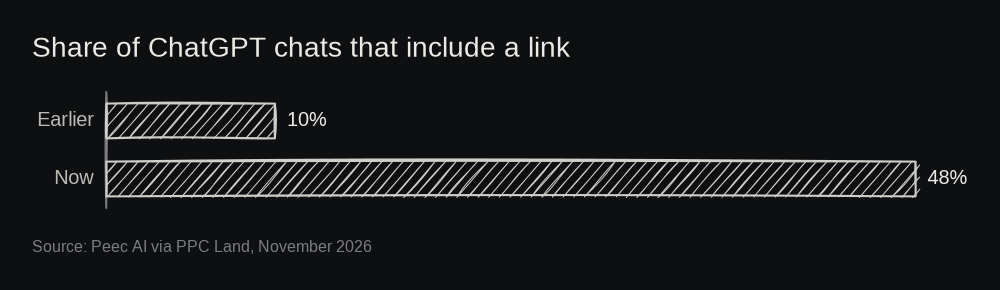
Lily Ray, who runs SEO strategy and research at Amsive, flagged the awning problem and said it out loud. The Business Hub tracks mentions of your website, your domain, the citation, not your brand name surfacing in the conversation. Somebody could spend four uninterrupted minutes inside ChatGPT praising your company by name, by actual name, and if the model never cites your URL, Clive did not click, you are back to counting the canvas while the love walks on by. And this gets worse by the week, because ChatGPT is throwing out more links than it used to, Peec AI clocked it now dropping links into roughly 48% of chats, up from about 10%, and here is the part where you set the coffee down and step back from it, 63% of those links are not citations at all. Links, mentions, citations, three overlapping circles doing a little Venn diagram, and Business Hub hands you a count it labels mentions without ever telling you that the thing it means is a website citation, not your brand coming up in conversation, so you are standing somewhere inside that Venn diagram and nobody will tell you where.
I wrote a whole screed a while back about how being cited by AI can be worse than not appearing at all, and the Business Hub proves my point by accident, like a man slipping on ice to demonstrate gravity, because now you can sit and watch a number climb, a number attached to a thing you don't control, can't see the context of, can't connect to a single dollar, and you can feel something. Pride. FOMO. The specific narcotic hit of a graph going up and to the right. OpenAI has built a machine that manufactures that exact feeling at industrial scale and hands it to you for free, free for now, and if you have been in this trade longer than one week you already know in your spine that a free number engineered to make you feel something is the oldest move in the catalog, it is my Uncle Morrie's eight thousand promotional yo-yos moldering in a storage unit for a restaurant that shut its doors in 1978, it is what my grandmother called luftgeschaeft, an air business, a thing that is almost entirely the sensation of a thing with no thing inside it. I told the Morrie story in the piece about how two decades of this makes a man dream of turnips, and I drag him back in here because a mention count with no prompts behind it is a yo-yo, it spins out and snaps back to the hand and makes that satisfying little sound, and it has fed nobody since 1978.
The Half A Percent Walks In Wearing A Suit
Remember Clive's twenty-four door-looks out of four thousand one hundred and eighty. Remember the half a percent I made you pin to your skull. Here it is, washed, shaved, suited up.
Otterly ran the real numbers on their own live Business Hub account and found roughly one click for every 170 times ChatGPT referenced their website, which pencils out to about 0.6% of mentions turning into a click. Their breakdown is over at Otterly, and the detail that earns its seat is this, Business Hub gives you one single click-through rate for your entire domain, flattened into one pancake, and it counts clicks on links inside ChatGPT, not completed visits. It is Clive counting door-looks, heads swiveling the way a neck swivels when a car backfires near it, and a swiveling neck has sold no sandwiches to anyone.
Now I have to be straight with you about how gloriously, uselessly messy the real data is, because Lily Ray's own numbers will not sit still for the photograph. Digiday reported her dashboard showing four clicks from twenty-five mentions. The same week, Ray herself posted eight clicks from twenty-six mentions, a different ratio entirely, a third animal. These are snapshots grabbed from different accounts at different moments in a beta not two weeks old, and averaging them into one tidy number for a client deck would be a crime against arithmetic, and the honest, load-bearing truth is that the ratios vary wildly from account to account and nobody has explained why, because OpenAI has never, at any point, defined what a mention is. The counts are real, PPC Land is careful about that, real humans really did the thing. But when nobody will tell you what a mention is, counting them precisely is just doing numerology on a server you rent by the hour, and I have written at punishing length about vanity metrics being astrology for people who own spreadsheets, so you can picture the sound I made when this shipped, somewhere between a kettle and a man sitting on a cat.
The Part Where You Read Section 10, And Not With Your Thumb Over It
And then there is the napkin, which is where I stop grinning, because this is the part that actually matters.
Before the revision, Section 10 of OpenAI's terms for businesses using ChatGPT appeared, to the lawyers Digiday showed it to, to require those businesses to give up certain legal claims against OpenAI, and the privacy expert Alan Chapell, of Chapell and Associates, warned that publishers who signed up and accepted the terms could have faced restrictions on how they pursued such claims. Days after launch, after Digiday reported on it, OpenAI rewrote the terms, and the revised version no longer reaches unrelated disputes, which is a real improvement and I will put it on the record that it is an improvement, but the revised terms still require businesses to waive certain legal claims related to their use of the Business Hub and its Business Agents. You still sign something away, a smaller amount than before and only because a reporter made them flinch, and you still put your name on it.
Honoré-Victorin Daumier, "It fits you like a glove!," plate 34 from Types Parisiens, 1839. Art Institute of Chicago.
Now hold the backdrop next to it for one second, just one. The New York Times and a group of other publishers are in federal court right now asking a judge to sanction OpenAI, accusing the company of withholding or destroying evidence in a copyright case about how ChatGPT was trained. That is the live, pending, un-fun legal weather hanging directly over the exact kind of company OpenAI just invited to claim a profile and sign a terms document that touches their ability to bring claims. I am not a lawyer and I am not telling you the hub is a bear trap in a leaf pile. I am telling you that the admission price to a free vanity counter was, at launch, your signature on language about surrendering legal claims, that three of the six large publishers Digiday contacted were setting up accounts, and that the revision only came after the reporting, and the river, as rivers do, runs downhill toward OpenAI.
Why There Is A Man In The Hedge At All
You might ask, fairly, why OpenAI built Clive in the first place, why count anything, why give it away free, and the answer is sitting one browser tab over in Digiday's September reporting, because the Business Agent, the free, organic way your brand gets represented inside a ChatGPT conversation, is the free counterpart to a format OpenAI has already been testing as a paid ad. Two doors into the same conversation, and only one of them has a card reader bolted to it today. Business Hub and the agents are free for now, and Benji Shomair, OpenAI's VP of monetization, a job title I would like you to read again, slowly, out loud, Vice President of Monetization, did not rule out a paid model later, because of course he didn't, you don't give a man that title and then have him swear off money, that's like hiring a shark to lifeguard.
So I'm bracing for something, and it's a guess, not a fact. Clive counts your awning free this month so that later he can offer, for a reasonable monthly fee, to stand a little closer, or to say the word Dolores out loud to passersby, or to fish one or two of the actual conversations back out of the river before they fully dissolve, premium river insights, and you will pay it, you will absolutely pay it, because by then you will have months of his graph tattooed on the inside of your eyelids and you will not be able to stop.
Claim the profile anyway, it costs nothing and it works fine as a free baseline, fix your own information so the model isn't reading a dead address off a gravestone, keep half an eye on the trend because a trend you don't trust is still, once in a blue moon, a smoke alarm going off, and Shehata's advice is dead right, cross-check the Business Hub movement against things you can actually see and bank, your own ChatGPT referral logs, your newsletter signups, your conversions, the stuff inside the shop where you, not Clive, are standing with your own two eyes. Ray said the plainest true thing anyone said all month, that the hub will not replace the measurement tools she already uses, and she is nobody's fool. Just do not mistake the laminated card for a Search Console, do not drop the mention number in a client deck with a straight face and a laser pointer, do not sign the napkin without reading Section 10 with both thumbs off the page, and above all, above everything, do not let a tally of awning-points convince you that you know what the street is saying, because you built your shop on land you are renting from a landlord who throws every conversation in the river at dusk and hands you back a number in the morning like it's a gift.
I checked on Clive before I filed this. The sandwich shop never existed, the man never existed, and yet somehow he has a lanyard, a threshold, a satchel, a reprinted napkin, a VP title he awarded himself, and a graph that only ever climbs, and he has moved. He no longer stands across the street. He lives in the hedge now, the one by your door, because he said the sightline is better and the river is closer, and three of your competitors have already signed with him, and he is in there, in the leaves, clicking at the awning, counting a crowd of 1.2 billion people who cannot see him, and he still has not told one living soul a single thing that was said.