
I want to tell you about a man named Merle, and I want to be upfront that I made Merle up about four minutes ago so that I would not have to name the actual human beings doing the thing Merle does, because the actual human beings have families and LinkedIn pages and I am trying to keep this out of court. Merle is a restaurant critic. He lives in a mid-size town that I also made up, and he writes a newsletter called Merle's Table, and it goes out every Monday at 6 a.m. to two thousand three hundred subscribers, and the very top of every issue, above the fold, bolded, in a font Merle personally selected after what he describes as "a weekend of research," is a section called This Week's Winners and Losers, and people read it, and people forward it, and people cancel anniversary dinners over it, and the whole thing, every word of it, is built on plastic food.
Stay with me. I promise this is about your website. It is going to take a while and it is going to get worse, which is, if you have read me before, sort of the house style.
Here is how Merle operates, and I need you to understand that Merle considers this a methodology. Merle arrives at every restaurant at 11:47 a.m. On the dot. He read in a book once that 11:47 is before the lunch rush so the kitchen has "no excuse," and he has built eleven years of his life on that sentence. He sits by the window, always the window, because the light. He pulls out a laminated scoring rubric, nine categories, each one weighted, the weights derived from a formula Merle will explain to you for forty-five minutes if you make eye contact, which you must not. He carries a small stainless-steel ruler to measure the thickness of a pork chop, because thickness is category four and it is worth eleven percent. He carries a photographer's gray card so his food photos have accurate color balance. He orders the same three dishes at every single establishment in town, for consistency, and he logs all of it into a spreadsheet that is forty columns wide, and the top of the spreadsheet, in a cell he merged himself, says MERLE'S TABLE - PROPRIETARY DINING INDEX - CONFIDENTIAL, which is a beautiful touch, confidential, as though someone has ever once tried to steal it.
And Merle believes all of this makes him rigorous, the ruler and the gray card and the 11:47 and the laminated rubric, the whole apparatus producing truth, and he has never once, in eleven years, noticed the single fact that would detonate his entire career if it ever reached the part of his brain where he lives, which is that every kitchen in town can see his car from the parking lot.
Thomas Rowlandson, At an Old English Eating House, n.d.. Art Institute of Chicago.
The Group Chat Merle Does Not Know Exists
This town has a dining district done up Osaka-style, with the glass cases out front stuffed with lacquered plastic food, the shining plastic ramen and the plastic tonkatsu and the plastic parfait that has not moved, not one millimeter, not been dusted, since 2019. I am not going to justify why my fictional town has an Osaka plastic-food district. It is my town. I built it. I will put a plastic shrimp wherever I please, and if you have a problem with the worldbuilding you can start your own newsletter and I will not subscribe. The plastic is there for tourists to point at. It looks exactly like food. It is molded and airbrushed by actual professionals who went to actual schools for this. Nothing on the plastic shrimp announces that it is plastic. You would have to bite it, and nobody bites the shrimp.
Every kitchen in town is in a group chat. The group chat has one purpose. Merle drives a Corolla with a dented rear quarter panel and a bumper sticker that says ASK ME ABOUT MAILLARD, and the second that Corolla turns into any lot in the district, a line cook somewhere looks up from the flattop and types one word into his phone.
Merle.
And here is what the kitchens worked out, independently, over the years, the way raccoons at different campsites all independently learn to open coolers. A normal person who walks in hungry and sits down and orders a sandwich gets a real sandwich, because the kitchen wants that human to come back and bring their disgusting beautiful family and spend money. But Merle, to the kitchens, is a measuring instrument that happens to have legs, something that arrives and scores and reports the score to two thousand three hundred people who make decisions off it. So the correct move, the move every kitchen in town arrived at without a meeting, is to go out to the window case, pick up the plastic, plate it, garnish it, set it in front of Merle, top off his water with a little smile, and let him get out his ruler and measure the thickness of a pork chop that was airbrushed during a previous administration.

Kitagawa Utamaro, Kitchen Scene, c. 1794/95. Art Institute of Chicago.
Merle scores it. A seven-point-eight. Merle photographs it against his gray card. Merle types into column R. Merle writes two hundred words about the "restraint of the glaze." And Merle never picks up a fork, not once, because picking up a fork was never in the methodology, the methodology is the ruler and the gray card and the 11:47, and so Merle has spent eleven years conducting the most rigorous program of pork-chop measurement in the history of his made-up state, on pork chops that are, every one of them, a decorative resin casting, and nobody at the table says a word, least of all the plate.
Even the Critics Cannot Agree How Much of It Is Plastic
Merle is not the only critic in town, and this is where it gets, and I mean this clinically, genuinely stupid. There are three of them, and they file wildly different reports from the same restaurants on the same nights, and none of them can explain why.
Merle, who drives the loud dented Corolla with the Maillard sticker and therefore gets clocked more than anyone, is convinced the plastic problem is enormous. He launched an investigation. He is very proud of the investigation. He says that since the thirteenth of September, roughly eight percent of the meals he has been served were plastic, up from a baseline of basically never, about 0.17 percent, a rounding error, the kind of number you only get on a night the airbrush guy forgot. And for three nightmare nights at the end of September it spiked to around twenty-seven percent, better than one plate in four, resin, parsley on top, water refilled with a smile. On those poisoned nights only about a fifth of the dishes that normally make the menu were even present, versus nearly ninety percent on a clean night. Merle is beside himself. Merle wrote nine hundred words about it. People shared it with fire emojis.
The second critic, a tidy woman who drives a nondescript sedan nobody can place and changes what she orders, which is the whole trick, says it is more like one percent. A blip. She has no idea what Merle is on about.
The third critic is a big chain operation with a fleet of reviewers and a corporate statement, and the corporate statement says, and I am paraphrasing a corporate statement so you will have to imagine the sound of someone shrugging into a webcam, yeah, we have been getting some bad plates since late summer, but honestly the impact is limited and it is mostly happening at the back tables, the ones past the first row of the menu.
So. Three people in this town get paid to tell you what the food is like, and they cannot agree on what fraction of the food is a paperweight, Merle screaming a quarter of the plates on a bad night while the tidy woman calls it a blip and the chain shrugs that it is fine, really, only the tables past the first page, and nobody wants to say the obvious thing out loud, which is that whatever these numbers are measuring is plastic rather than anything a human would swallow, and if the three people whose entire job is telling you what the food is like cannot agree whether the problem is one percent or twenty-seven, you have no business building a Saturday reservation on any single one of their charts.
Before you report an unconfirmed Google update or panic over a major drop in your rank tracker: check if you were served a poisoned SERP.
- Brodie Clark
And the thing Merle has never once let himself look at head-on, the one that should have ended Merle's Table forever and put Merle into some other line of work, maybe insurance, is this. On the plates that turned out to be plastic, the restaurant Merle had driven across town to review, the one he had promised his readers, was missing from the case entirely when he arrived, gone, not on the window menu at all, and Merle, God love him, concluded the place had shuttered and wrote it an obituary with the word beloved in it. Nearly six times out of ten, on those plastic plates, the specific place he had come for simply was not in the case.
It reopened Thursday. It had never closed. It was full, because what Merle got served was a decoy the kitchen keeps in the case to make the instrument stop measuring and go home, and the instrument printed it as news and someone's grandmother canceled a reservation over it.
Merle Has a Website Now and It Is Plugged Into Your Rank Tracker
You see it. You have seen it since the ruler. But I am going to say it with my whole chest anyway.
On the tenth of November, at six minutes past ten in the morning Pacific time, Google logged the November 2026 core update on its status dashboard, and described it as a regular update designed to better surface relevant, satisfying content for searchers from all types of sites, which is corporate boilerplate of exactly the kind Google reaches for, the corporate equivalent of a plastic pork chop, molded and painted to look like information, and said the thing would roll out for up to two weeks, which lands the finish line somewhere around the twenty-fourth, two days before Thanksgiving and three before Black Friday, and we are going to come back to that comedy because it is a good one.
And people started posting winners-and-losers lists.
A winners-and-losers list like that gets built the way Merle builds his. I am not being cute, I am not reaching, it is Merle sitting in the window with his ruler. Because a week-one winners-and-losers list leans on rank trackers, and a rank tracker is an instrument, it sends out automated collectors to go order the same three dishes at 11:47 every day and report what they were served, and since mid-September those automated collectors have been served complete, wrong pages, the plastic plated and garnished, with nothing on the page admitting it, and Google has not explained why, and as of late October had said nothing publicly about any of it. Why it is happening is a vendor theory, some sort of anti-scraper countermeasure is the story people tell, but Google has confirmed none of that.
Nozzle counted the plates, 27.5 million results pages across 49 countries, and found that since the thirteenth of September roughly eight percent of the pages served to automated collectors were poisoned, their word, a complete, normal-looking Google results page with the real organic listings swapped out for different ones and nothing anywhere on the page admitting it happened. Up from a baseline of about 0.17 percent. From basically never. For three days at the end of September it hit around twenty-seven percent. On poisoned pages only about a fifth of the sites that normally rank were still present, versus nearly ninety percent on a clean page, and the project's own tracked site was missing from the top ten on about fifty-nine percent of poisoned pages, versus under three percent normally. Gone. Eulogized. Reopened Thursday, because about seventy-eight percent of those false drops snapped back within three days.
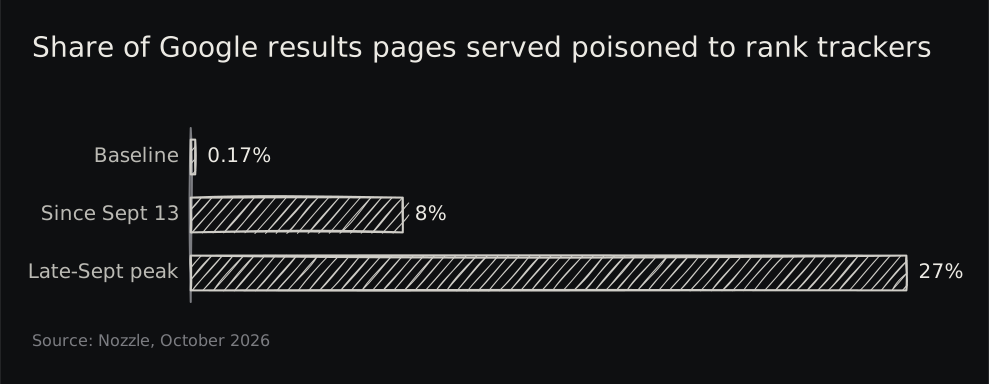
So your tracker gets the Merle treatment, a complete plate, plated nice, garnished, airbrushed by professionals, with nothing on it that says it is resin, and somebody writes it up as the state of search and emails it to their list before lunch.
Nobody at the Restaurant Will Sign the Review
Close the winners list and go stare at a wall for your mental health, because Google has not named a single site that moved in this update. Not one. Its completion posts never name winners or losers, there is no list of winners taped to the door, there is no losers column, and Google has said that nothing in a core update is site-specific, that it is not a penalty aimed at you personally, that pages which dropped are not necessarily bad pages at all and that the change is benefiting pages that were, in Google's telling, previously under-rewarded, which you may believe or not believe, but either way it is a philosophy statement, and nobody stapled a roster of the dead to it.
So the winners-and-losers posts you are reading this week are built by people who took an instrument, aimed it at a town where the instruments have been getting fed plastic since September, and transcribed what came back as if it were dinner, confidently, with a chart, while the three critics cannot even agree whether the problem is one percent or twenty-seven. I have told you before that volatility is not an update, that a twitch on your dashboard can have nothing to do with Google changing its mind, and this cycle pours a second bucket of poison over that problem, because now you cannot even trust that every twitch is real, some meaningful fraction of it might be a lacquered parfait that has not been edible since 2019.
And the checkmark will not rescue you either, because the checkmark means the kitchen stopped adding ingredients, which does nothing about the fire already going. My favorite example, and I mean favorite, I think about it fondly. The May 2026 core update was marked complete on the second of June. The checkmark went up and everyone exhaled and started typing the "it's over, here's what we learned" post, and that same day, the day of the checkmark, Barry Schwartz watched the volatility spike big time, on the finish line, just when everyone had decided it was safe to get back in the water.
What Merle Is Actually Selling, and It Is Not Pork Chops
I want to be fair to Merle, because I am a generous soul and because mocking myself is more my brand than mocking a man I invented eleven paragraphs ago. Merle is a guy who fell so deeply in love with his apparatus that his brain developed a protective callus over the one fact that would destroy him. The ruler works, the forty-column spreadsheet works, the gray card produces beautifully color-accurate photographs of a resin shrimp, and the whole machine hums along flawlessly on top of the assumption that the thing on the plate is food, which stopped being true in September and nobody told Merle, and the kitchens are, at this very moment, laughing about it in the group chat with the three raccoon emojis they use for Merle.
The winners-list people are mostly Merle, lost in the apparatus, with one upgrade Merle never bothered with, which is a pricing page. That is the part that curdles it from comedy into something I have open contempt for. A confident winners list in week one of a named core update is a marketing document, the retweets and the quote-tweets and the "can you do my site next," and admitting that you cannot actually see anything yet, that the collectors are getting fed plastic and your chart might be plastic too, does not move a single retainer. Right when the data is least trustworthy, mid-rollout, vendors disagreeing by nearly a factor of twenty, the loudest incentive is to sound certain, and the honest answer, which is "I do not know yet and neither do you and anyone who says otherwise owns a ruler," does not sell anything, so it mostly does not get said. This is the same disease as chasing every algorithm update in general, the itch to do something, anything, fast, except now the data you are reacting fast to might be plastic, and acting on it will cost you real money, because you are about to go delete pages or rewrite content or nuke your backlink profile over a drop that was a plastic shrimp, and then Thursday the shrimp reopens full of diners and the only thing you managed to kill is the part of the restaurant that was actually alive.
Francisco José de Goya y Lucientes, Charlatan's show, plate 75 from The Disasters of War, 1815/20, published 1863. Art Institute of Chicago.
The Honest Read, and Why I Can't Hand You a Tablet From the Mountain
What you actually look at during a core update that landed on top of months of poisoned results nobody at Google will explain in the middle of the holiday distortion, once you give up on the trackers, is the thing that never arrives on the instrument's plate as plastic, your own receipt, imperfect as even that turned out to be this month. You sit down like a person, you order, you chew, you swallow, you keep the receipt. In the real version that means Search Console and your actual money, impressions and average position for your own queries over your own dates, cross-checked against real traffic that landed on real pages and real conversions that turned into real dollars, because Search Console is reporting on the searches and clicks your own property actually registered, the people who found your pages and sometimes gave you money. The practical test when a tracker starts screaming is embarrassingly simple, go to Search Console, same query, same dates, and if your impressions and average position are flat as a parking lot while the tracker shows a cliff, the tracker ate the plastic, done, ignore it, go outside.
I would normally end right there, hand you Search Console like it was carved into stone and dragged down a mountain, and send you home. I cannot do that cleanly this cycle and I am not going to pretend otherwise, because I have spent twenty years watching people treat one number like scripture and I refuse to become Merle with a different ruler. Search Console itself wobbled in the run-up to this update. Around the eleventh of October its Performance report ran a data delay. Around the third of November a whole pile of sites saw a phantom clicks spike in Search Console that never showed up as actual visitors in anything else, a number that climbed while literally nobody walked through the door, and it got patched for some properties a day later. So even the receipt printer jammed twice in the weeks before this. I have written a whole thing on how your own analytics lie to you, signal versus noise, and the lesson holds, the receipt is dramatically better than the critic's rubric because it is first-party and it reports on searches your own property actually logged, cross-checked against what those people actually did once they arrived, but it is still an instrument, and instruments have bad nights, so you read it with your eyes open and you corroborate anything scary across more than one source before you go amputating.
And then the other half, the half nobody wants, the half that will never farm a single retweet, which is patience. Google's own guidance is to wait until the rollout finishes and then wait a full additional week on top of that, then compare that later week against the week before the update started, which for this one means a baseline from the days before the tenth of November. And that later week is not actually a clean week either, which is the part nobody wants to hear, because if this thing runs its full two weeks it finishes around the twenty-fourth, which means your comparison window opens straight into Thanksgiving and Black Friday, and your traffic is going to leap and belly-flop for reasons tangled up with the shopping calendar rather than with Google's core systems, so your honest read probably slides into December while the retail noise drains out. Danny Sullivan said it flat out back in March 2024, let the thing complete before deciding whether to make any fundamental changes, there might be nothing to do at all, look at traffic over months, weigh the season. That one did not exactly set the group chat on fire, since waiting a month and squinting at seasonality does not photograph well against a gray card.
I would let the update complete before deciding if there are any fundamental changes you might want to make. There might not be any to do at all.
- Danny Sullivan
So the real timeline is a week after the rollout ends, which on the two-week estimate Google gave means around the first of December, with a holiday asterisk the size of a parade balloon, read off your own receipts, corroborated, against a baseline from before the tenth, knowing full well that even your receipts had a rough October. That is the honest version, and it is going to lose to Merle in the window every single time, because Merle files his list on Monday morning and the honest version is still out there waiting to see who is open on Thursday.
Merle at the Window
I think about Merle more than is healthy for a man I invented for the purposes of an essay. Merle in his window seat, gray card out, ruler out, measuring the thickness of a pork chop that was airbrushed while a different person was president, filing his report, confident, thorough, color-accurate, and wrong in every particular, and I cannot even hate him, because Merle is just a man who loved his method so much that his brain grew a callus over the only fact that mattered. By now Merle has escalated, of course, the way these things do. He added a tenth category. He bought a second ruler, a backup ruler, in case the first ruler is ever compromised. He started a petition demanding the restaurants stop "deceiving the press," and it has twenty-three signatures, nineteen of which are his sister, who signed under nineteen different names because she feels bad for him. He is talking about a lawsuit. He is thinking of installing a webcam in his Corolla. He has never once, in any of this, picked up the fork.
The people posting November winners lists own calibrated, stainless, excellent rulers, and the ruler was never the thing I am worried about, because something out back is handing plastic shrimp to the instruments and nobody has said why, and your rank tracker, which is an instrument, is dutifully photographing the shrimp against a gray card and emailing you a chart, and some confident person with a bolded headline font is turning the chart into a list of the dead, a lot of whom are about as dead as that lacquered shrimp.
Let Merle keep the window seat and the ruler and the lacquered shrimp that has not been edible since 2019, and go sit down and order something and chew it and keep the receipt, and when the man with the Maillard sticker tells you the place closed on Monday, go see for yourself whether it is packed on Thursday.