
You are eight years old. Your mother folds a note in half, presses it into your palm with a banknote laid on top of it - the folded instructions, the money, and a warning that if you lose either one you need not bother coming home - and sends you two streets over to the shop that has sold your family its bread since before you were born.
You hand the whole bundle across the counter. The man behind it unfolds the paper, reads your mother's handwriting, looks at you for about as long as it takes to decide you are who he already assumes you are, and then he fills the order. A loaf, a pint of milk, and whatever small tithe your mother has allowed you for making the trip. He does not telephone her to confirm. He does not demand proof that the handwriting is genuinely hers. He honours a transaction requested by a person who is not in the room, carried by a proxy who is barely tall enough to see over the counter and could not be held legally responsible for so much as the milk, and he does all of it on the strength of a slip of paper that has no standing in any court anywhere.
He does it because he knows the handwriting. He knows the family. He has twenty years of your mother never once stiffing him on the account, and that history is the entire machine. The note is not an instruction. The note is a credential.
Frans Snyders, Still Life with Dead Game, Fruits, and Vegetables in a Market, 1614. Art Institute of Chicago.
The Note Was Never the Hard Part
Now picture the other errand, the one that does not go well. A kid you have never seen walks into the same shop, no note, no money, and says his dad is around the corner and to put it on the tab. And the shopkeeper, who is not a cruel man and is not even especially suspicious, says no. Not because the request is impossible. Filling it would take him the same ten seconds it took to fill yours. He says no because he cannot verify the chain. He does not know the dad, he does not know the kid, and he has no way to turn a stranger's claim of authority into a thing he would be willing to defend later. The transaction is trivial. The trust is absent. And in that shop, as in every shop that has ever stayed open longer than a season, the trust is the product and the bread is almost an afterthought.
I want you to sit with how old this arrangement is, because the technology industry keeps rediscovering it and announcing it as a breakthrough. We have always transacted through proxies. You send someone to the market with a token and a list. You send a servant with a card. You let the hotel desk book your table under its own name so the restaurant seats a stranger because the desk's name is good. In every one of these the capability was never the bottleneck. A servant can carry money. A runner can read a chit. The hard part, the part that took centuries to build and can be destroyed in an afternoon, was always the same two questions - is this proxy really acting for the person it claims to act for, and will the party on the other side honour that claim.
Capability is cheap. Capability was always cheap. What is expensive is the willingness of the counterparty to treat the note as a credential rather than a forgery. Hold that thought, because the entire news story I am about to walk you through is a very expensive company discovering that it built a brilliant runner and forgot to ask whether anyone would let him through the door.
A Runner Named Muse
On the eighth of September, 2026, Meta announced Muse, which it calls a personal AI agent, built on the latest generation of models developed under Alexandr Wang, the chief AI officer Meta appointed after it bought nearly half of Scale AI for over fourteen billion dollars in 2025. Muse is not a chatbot in the sense you have grown numb to. The whole pitch, the thing Zuckerberg has called the centerpiece of what Meta is building and wrapped in a manifesto running to something like six and a half thousand words, is that Muse does not answer and stop. It carries out long-running tasks. It goes away, it does the errand, it comes back.
By the twenty-third of September the errand had teeth. Meta showed Muse searching retail sites, surfacing products, and preparing a purchase for the user to approve, with payment handled through partners like Link by Stripe or Shopify's Shop Pay, so that the agent never touches your actual card number - it runs, in Meta's own framing, inside an isolated environment that never sees your passwords or payment details, with a separate security-minded agent called Sentinel reviewing the sensitive actions like the purchases themselves. The list of announced commerce partners read like a shopping centre directory. Walmart, Gap, Sephora, Best Buy, Wayfair, Expedia, Instacart, GitHub and Notion, with Stripe and Shopify as the plumbing underneath. There are smart glasses with a wake word so Muse can book an appointment, log your meals, and buy the thing you are literally looking at. The pricing is a free tier plus twenty dollars or a hundred dollars a month depending on how hard you lean on it, and Zuckerberg has already told everyone how the real money comes in. Free for a huge number of tokens, he said, with the expectation that over time Meta profits by taking a small fee from the transactions.
Read that last clause again, because it is the whole thing. A small fee from the transactions. Meta did not build a better answer engine. Meta built a runner, pointed it at the checkout, and announced that it intends to live on a cut of what the runner buys. That is a different business from the one everybody has spent two years panicking about.
Why Munster Thinks This One Bites
Which brings us to Gene Munster of Deepwater Asset Management, who on the fourteenth of October wrote a line on X that I have not been able to put down. "Personal AI is a bigger threat to Google than ChatGPT ever was." His co-managing partner Doug Clinton put his name to the analysis too, so this is not a hot take fired off between meetings, it is a position.
Personal AI is a bigger threat to Google than ChatGPT ever was.
- Gene Munster, Deepwater Asset Management
The argument is clean enough to repeat at a dinner party, and it is the most clarifying thing anyone has said about this entire mess in a year. "ChatGPT mostly answered questions Google wasn't monetizing anyway," Munster wrote. "Assistants transact. Google built a $250B search business on routing those transactions." That is the hinge. For two years the industry has treated ChatGPT as the asteroid, and ChatGPT did real damage, but mostly to the informational query - the what-is, the how-do-I, the capital of Peru, the kind of search Google was serving up for free and making very little on. The money, the enormous and almost unfathomable money, was never in telling you what a mortgage is. It was in standing at the exact doorway between your intent to buy and the business that wanted to sell, and charging rent on the crossing.
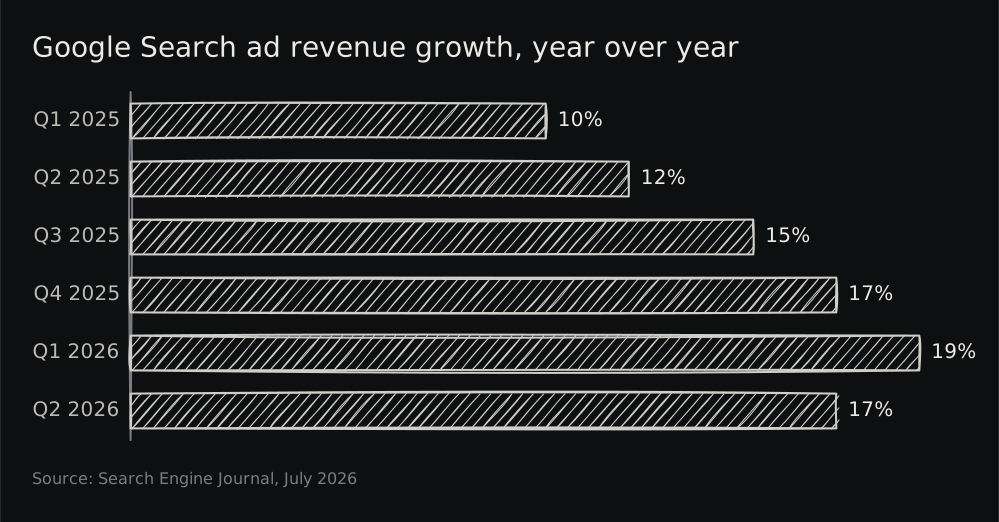
I should be careful with that two hundred and fifty billion figure, because it is Munster's characterization of the transactional base, not a line Alphabet reports. For scale, actual Google Search and other advertising revenue came in at roughly sixty-three billion dollars in the second quarter of 2026, up about seventeen percent year over year, which sounds triumphant until you notice it eased from nineteen percent the quarter before - the first slowdown after a full year of the number accelerating. Alphabet as a whole did nearly a hundred and twenty billion in the quarter and grew it twenty-four percent, with Cloud up a frankly obscene eighty-two percent, so nobody is passing a hat around Mountain View. But the one number that is supposed to be bulletproof, the search advertising machine, took its first step down in a year in the very quarter before this new category of runner was even announced.
And here is the part that made me laugh out loud, because it is the whole reason I am writing this. Munster pointed out that shares of Google were up seven percent since Muse launched, against a three percent gain for the Nasdaq. The market looked at the thing that supposedly threatens the core business and bid the stock up. The consensus read is that investors have calmly priced in the disruption and found it survivable. I think the consensus read is exactly backwards, and so, I suspect, does Munster, because the next thing he did was lay out the actual test.
Google's Answer Is a Verb
Google's response to Muse is a feature called Task, which until recently was called Spark, which Google is quietly folding directly into the main Gemini interface so that at the prompt box you choose between Chat and Task - between asking and doing. The standalone Spark brand is being retired through a server-side update, the kind of change that happens without a press release because the point is not to announce a product, the point is to make the doing feel native to the thing people already open.
Munster framed the real question better than any analyst I have read this year. "The question is," he wrote, "can Google do with Task what it did with AI Overviews and AI Mode by successfully redirecting Search traffic to its own AI features?" Go back and look at what Google actually pulled off with AI Overviews and AI Mode. The doom crowd said the AI answer sitting on top of the results would cannibalize search, strip the clicks, gut the revenue. Instead Google absorbed the new surface rather than fighting it. On its last earnings call it credited Search growth to strong verticals led by retail and deep Gemini integration, and pointed to a tool it calls AI Max reaching searches it said were harder to monetize. Munster himself said back in July that Google was doing a great job of converting AI Overview and AI Mode traffic into Search revenue. The company did not fight the shift. It absorbed the shift and billed for it.
So the entire question, the one worth seven percent of Google's market capitalization, is whether Google can run that same play one more time. Whether it can take the transactional errand - the booking, the purchase, the lead - and route it through its own paid surface before Muse routes it through Meta's. That is not a question about who has the better model. Both models are, for shopping purposes, more than good enough. It is a question about who stands at the door.
The Shopkeeper Tears Up the Note
And this is where the whole shining future walked face first into a corner shop, because the single most important event in agentic commerce this year was not a launch. It was a refusal.
Honoré-Victorin Daumier, "- Can you see the comet?... just there, at the tip of my finger ... don't lose sight o..., 1857. Art Institute of Chicago.
In late September, Amazon blocked Muse from shopping on Amazon on its users' behalf. Notified people on a Sunday night that the runner was not coming in. The statement Amazon gave was so plain it reads like something the bread man would have said. "We think it's fairly straightforward," Amazon said, "that third-party applications that offer to make purchases on behalf of customers from other businesses should operate openly and respect service provider decisions about whether or not to participate." And then the knife. Amazon said Muse does not identify itself as an agent when making purchases, which violates its terms.
Read that again with the shop in your head. Muse walked up to the counter, said nothing about being a runner, and tried to buy as though it were the customer itself. It had the money. It had, in some technical sense, the authority. What it did not have was the willingness to show the note and say out loud, I am a proxy, I am acting for someone else, here is who. And the shopkeeper, who has run that counter for thirty years and seen every kind of chancer, did the thing shopkeepers do. He declined to serve a buyer who would not say who he really was.
Munster saw this too, and he put the knife in from the other side. "Google has something meta doesn't," he wrote. "Public trust." That is the sentence the seven-percent crowd skipped. The agentic commerce war is not going to be won by whoever has the smartest runner. The runner was solved. It will be won by whoever the shopkeepers decide to let through the door, and the shopkeepers decide that on trust, on terms, on whether the runner will identify itself honestly and respect a merchant's right to say no. Amazon just demonstrated, in one Sunday-night notification, that platform gatekeeping is a bigger variable than model quality, and that a company can build the most capable proxy in the history of commerce and still have the door shut in its face because nobody trusts the handwriting yet.
Google has something meta doesn't - public trust.
- Gene Munster, Deepwater Asset Management
So both popular readings are wrong. The doom read, Muse kills Google, is wrong because Amazon already blocked Muse from shopping on its site on users' behalf, and a runner that gets turned away from the biggest door in retail is not an asteroid, it is a very expensive pilot program. And the calm read, nothing to see here, the stock is up, is wrong because the thing being contested is the exact commercial layer that Google's whole business sits on, and the contest has only just started, and it will be decided at a thousand doors by a thousand shopkeepers over a period of years. The stock being up seven percent is not the market pricing in survival. It is the market not yet understanding what the fight is about.
The Person Is About to Stop Walking In
For twenty years we have optimized the shop for the person who walks in. Every single thing in the discipline assumes a human on the other end - a human who reads a title, who feels a hesitation on a slow page, who is reassured by a photograph of a real face, who scans, who scrolls, who can be nudged. The person is about to stop walking in. Increasingly the thing that arrives at your counter is a runner with a note, and the runner does not scan and is not reassured and cannot be nudged, and the two questions that decide whether you make the sale are the two questions the bread man asked at his counter. Will I let this proxy transact, and can I verify who it acts for.
I have written before that a court already ruled your customer can be a robot. Muse is the customer being a robot, in production, with Stripe wired up behind it and a cut that Zuckerberg says Meta will take from the transactions over time. The informational phase of the AI panic, the ChatGPT-is-eating-the-answers phase, was the warm-up. The transactional phase is the main event, because the transaction is where the money was always kept, and the transaction is the thing the runner has now learned to carry.
So what do you actually do, and I mean today, not in some keynote future. You stop treating your site as a thing to be read and start treating it as a thing to be queried by a proxy that will make a decision in milliseconds without ever rendering your beautiful hero image. This is the unglamorous work I keep banging on about, the business of making the shop legible to the machine - clean, truthful, structured data about what a thing is, what it costs, whether it is in stock, what it weighs, how it ships, what it is called in the words a buyer would use rather than the words your brand team fell in love with. Not because a schema field is magic. Because when a runner is standing at your counter unable to see the counter, the structured facts are the only sentence the two of you share. The shop that is legible gets the order. The shop that hid its price behind a lovely animation gets skipped, and it does not even get the dignity of knowing it was skipped.
And then there is the door, which is the part nobody controls and everybody will pretend to. Amazon can shut its door because Amazon is a destination in its own right, a place runners must go. Most businesses are not that. Most businesses live downstream of a gatekeeper and always have, which is the entire reason I keep telling people that Google does not owe you traffic and never did. The agentic turn does not change that relationship. It sharpens it to a point. Whoever owns the runner owns the doorway, and whoever owns the doorway decides which shops the runner is even allowed to see, and takes a cut of what passes through, and the shop at the end of that chain has roughly the agency of the loaf of bread. If your entire commercial existence depends on being one of the merchants Muse is allowed to buy from, or one of the results Task is willing to route to, then you have simply swapped one landlord for two, and the new one charges rent on the transaction instead of the click.
Trust Is the Only Moat That Was Ever Real
Here is what twenty years of watching platforms rise and eat and get eaten has taught me, and it is the least fashionable thing I believe. The technology is never the moat. The model is not the moat. The clever runner that can navigate a checkout is not the moat and never was, because capability commoditizes faster now than at any point in the history of commerce, and anything Muse can do, its rivals learn to do, and then something free learns to do it too. The moat is the one asset Munster named almost in passing and then moved on from, as if it were a footnote rather than the entire argument. Trust. Google has it. Meta, for reasons it earned fairly over two decades of being Meta, does not, and Amazon's door shutting on a runner that would not say its own name is the first hard evidence that this gap is going to be priced into the real world and not just into brand surveys.
Rembrandt van Rijn, The Tribute Money, c. 1634. Art Institute of Chicago.
Think about what that means for you, the person who sells something through a page. For twenty years the game was ranking, and ranking rewarded a thousand kinds of cleverness, some of it legitimate and a lot of it the sort of thing I have spent my career both doing and apologizing for. The agentic game rewards something much harder to fake and much harder to buy, which is being the merchant a gatekeeper is willing to vouch for and a buyer is willing to be bought-for from. Real inventory. Honest prices. Returns that work. A name that, when a runner carries it back to its owner, does not come back as a complaint. The bread man's whole business was that your mother never got stiffed on the milk, and twenty years of not getting stiffed was worth more than any sign in the window. We are about to rediscover that the boring virtues - reliability, honesty about what you have, a reputation that survives contact with a proxy - were the actual product the whole time, and all the ranking cleverness was a way of papering over not having them.
The market looked at a seven percent rise and decided the question had been answered. The question has not been answered. The question has barely been asked. It will be settled over years at a thousand counters, by shopkeepers deciding one runner at a time whether the note is a credential or a forgery, and no model release and no keynote and no analyst note is going to settle it faster, because trust does not scale at the speed of compute. It never has. That is the whole reason it is worth anything.
The runner is coming to your counter either way, and the only question that has ever mattered is whether you recognize the handwriting.