
You open the dashboard on a Monday - because the client's email arrived in that particular register of calm that means the precise opposite of calm - and the organic traffic line has walked off a cliff, and now you get to play detective in a locked room where every single person in the house had both a motive and an alibi. The core update landed three weeks back. The dev team shipped a redesign the same fortnight and told nobody. The content pipeline went dark over the holidays. A newly funded competitor started carpet-bombing the exact queries that pay the rent. Google folded AI Overviews over another wedge of the result page. And somewhere underneath all of it, the client's nephew edited the robots file "to tidy things up," which is a sentence that has ended more careers than cocaine.
So which one did it? You do not know. You will never properly know. You will write a report that sounds like you know, you will bill for it, and the report will blame whichever villain the client was already inclined to hate, because that is the version that gets approved and the invoice paid. I once wrote a whole checklist that promises you can diagnose a traffic drop in thirty minutes, and you can, in the sense that you can narrow it down - but the checklist's real lesson, the one I buried politely in the middle, is that the drop almost never has one clean cause. It has six causes braided together, and they all moved in the same three weeks, and untangling them is not analysis. It is astrology with a spreadsheet open for cover.
This is the oldest problem in anything that calls itself science, and it has a plain name. The confound. When too many variables change at once, you cannot assign blame to any of them, and the honest answer to "what caused this" is "yes." Which is why the rarest and most beautiful thing in any empirical field is the moment when the world, by pure accident of structure, holds most things still except one.
William Hogarth, A Midnight Modern Conversation, March 1732/33. Art Institute of Chicago.
Four Seedlings, One Greenhouse
Gregor Mendel is remembered now as the monk who founded genetics, and the thing he is remembered for doing is refusing to let more than one thing vary at a time. He changed one trait - tall versus short, smooth versus wrinkled - and tried to hold everything else as steady as a man with a garden and a notebook could manage, so that when a result came out the other end it meant something. There is an older and colder version of the same instinct in the story of the doctor who mapped cholera deaths around a water pump on Broad Street and noticed that the thing which seemed to separate the sick houses from the healthy ones was which pump they drank from. Isolate the variable and the world stops lying to you. Fail to isolate it and you can stare at corpses for a year and conclude that the problem is bad air, which is roughly what the respectable opinion of the day did conclude, loudly, with credentials.
Nobody runs this experiment on purpose in business, because running a clean version would require you to build four companies, hand them to one management team, feed them the same capital and the same culture and the same quarterly pressure, change exactly one thing about one of them, and wait - and nobody does that, because it is insane and no board would fund it. What you get instead, on rare lucky occasions, is an accidental, imperfect version, where the structure of a company happens to hold a lot of things roughly still while one thing pulls away. That is not Mendel's garden. But it is about as close as the real world tends to offer, and this month a company in India called Info Edge handed us one, in a business update filed with the regulator, and almost everyone who read it managed to miss the single most useful sentence it contained.
Info Edge runs four internet verticals under one roof. Naukri.com, which is recruitment, the big one, the engine. 99acres.com, which is real estate listings. Jeevansathi.com, which is matrimony, plus a dating app called Aisle bolted on the side. And Shiksha.com, which is education - college listings, course directories, entrance-exam guides, the whole apparatus a seventeen-year-old and a terrified parent consult at 2am. Four businesses. Roughly the same soil, roughly the same sun, the same patient man with the watering can. For the quarter that ended on the thirtieth of September 2026, three of those seedlings grew and one of them is dying on camera, and because so much else about them is shared - the ownership, the management, the home market - the contrast is worth staring at rather than shrugging past. That is the gift. Not a clean proof. A contrast clean enough to be worth the stare.
Read the Ledger Out Loud
Here is what grew. Total standalone billings rose about 12.8 percent year on year, to roughly 822 crore rupees from around 729 the year before. Recruitment, the Naukri engine, climbed about 12.6 percent to the neighborhood of 614 crore, and management went out of its way to say that the headline figure understated the real momentum, that adjusted for the timing of customer renewals the underlying growth was closer to 14 or 15 percent. Real estate was the show-off. 99acres grew about 21 percent, to roughly 148 crore, accelerating from the quarter before, which is not what a dying content business does. Matrimony and dating together grew about 23 percent, with the little dating app reportedly up something like 40. Earnings per share for the quarter ran around 6.88 rupees against 4.57 a year earlier, which is the financial equivalent of a man whistling. The stock, when the update dropped on the eighth of October, wobbled maybe two percent intraday and got on with its life.
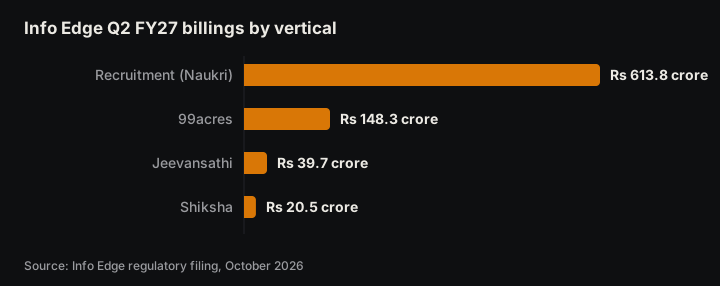
And here is what withered. Shiksha's billings fell about 27 percent year on year, to roughly 20.5 crore from around 28 the year before - a loss of something like seven and a half crore, which is small change against an 822-crore total, barely a rounding error, and that smallness is exactly why everyone shrugged. For the first half of the year Shiksha was down about 24.5 percent, roughly 55 crore against 73. This is not a bad week. This is a trend with a spine. The quarter before this one, Shiksha was already down about 23 percent. The quarter before that marked its first annual billings decline in six quarters. Rewind a little further, to the first quarter of the prior financial year, and Shiksha was still growing - revenue up around 19 percent, billings up near 8 - so this is not a business that was always sick. It got sick. Recently. On a date you could nearly circle. One caveat before anyone prints the decimals on a mug: these figures come from a pre-results business update, not the final audited accounts, which were still working their way through the Audit Committee and the Board as I write, so treat the exact numbers as provisional and the direction as not.
The reflexive read, the one the analysts filed by lunchtime, is reassuring and lazy in equal measure. Shiksha is about five percent of revenue. The other three verticals are humming. The AI hit is contained, the patient is fine, nothing to see. And that read is correct about the balance sheet and completely blind to the contrast. Because the interesting fact is not that the small vertical shrank. The interesting fact is that four businesses sitting under one roof, run by one team, caught one disease between them, and only one of them caught it. That does not prove the cause, and I will get to an honest confound in a minute - the markets differ, the demand cycles differ. But it points hard away from the shared soil. Whatever is hurting Shiksha is unlikely to be the management, or the capital, or the Indian economy, or the macro cycle, because those are largely shared with three siblings that grew double digits. It is far more likely to be one of the things about Shiksha that is not shared. And the company named one of those things itself, in the same filing.
The Sentence Nobody Highlighted
In the filing, in the flat affectless prose that corporate counsel beats all the life out of before a document touches a regulator, Info Edge wrote this. "Shiksha's traffic and billings have been under pressure, as AI-driven search increasingly answers user queries directly and reduces search referrals to the platform." Read it again, slowly, because that is a public company putting into a regulatory filing the thing a lot of us in this trade have long suspected while Google insists the open web is thriving. The referrals thinned. The engine that fed the business quietly throttled down, and the platform did not own the engine, and now the billings line shows the damage in rupees instead of in a traffic graph you can wave away.
Shiksha's traffic and billings have been under pressure, as AI-driven search increasingly answers user queries directly and reduces search referrals to the platform.
- Info Edge Q2 FY27 regulatory filing
Then they wrote the part that is almost worse, the part that is a forecast with its hat in its hand. "The business is adapting its model and introducing new offerings to reduce its dependence on search. We expect this transition to take place over the medium term as these initiatives scale, and billings growth is likely to remain under pressure in the interim." Translate that out of filing-ese and it reads: we were too dependent on a channel we do not control, we are frantically building things that do not depend on it, and until those things work we are going to keep bleeding. That is not a company that got blindsided by a storm. That is a company that discovered it had built its warehouse on a floodplain, and is now explaining to shareholders why it is moving the warehouse one brick at a time while the water rises.
I would be lying, and this site does not do that, if I pretended the 27 percent is purely a Google story. It is not clean, and honesty requires naming the confound. Study-abroad demand has been shifting away from the United States toward the UK, the UAE and Europe, and that demand wobble hits an education platform independently of anything happening in a search result. Nobody has published a clean split between how much of the decline is Google's AI Overviews, how much is students going straight to chatbots, and how much is that demand shift. So do not let anyone tell you Google ate the entire seven and a half crore, because the sheet does not support that and neither do I. But - and this is the point - the confound does not undo the contrast. It widens the error bars. The other three verticals sit in the same country, under the same management, grew double digits, and face no equivalent collapse. The thing about Shiksha most worth pulling on, the handle that most obviously separates it from its siblings, is how its users arrived. It is not the only variable. It is the loudest one.
What the Contrast Actually Points At
Here is where I stop admiring the elegance of it and say the uncomfortable thing. What this contrast points at is not "AI." We keep calling it AI disruption, and the phrase is doing a lot of lazy work, because it makes the threat sound like a weather system, something vast and impersonal and nobody's fault, a thing that happens to you. But AI is not really what hurt Shiksha. Search-dependency hurt Shiksha. AI was merely the thing that finally made the landlord decide to stop forwarding the mail.
Think about what actually differs between the seedling that died and the three that thrived. Naukri serves both sides of a market - the job seeker filling in a profile and the employer paying to search those profiles - and MediaNama's framing is that Info Edge holds proprietary data from both of those sides. A job seeker does not typically reach an employer through a Google snippet. 99acres sits between buyers and brokers and developers who list inventory and pay for visibility. Jeevansathi sits between two people trying to get married, and that introduction is not a thing Google can hand over in a paragraph at the top of the page, because Google cannot marry you off, not yet, give it a release cycle. All three are, in MediaNama's framing, marketplaces holding proprietary data from both sides, where the valuable relationship lives on the platform rather than inside a search result.
Shiksha did not work like that. Shiksha was, at its core, a magnificent content asset - and I mean magnificent, because between July 2025 and June 2026 it recorded over six million annual registrations, 467 million page views, 228 million visits, across listings for more than 68,000 colleges and over half a million courses and more than 1,150 entrance exams. That is not a weak site. That is an authoritative, comprehensive, genuinely useful reference work. And it is exactly the kind of site that AI Overviews exist to eat, because the whole value of a directory of exam cutoffs and course comparisons is that it answers a question, and an answer engine's entire job is to deliver that answer without the trip. When the user's question is "what is the cutoff for this college," and Google now says the cutoff directly, the magnificent reference work becomes the thing the machine read on its way to not sending you there. I have written before that Google does not owe you traffic and that building on its results is building on rented land, and Shiksha is that essay rendered in a quarterly filing. Six million registrations a year, and the model raised the rent, and there was no lease.

Yi Taek-gyun, Books and Scholars' Accoutrements, late 1800s. Cleveland Museum of Art.
The Numbers That Are Not Indian
If you think this is a quirk of one company in one country, I have bad news shaped like an American ed-tech firm. Chegg sells homework help and study tools, and Chegg told the SEC - in a real filing, not a press release, which is where companies tell the truth because lying there is a crime - that Google's AI Overviews and rising student use of generative chatbots caused "a reduction in traffic to our website," and that this materially hurt the business. Google rolled AI Overviews out broadly in August 2024. By February 2025 Chegg had announced a strategic review, the corporate word for standing in the driveway wondering whether to sell the house, and it named the cause plainly: the new realities of AI and reduced traffic from Google to content publishers. Same disease. Different continent. Same pump.
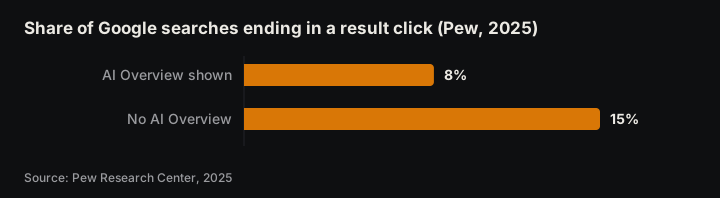
And the independent evidence, the stuff not written by a company explaining its own stock price, lines up with grim consistency. Pew Research watched about 69,000 real Google searches in 2025 and found that when an AI Overview appeared, only 8 percent of searches led to a click on a normal search result, against 15 percent when no summary appeared - roughly half - and that users clicked a source link inside the Overview itself about one percent of the time. One percent. A separate randomized field experiment run by researchers at the Indian School of Business and Carnegie Mellon, tracking just over a thousand desktop users, found outbound clicks fell about 40 percent and zero-click searches rose about 34 when an Overview was present. Google, for its part, called the Pew study methodologically flawed and unrepresentative, which is the thing you say when the number is inconvenient and you own the only dataset that could prove it wrong and you decline to share that dataset. A rebuttal you cannot check is not a rebuttal. It is a press posture with a lab coat on.
No Cavalry Is Coming, Said the Judge
You might reasonably hope, if you run a Shiksha-shaped business, that the law will ride in. That some court will look at a search engine that scrapes your content, summarizes it at the top of the page, and keeps the click, and will call that what it feels like. Chegg thought so. In February 2025 Chegg sued Google over AI Overviews, arguing an antitrust theory of product tying - the claim that a publisher cannot avoid feeding the Overview without also vanishing from Search, that the two are bolted together and you are forced to supply the thing that replaces you. Penske Media, which publishes Rolling Stone and Variety and Billboard and The Hollywood Reporter, filed a similar suit in September 2025. Two real plaintiffs with real lawyers and a real grievance, and for a moment it looked like the question would get answered in a courtroom instead of a comment section.
It got answered. In early October 2026, a federal judge - Amit Mehta - dismissed both suits, having heard them together that August, finding that the publishers had not plausibly made out reciprocal dealing or established antitrust standing. Whether they appeal is open. But the read-across for anyone watching is cold and immediate. The courtroom door, for now, is shut. There is no legal rescue coming for the business model that depends on Google sending you the visitor and Google deciding to keep the visitor instead. The court did not bless the structure - it dismissed the suits on narrower grounds, finding the publishers had not plausibly made out reciprocal dealing or antitrust standing - but the practical effect is the same. Which means the only move left is the one Info Edge already wrote into its filing, the one that reads like a company talking itself into a long difficult renovation: reduce dependence on search, build offerings that do not route through it, expect pain in the interim.
Honoré-Victorin Daumier, The Three Judges, 1858/60. Art Institute of Chicago.
And here is the thing I keep coming back to, the thing the share price understood even if the headlines did not. The reason Info Edge as a whole is fine - EPS up, billings up, stock barely flinching - is not that it dodged the disease. It is that it built most of its business on ground it owns, and only exposed one small vertical to the floodplain. The managing director's own positioning says as much: proprietary data from both sides of the marketplace, millions of user interactions every day, over two decades of domain knowledge, and the claim that these strengths become more valuable in an AI-driven world, not less. He may be right. Not because it is a flattering thing to say, but because the contrast under his own roof points that way. The verticals built on data he owns grew double digits while the one most exposed to search fell about 27 percent across the same stretch. That is not proof in the Mendel sense, and I have been careful not to pretend it is. But it is the kind of evidence a careful person updates on, and he happens to own the garden.
Google Zero Grew Up and Learned Accounting
The SEO trade talks about "Google Zero," the hypothetical day Google stops sending clicks outward, as a thing that lives in traffic dashboards - a line on an analytics chart, a scary slide at a conference, a tweet with a graph that goes down and to the right. It was abstract because it only ever cost you sessions, and sessions are a currency that marketers can explain away, reframe, blame on seasonality, or quietly stop reporting. A session is a soft number. You can argue with a session.
What changed, and what makes the Info Edge update worth reading twice rather than filing under "another sad traffic story," is that Google Zero has climbed out of the dashboard and into the financial reporting that investors actually price. It is no longer a session you can spin. It is a billings line, down about 27 percent, in a business update the company filed with the regulator - the kind of document institutional investors read and act on, even while the final numbers are still working through the Audit Committee and the Board. When the damage lived in Search Console you could call it a channel-mix issue and keep your retainer. When it shows up in a billings update next to the EPS figure, it stops being a channel story and becomes a company story, and company stories move money.
And this is the part I would tattoo on the inside of every founder's eyelids if the procedure were legal. The lesson is not "AI is scary" or "the sky is falling," because the sky is doing fine for three of the four verticals and the fourth is not falling so much as being quietly repossessed. The lesson is that distribution you do not own is a liability that does not show up until the day it shows up all at once, and by then it is in the ledger and the ledger does not negotiate. I have argued, probably too often, that the best SEO strategy is not needing Google, and people hear that as either defeatist or impossible, as if I am telling them to quit the channel that feeds them. I am not. I am telling them to make sure the channel is a channel and not the foundation. Use Google to acquire. Own the relationship after. Hold data from both sides. Build the thing the answer engine cannot answer for you, which is almost always the transaction, the account, the two-sided market where the value lives in the connection and not in the paragraph a model can lift.
One last scene, free of charge, because it is too perfect not to tell. Try it yourself today. Search for this story the way a human would - paste the headline into Google - and Google, with no sense of irony whatsoever, serves up results that are entirely about Q2, the television station in Billings, Montana, because it has decided that "Q2" plus "Billings" means a local broadcaster and not an Indian internet company's financials. The single most on-the-nose demonstration of the whole piece, delivered unprompted by the defendant. A search engine, asked about a company dying of search, cannot find the company. It finds a TV station in Montana and feels good about it.
Shiksha was not killed by a robot. Nothing so dramatic happened. Three of them own the ground they stand on, one of them rented, the landlord learned to answer his own door, and the eviction notice now arrives notarized in a currency the auditors can read.