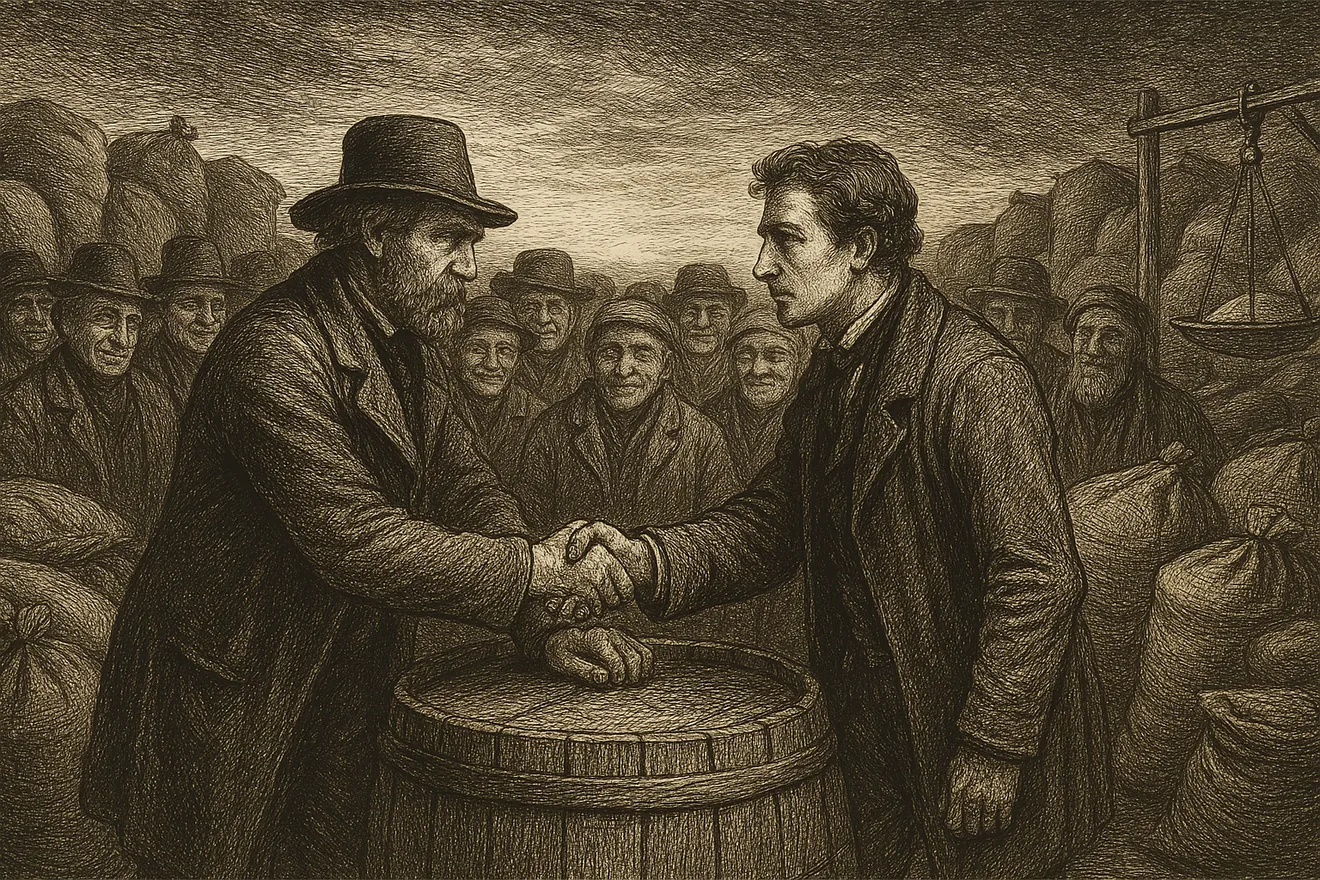
Put your right hand out, palm vertical, thumb riding on top, fingers loose, and hold it there for a second longer than feels natural. In a moment a stranger takes it, you squeeze once, maybe twice, you let go, and in that half second of warm dry contact you have executed what is probably the oldest unsigned document in the world. No paper. No witness who counts. No clause covering what happens when one of you decides, later, over coffee, with a lawyer in the room, that the thing you both believed you had agreed to was never actually agreed to at all.
We have been closing deals this way for a very long time. Grain was sold on it, horses were sold on it, and entire companies with real buildings and real payroll have changed hands on nothing firmer than two men gripping palms in a parking lot and nodding like they meant it. The whole ritual is engineered to feel binding. You look the other person in the eye - that is part of it, the steady gaze, the firm grip your father told you about as if a weak one were a moral failing - and the gesture does one very specific job. It converts an expectation into something that feels like an obligation.
Feels like. Hold onto that verb, because it is going to do a great deal of work before this is over.
What the Gesture Is Actually Worth
Here is the uncomfortable thing about a handshake, the thing nobody says while they are doing it, because saying it would ruin the whole effect. A handshake can be evidence that a deal happened, but it is not the deal, and if the terms are loose enough the whole thing may turn out not to bind at all. If it goes sour and you drag it in front of a judge, the handshake by itself settles very little, and the court goes hunting for the things that actually make an agreement an agreement - was there consideration, were the terms definite, was there a genuine meeting of the minds - and a firm grip and a steady gaze do not do that work on their own. They never did. The strength of a handshake is largely social. It works because everyone involved agrees to pretend that it works, and the pretending holds up beautifully right up until the money gets large enough that one party would rather have the lawyer than the friend.
And I want to be fair to the handshake here, because I am not above one myself. Most of the time the pretending is enough. Most of the time two people who shook on something behave as though they shook on something, and the whole quiet machinery of ordinary commerce runs on exactly this - the understanding, the nod, the thing we do not write down because writing it down would imply we did not trust each other, and implying that would be its own small insult. A lot of the world is held together with gestures that would not survive a courtroom and never have to, because nobody takes them to one.
But a gesture that has never been tested is not the same as a gesture that has been tested and held. It is just a gesture that nobody has yet had a reason to call. The strength you are feeling in that grip is the strength of nobody having pushed on it. And the day someone pushes - the day the stakes cross whatever private threshold turns a friend into a counterparty - you discover, often all at once, that what you thought was a contract was a feeling you had about a contract, and that the two are not even slightly the same thing in the one room where it matters.
Which brings me to the largest handshake deal in the history of commerce, a deal that roughly everyone reading this is a party to, a deal nobody in it ever signed.
The Biggest Handshake Ever Made
Go open your robots.txt. Right now, if you have a site - type your domain and /robots.txt into the bar and look at it. Unless you have gone out of your way to forbid it, or there is nothing there at all forbidding it, you are letting Googlebot in. You wrote that. Or your developer did, or a plugin did, or it got there by default and you never touched it, which is its own kind of writing it. You opened the door to the crawler, and you did it for nothing, and in exchange you expected - everyone expected - that Google would read what you made and send people to it. That was the deal. Crawl us, index us, rank us, and in return route us a slice of the attention you are standing on top of.
Nobody signed that. There is no document. For twenty years the entire industry I work in treated that arrangement as if it were a contract with terms and remedies and a signature page, and acted on that assumption every single day, and so did every publisher who ever built a business plan on organic traffic. We optimized for a counterparty we had never actually contracted with. We tuned headlines and schema and internal links to satisfy the half of the handshake we could control, and we told ourselves the other half was reliable because it had always, so far, been there. It had always been there. That is not the same as being promised.
Press Gazette, writing about the ruling I am getting to, used a phrase that I cannot improve on and will not try to. Publishers, the judge found, had "voluntarily acceded" to a zero price for Google crawling their work. We let the bot in for free, gladly, for two decades, and we called the traffic that came back our due, and it was never our due. It was a gesture that nobody had yet had a reason to call.
Penske Media decided to call it.
An Expectation Is Not an Agreement
Penske Media Corporation is not a blog with a grievance. It is Rolling Stone, Variety, Billboard, The Hollywood Reporter, Deadline, and ten or so more mastheads, a real publisher with real reporters and a real bottom line, and on the twelfth of September 2025 it sued Google LLC and Alphabet in federal court in Washington, bringing fourteen of its publications along with it. The complaint ran a hundred and one pages. Its theory was that Google's AI Overviews - the generated answer box that sits on top of the results and gives you the gist so you never click through - were eating the traffic that the handshake was supposed to deliver, and that in a competitive market Google would have to pay for the content it was summarizing and training on, and that only its near-total search dominance let it avoid paying at all. Penske was the first major American publisher to take AI Overviews to court. Chegg, the education company, had filed its own version back in February of that year, telling the court plainly that it "depends on referrals from Google's monopoly search engine for a large portion of the revenue that it devotes to producing original online content."
In a signed opinion dated the thirtieth of September 2026, reported in the days that followed, Judge Amit Mehta dismissed both of them. And the sentence he used to do it is one that every single person in this industry should write on an index card and tape above the monitor, because it is the truest thing a court has said about our work in a long time, and it was not meant as comfort.
"Plaintiffs have pleaded only that they have an 'expectation' that Google will send them search traffic if they make their content available for free," Mehta wrote. "But an expectation is not an agreement. It is simply how a general search engine works."
There it is. The handshake, examined under the one light that strips the warmth out of it. The claims, Mehta said, "fail to get out of the starting gate." Penske had not pleaded any actual agreement under which Google promised to sell it any specific amount of traffic, because there was no such agreement, because there had never been one, because the thing we all treated as a binding mutual obligation was, in the dry language of the Sherman Act, no formal bargain at all. Just conduct. Just how the thing works. Just a gesture that everyone had agreed to pretend was a contract, held up to the only gaze that does not care how firm your grip was.
Read the Opinion, Not the Headline
The coverage mostly ran some version of the same headline - Google wins, publishers lose - and the headline is not wrong so much as it is lazy, the way "home team wins" is technically accurate and tells you nothing about the game. Because the remarkable part of Mehta's ruling is how little of it is actually a defense of Google, and how much of it is a confession dressed up as a dismissal.
Mehta did not say AI Overviews are fair. He did not say they are harmless. He did not say Google is behaving well. He went out of his way to say that the court was "not unsympathetic" to the publishers, journalists, educators and other creators whose content is being used and repurposed without compensation - he named the harm, in other words, and conceded it is real - and then he said that existing antitrust law cannot substitute for legislative action to address economic harm caused by technological innovation. In plain English: yes, this is hurting you, yes, it may even be unjust, and no, that is not a thing this court can fix, because you are asking me to enforce a contract that does not exist, and if you want one you will have to go and get Congress to write you a law. He dismissed it without prejudice, which means Penske can refile, which means even the judge is telling them the door is not fully shut, just that they came to it with the wrong key.
This is the same Amit Mehta, remember, who decided the remedies in the government's monopoly case against Google, the judge who has already looked harder at Google's grip on search than almost anyone alive. He is not a man who thinks Google is a charming underdog. And separately, a different antitrust suit over Google's ad-tech business - brought by publishers including the Daily Mail and Gannett - was allowed to proceed. So this was not a judge waving Google through on principle. This was a judge drawing a very specific and very consequential line: the ad-tech plumbing may be a live legal question, but the thing where you let us crawl you and hoped we would be generous, that was never a deal, and I cannot award you damages on a handshake.
Google, for its part, had been pushing hard for exactly this outcome. In its filings it noted, with the particular weariness of a defendant on its fourth round, that Penske and its counsel "are now on their fourth complaint challenging the same alleged conduct based on substantially the same legal theories," and that the amended complaint "remains legally defective in every way." They pointed out that the Penske and Chegg plaintiffs were represented by the same lawyers, the way you point out that two speeding tickets came from the same car. And back when the suit was filed, Google's public line was this: "AI Overviews make Search more helpful and send traffic to more sites." Note the shape of that sentence. It is not a promise. It is a description, offered in the present tense, of a thing Google is choosing to do and could stop choosing to do tomorrow. Which is exactly what Mehta said the whole arrangement always was.
AI Overviews make Search more helpful and send traffic to more sites.
- Google, at the time the suit was filed
We Have Been Saying This the Whole Time, Quietly
Here is where I have to be honest about my own trade, because the temptation is to act shocked, and I am not shocked, and neither are you if you have been doing this longer than a couple of algorithm cycles. The entire competent half of this industry has been saying "you built on rented land" for years. I have written that exact argument myself. The dependency was always the whole risk. Anyone who has done this long enough has had the conversation where you sit across from a client whose business runs almost entirely on organic search and you try, carefully, not to say the words "single point of failure" out loud because it sounds like you are fired already.
But there is a difference between a warning and a holding. When I say "Google doesn't owe you traffic," I am offering you my professional opinion, and you are free to take it as the grumbling of a man who has seen too many sites go dark after an update. When a federal judge says an expectation is not an agreement, in a signed opinion, in a docket, it stops being opinion and starts being the shape that the law takes when it is forced to look directly at what we do. The thing we muttered as a caution has now been written down by someone with the power to write things down that bind. The rented land has a deed now, and your name is not on it, and a court has read the deed aloud.
And the terrible, clarifying thing about that is how it reframes twenty years of standard advice. Every best practice, every audit, every careful program of making your site more legible and more crawlable and more deserving of the click - all of it was, in legal terms, us voluntarily acceding to a zero price, more enthusiastically every year, and calling the enthusiasm strategy. We were not negotiating with Google. You cannot negotiate with a counterparty that has not agreed to be one. We were performing for a judge who had not yet been asked to rule, and now he has, and the ruling is that there was no contract to breach.
What Google Pays for the Thing It Took
Now, if you want to know how much the handshake was ever really worth to the other hand, you do not actually need the court case. You can just look at what Google pays when it bothers to pay at all, because it has started, in a small and telling way, to pay.
Google runs a pilot program - reported this autumn by The Information, and summarized by The Decoder in a headline I have been thinking about since I read it - in which it pays roughly a hundred digital publishers for content used in AI Overviews, AI Mode and Gemini. Here is the range of what those publishers receive. At the bottom, under a thousand dollars across several months. At the top, more than a million dollars a year. And for several of the small and midsize sites in the program, the payment comes to less than one tenth of one percent of their advertising revenue. One publisher got somewhere between fifty and sixty thousand dollars over a few months, which sounds like money until you set it against the cost of producing the content that earned it. And some of the participants - this is the part that would be funny if it were not so bleak - say they do not actually know how Google calculates the number. They just receive it. A figure arrives, with no formula attached, from the party that controls both the summary and the check.
Set that against the scale of what Penske said the fight was about. Penske's own complaint valued the AI content licensing market at thirty billion dollars by 2034 - and I will flag, because it matters, that this is Penske's allegation and not the court's finding, a number from a pleading rather than a ledger. Penske also alleged, citing an Ahrefs analysis, that AI Overviews cut click-through rates by better than a third, and that its own organic affiliate revenue had fallen more than a third from its peak by the end of 2024. Allegations, all of them, not adjudicated facts. But even as allegations they describe the gap: on one side, a publisher pointing to a thirty-billion-dollar market, and on the other, a program that pays some of its participants under a thousand dollars over several months and, in some cases, cannot or does not tell them how the figure was reached.
That is what the handshake has been worth, so far, to the roughly one hundred publishers Google chose to pay. Not thirty billion. Not a license. A payment at Google's discretion, in an amount some recipients say they cannot account for, to about a hundred sites, while the rest of the web opened the door for free. The rest of us get the thing we always got, which is the hope of a click, now mediated through a box that is designed to make the click unnecessary.
And lest the human cost of this get lost in the abstraction of market sizes, look at Chegg, the other plaintiff, the one that filed first. When Chegg sued, it was worth less than two hundred million dollars, its stock was trading just above a dollar, and it had just reported a six million dollar net loss on quarterly revenue that had fallen twenty-four percent year over year. It had hired Goldman Sachs to consider selling itself or going private. Chegg had warned, going back to its former chief executive, that students using OpenAI's ChatGPT were cutting into its new-customer growth, and it told the court that AI summaries had hurt its traffic and its revenue. Chegg did not sue because it was greedy. Chegg sued because it was drowning, and it reached for the only rope it could see, and the rope turned out to be attached to nothing. An expectation is not an agreement. It is not a flotation device either.
depends on referrals from Google's monopoly search engine for a large portion of the revenue that it devotes to producing original online content.
- Chegg, in its complaint
Where the Fight Actually Goes Now
So the courtroom door is, for the moment, closed - without prejudice, Congress's problem, come back when you have a statute. And that means the entire fight over who gets paid for the web's content moves out of the one venue that has subpoena power and into the one venue that has none, which is the answer box itself. The place where you will actually lose or keep your traffic is no longer a courtroom and is now a generated paragraph that appears above the results and tells the reader what you wrote so that they never have to meet you.
I have argued before, and I still believe, that being cited by an AI answer is in some ways worse than not appearing in it at all, because the citation is proof that your work was good enough to summarize and the summary is proof that someone decided you did not need the visit. And there is a deeper strangeness underneath all of this, which is that the reader we are now optimizing for is increasingly not a person deciding whether to click but a model deciding what to say, a shift so strange that I have spent a whole essay chewing on whether the entity consuming your content even counts as a customer anymore. We spent two decades learning to write for an audience of human beings routed to us by a handshake, and the handshake has been voided, and more and more of the audience is a machine that reads everything and sends back almost nothing, and the one legal remedy we reached for has been sent back to refile, with the court pointing at Congress.
I do not get to narrate this from the cheap seats, and I would rather say so than let you catch me at it. The whole industry spent years urging everyone to make their content more extractable, more structured, more answerable - to feed the machine cleanly, to be the source the summary draws from, as if being the quarry were better than being the building - and I was not standing outside that consensus. It is the same reflex that had all of us pouring the open web's attention into Google in the first place and congratulating ourselves on the pour. We were extraordinarily good at making ourselves summarizable. We were building, with great care and no contract, the exact corpus that would eventually be used to make us unnecessary, and the invoices for doing it got paid, which is how you know the work was useful to the one party whose hand was never really in ours.
Mehta did the industry a favor, if you can stand to take it as one. He said the quiet thing in a voice with authority behind it. The deal you thought you had was a feeling you had about a deal. The traffic you thought you were owed was traffic you were being given, which is a different word with a different future. There is no breach, because there was no promise, because a search engine sending you visitors was never a covenant - it was a behavior, maintained at the other party's pleasure, for exactly as long as it served the other party to maintain it. And the moment a better behavior came along, one that keeps the reader on Google's page instead of sending them to yours, the old behavior quietly ended, and no court will call it a wrong, because you cannot breach a handshake that was never a contract.
We shook on it, all of us, for twenty years, and it turns out the other hand was never really there.